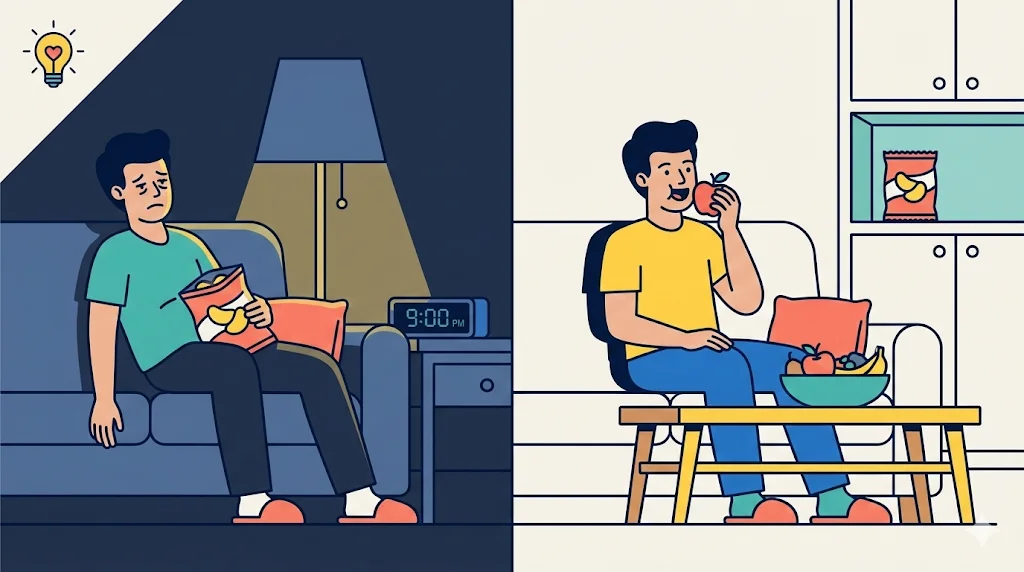
Why Willpower Is Not Enough
In a high-choice world, design beats effort.
At 6:40 a.m., a mid-level manager sits on the edge of the bed and checks a phone “just for one minute.” Overnight messages are waiting. A calendar is packed. A child’s school note needs a reply. A work chat is blinking. Before breakfast, they have already made twenty small decisions.
By late afternoon, the manager feels strangely empty—like the inside of the day has been spent. They still have “important” goals: exercise, patient parenting, learning, saving money, better sleep. But in the evening, they choose the fastest comfort: delivery food, endless scrolling, and “tomorrow.”
Willpower is real—but limited
Many psychologists describe self-control as a limited resource: it can be used up by stress, resisting temptation, switching tasks, and making repeated choices.
Even if you dislike the “battery” metaphor, the daily experience is familiar: after a long day, the hardest part is not knowing what to do—it is doing it.
Modern life adds fuel to the fire. Apps offer infinite options. Stores are open late. Work can follow you home. Every tap creates another choice: reply, ignore, compare, buy, save, watch, stop.
Decision architecture: make the good path the easy path
This is where decision architecture matters: the way choices are arranged in your day.
A manager tries three changes:
- Fewer decisions in the morning: one simple breakfast, one work outfit style, one first task.
- Strong cues: a fixed “shutdown” time for work, and a fixed “start” time for exercise.
- Environment design: phone charges outside the bedroom; snacks are harder to reach; “fun apps” are off the home screen.
Behavioral economics calls some of these ideas “choice architecture” and “nudges”—small design changes that guide behavior without force. The key is respect: you are not tricking yourself; you are protecting your limited attention.
Energy management is not selfish—it is strategy
Sleep, food, movement, and breaks decide how much self-control you have. The World Health Organization has discussed burnout as a real work-related problem, reminding us that stress and exhaustion change how we function. When you are hungry, tired, or overloaded, your brain will ask for quick rewards.
So a wiser plan is not “be stronger.” It is:
- build recovery into the week,
- reduce daily decision load,
- and remove easy triggers during your weakest hours.
The ethical side: some systems help, some systems exploit
Not all environments are neutral. Many digital products are designed to capture attention. Some workplaces reward constant availability. Some stores make impulse buying easy at the checkout. When we blame individuals for “low discipline,” we ignore how strongly systems shape behavior.
The most humane question is not, “Why am I failing?”
It is: “How can I shape my day so my best self is the easiest self to be?”
Key Points
- Self-control drops when decisions, stress, and temptations pile up.
- Decision architecture (cues, fewer choices, better spaces) reduces willpower load.
- Energy care and ethical environments protect discipline in modern life.
Words to Know
architecture /ˈɑːrkɪtektʃər/ (n) — the design of a system
overload /ˌoʊvərˈloʊd/ (n) — too much to handle
notification /ˌnoʊtɪfɪˈkeɪʃən/ (n) — an alert on a device
exploit /ɪkˈsplɔɪt/ (v) — to use for profit, often unfairly
attention /əˈtenʃən/ (n) — the mind’s focus
nudge /nʌdʒ/ (n) — a small push toward a choice
temptation /tempˈteɪʃən/ (n) — a pull toward quick pleasure
recover /rɪˈkʌvər/ (v) — to regain energy
rhythm /ˈrɪðəm/ (n) — a repeated pattern over time
friction /ˈfrɪkʃən/ (n) — small difficulty that slows action
default /dɪˈfɔːlt/ (n) — the normal option if you do nothing
trigger /ˈtrɪɡər/ (n) — a signal that starts a habit
boundary /ˈbaʊndri/ (n) — a clear limit you keep
compassion /kəmˈpæʃən/ (n) — kindness toward suffering