Wisdom English Learn about the world. Grow your English.
Mind & Habits

Why Willpower Is Not Enough

A1 A2 B1 B2

Willpower feels strong in the morning but weak at night. This topic shows why—and how simple cues, better environments, and energy care can protect your habits.

A1 Level

Small changes can help you do the right thing.

Why Willpower Is Not Enough

Small changes can help you do the right thing.

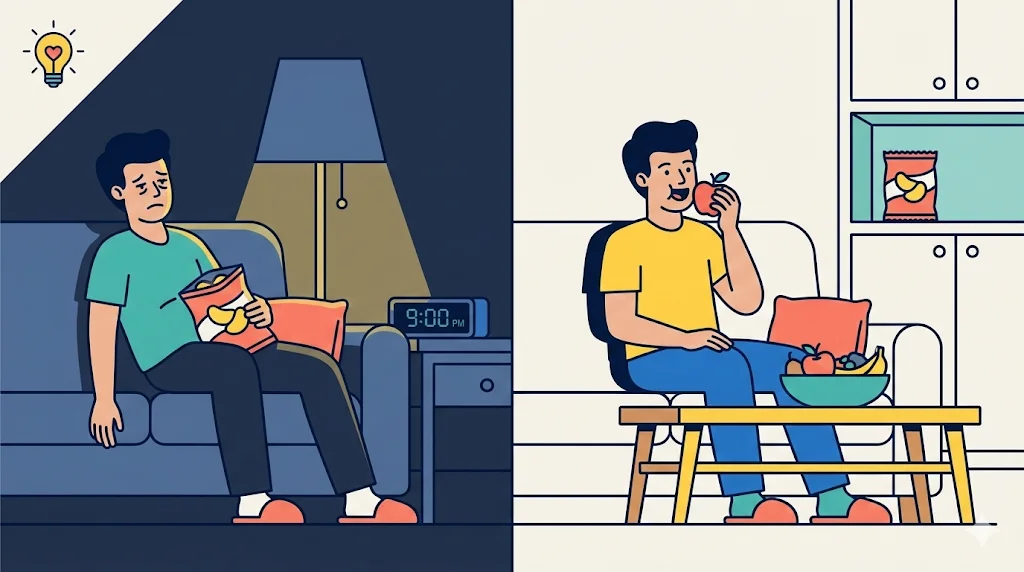
It is 9 p.m. The TV is on. The room is quiet.
A bag of chips is in the cupboard.

An adult sits on the sofa. They feel tired.
In the morning, they said, “No chips tonight.”
Now their day feels heavy. Work was long. Messages were many.
They stand up without thinking. They open the cupboard.

They feel a little sad. “Why do I do this again?” they think.
But the problem is not only “being strong.”
When we are tired, it is hard to say “no” again and again.
Willpower can get smaller, like a phone battery.

The next day, the adult tries one small change.
They put the chips on the highest shelf.
They put a bowl of fruit on the table.
A bright red apple sits where the chips used to be.

At 9 p.m., they still want chips. But the apple is easy to see.
They eat one apple and keep watching the show.
They smile a little. “This small change helped me,” they think.

You do not need to fight all the time.
You can help yourself with your room and your routine.


Key Points

  • Willpower gets weaker when you feel tired.
  • Small changes around you can make good choices easier.

Words to Know

willpower /ˈwɪlˌpaʊər/ (n) — strength to control yourself
tired /taɪərd/ (adj) — needing rest
choice /tʃɔɪs/ (n) — a decision between options
habit /ˈhæbɪt/ (n) — something you do often
easy /ˈiːzi/ (adj) — not hard
environment /ɪnˈvaɪrənmənt/ (n) — the place around you
routine /ruːˈtiːn/ (n) — a usual daily pattern


📝 Practice Questions

A1 – True/False

  1. Willpower can feel weaker when you are tired.
  2. The adult keeps the chips on the table to help.
  3. A small change in the room can help a habit.

A1 – Multiple Choice

  1. What time is the snack scene?
    A. 9 p.m.
    B. 9 a.m.
    C. 3 p.m.

  2. What did the adult put on the table?
    A. A bowl of fruit
    B. A new TV
    C. A big cake

  3. What happens to willpower after a long day?
    A. It often gets weaker
    B. It always gets stronger
    C. It never changes

A1 – Short Answer

  1. What snack was in the cupboard?
  2. What fruit did the adult eat?
  3. Willpower is like a phone _____.

A1 – True/False

  1. True
  2. False
  3. True

A1 – Multiple Choice

  1. A
  2. A
  3. A

A1 – Short Answer

  1. chips
  2. an apple / apple
  3. battery
A2 Level

Your brain gets tired of choosing.

Why Willpower Is Not Enough

Your brain gets tired of choosing.

Morning is busy in a small apartment.
A parent looks at the clock. A teenager is putting on shoes.
The parent wants to exercise today. But many small choices come first:
“What should I wear?” “What should we eat?” “Which message is urgent?”

After ten minutes, the parent feels rushed.
They think, “I will walk later.” Then later becomes never.

At breakfast, the teenager says, “You decide too many things early.”
They point to the hallway. “Put your shoes and clothes there tonight.”
“Then you can walk right after you wake up.”

Your willpower is not endless

Experts say our brain gets tired after many decisions.
This tired feeling is called decision fatigue.
When decision fatigue grows, self-control becomes harder.
You may choose fast food, skip study, or scroll your phone longer.

Cues and small changes help

A habit cue is a signal that starts an action.
It can be a time (7 a.m.), a place (the door), or a feeling (stress).
If the cue is clear, you do not need to “push” so hard.

The next night, the parent prepares: clothes by the bed, shoes by the door.
In the morning, they see the shoes first. They walk for ten minutes.
It is not perfect, but it is real.

Maybe you can ask yourself:
“What choice can I prepare now, so tomorrow is easier?”


Key Points

  • Many decisions can cause decision fatigue.
  • When you are tired, self-control becomes harder.
  • Cues and small environment changes make good habits easier.

Words to Know

decision /dɪˈsɪʒən/ (n) — a choice you make
fatigue /fəˈtiːɡ/ (n) — strong tiredness
self-control /ˌself kənˈtroʊl/ (n) — control of your actions
cue /kjuː/ (n) — a signal that starts something
plan /plæn/ (n) — a decided way to do something
prepare /prɪˈper/ (v) — to make ready
temptation /tempˈteɪʃən/ (n) — a strong desire to do something not helpful
routine /ruːˈtiːn/ (n) — a regular daily habit
environment /ɪnˈvaɪrənmənt/ (n) — the space around you


📝 Practice Questions

A2 – True/False

  1. The parent makes many small choices in the morning.
  2. Decision fatigue can make self-control harder.
  3. The teen says, “Make more choices every morning.”

A2 – Multiple Choice

  1. What does the parent often think?
    A. “I will walk later.”
    B. “I will never sleep.”
    C. “I will buy a car.”

  2. What is a habit cue?
    A. A signal that starts an action
    B. A kind of medicine
    C. A long vacation

  3. What change helps the parent?
    A. Shoes and clothes ready at night
    B. More messages in the morning
    C. Watching TV earlier

A2 – Short Answer

  1. What is decision fatigue (in simple words)?
  2. Name one habit cue from the story.
  3. What question does the parent think at the end?

A2 – True/False

  1. True
  2. True
  3. False

A2 – Multiple Choice

  1. A
  2. A
  3. A

A2 – Short Answer

  1. mental tiredness after many choices
  2. time / place / feeling (example: morning, door, stress)
  3. “What other small choices can I prepare at night?”
B1 Level

Discipline needs a system, not a hero.

Why Willpower Is Not Enough

Discipline needs a system, not a hero.

At 9:10 a.m., a young office worker opens a laptop.
They feel confident. “No social media during work hours,” they promise.
The morning goes well—until the day fills up.

By 2:30 p.m., they have answered emails, joined meetings, solved small problems, and made many tiny choices. Their head feels hot and crowded. Without thinking, their hand reaches for the phone. One scroll becomes ten minutes.

The afternoon trap: decision fatigue

This pattern is common. When you make many decisions, your mind gets tired. Your self-control drops. Psychologists call this decision fatigue. When it happens, your brain prefers the easiest path—the old habit.

Instead of saying, “I am weak,” it helps to say, “My system had a weak spot.”

Build cues that run on autopilot

The worker creates two clear rules:

  • Check messages only at 11:30 and 16:30.
  • Never check in between.

Now the time itself becomes a cue. They do not need to “fight” every moment.

Change the environment so it supports you

Next, they change the space:

  • Phone goes in a drawer during focus time.
  • A website blocker is turned on for certain hours.

A colleague in another country does something similar: “When work starts, my phone stays in my bag until lunch.” They say they feel calmer and more focused.

Try noticing one thing: When is your willpower lowest—morning, afternoon, or late night? Then add one simple rule and one small environment change to protect that time.


Key Points

  • Decision fatigue makes good choices harder later in the day.
  • Habit cues (time/place rules) reduce the need for constant willpower.
  • Environment design can remove triggers and protect focus.

Words to Know

discipline /ˈdɪsəplɪn/ (n) — ability to keep doing what matters
trigger /ˈtrɪɡər/ (n) — something that starts a habit
block /blɑːk/ (v) — to stop something from happening
focus /ˈfoʊkəs/ (n) — strong attention
rule /ruːl/ (n) — a clear plan you follow
friction /ˈfrɪkʃən/ (n) — small difficulty that slows an action
automatic /ˌɔːtəˈmætɪk/ (adj) — happening without thinking much
drain /dreɪn/ (v) — to use up little by little
cue /kjuː/ (n) — a signal that starts an action
system /ˈsɪstəm/ (n) — connected parts working together
recover /rɪˈkʌvər/ (v) — to get strength back


📝 Practice Questions

B1 – True/False

  1. The office worker scrolls more in the afternoon after many tasks.
  2. Time-based rules can work as habit cues.
  3. Environment design means hoping harder with willpower.

B1 – Multiple Choice

  1. When does the worker set message-check times?
    A. 11:30 and 16:30
    B. 09:30 and 12:30
    C. 14:30 and 18:30

  2. What is one environment change in the story?
    A. Put the phone in a drawer
    B. Buy a second phone
    C. Turn off the computer forever

  3. What is the main lesson?
    A. Build a system for low-willpower times
    B. Never use a phone again
    C. Only work at night

B1 – Short Answer

  1. Why does the worker scroll more in the afternoon?
  2. Name one cue the worker uses.
  3. What should you notice about your day first?

B1 – True/False

  1. True
  2. True
  3. False

B1 – Multiple Choice

  1. A
  2. A
  3. A

B1 – Short Answer

  1. decision fatigue after many tasks and choices
  2. check messages at 11:30 and 16:30 / fixed times
  3. when your willpower is weakest
B2 Level

In a high-choice world, design beats effort.

Why Willpower Is Not Enough

In a high-choice world, design beats effort.

At 6:40 a.m., a mid-level manager sits on the edge of the bed and checks a phone “just for one minute.” Overnight messages are waiting. A calendar is packed. A child’s school note needs a reply. A work chat is blinking. Before breakfast, they have already made twenty small decisions.

By late afternoon, the manager feels strangely empty—like the inside of the day has been spent. They still have “important” goals: exercise, patient parenting, learning, saving money, better sleep. But in the evening, they choose the fastest comfort: delivery food, endless scrolling, and “tomorrow.”

Willpower is real—but limited

Many psychologists describe self-control as a limited resource: it can be used up by stress, resisting temptation, switching tasks, and making repeated choices.
Even if you dislike the “battery” metaphor, the daily experience is familiar: after a long day, the hardest part is not knowing what to do—it is doing it.

Modern life adds fuel to the fire. Apps offer infinite options. Stores are open late. Work can follow you home. Every tap creates another choice: reply, ignore, compare, buy, save, watch, stop.

Decision architecture: make the good path the easy path

This is where decision architecture matters: the way choices are arranged in your day.

A manager tries three changes:

  1. Fewer decisions in the morning: one simple breakfast, one work outfit style, one first task.
  2. Strong cues: a fixed “shutdown” time for work, and a fixed “start” time for exercise.
  3. Environment design: phone charges outside the bedroom; snacks are harder to reach; “fun apps” are off the home screen.

Behavioral economics calls some of these ideas “choice architecture” and “nudges”—small design changes that guide behavior without force. The key is respect: you are not tricking yourself; you are protecting your limited attention.

Energy management is not selfish—it is strategy

Sleep, food, movement, and breaks decide how much self-control you have. The World Health Organization has discussed burnout as a real work-related problem, reminding us that stress and exhaustion change how we function. When you are hungry, tired, or overloaded, your brain will ask for quick rewards.

So a wiser plan is not “be stronger.” It is:

  • build recovery into the week,
  • reduce daily decision load,
  • and remove easy triggers during your weakest hours.

The ethical side: some systems help, some systems exploit

Not all environments are neutral. Many digital products are designed to capture attention. Some workplaces reward constant availability. Some stores make impulse buying easy at the checkout. When we blame individuals for “low discipline,” we ignore how strongly systems shape behavior.

The most humane question is not, “Why am I failing?”
It is: “How can I shape my day so my best self is the easiest self to be?”


Key Points

  • Self-control drops when decisions, stress, and temptations pile up.
  • Decision architecture (cues, fewer choices, better spaces) reduces willpower load.
  • Energy care and ethical environments protect discipline in modern life.

Words to Know

architecture /ˈɑːrkɪtektʃər/ (n) — the design of a system
overload /ˌoʊvərˈloʊd/ (n) — too much to handle
notification /ˌnoʊtɪfɪˈkeɪʃən/ (n) — an alert on a device
exploit /ɪkˈsplɔɪt/ (v) — to use for profit, often unfairly
attention /əˈtenʃən/ (n) — the mind’s focus
nudge /nʌdʒ/ (n) — a small push toward a choice
temptation /tempˈteɪʃən/ (n) — a pull toward quick pleasure
recover /rɪˈkʌvər/ (v) — to regain energy
rhythm /ˈrɪðəm/ (n) — a repeated pattern over time
friction /ˈfrɪkʃən/ (n) — small difficulty that slows action
default /dɪˈfɔːlt/ (n) — the normal option if you do nothing
trigger /ˈtrɪɡər/ (n) — a signal that starts a habit
boundary /ˈbaʊndri/ (n) — a clear limit you keep
compassion /kəmˈpæʃən/ (n) — kindness toward suffering

📝 Practice Questions

B2 – True/False

  1. The manager makes many decisions before breakfast.
  2. Decision architecture means arranging choices to reduce friction and temptation.
  3. The article says the problem is always a “bad personality.”

B2 – Multiple Choice

  1. What is one morning strategy in the B2 article?
    A. Fewer repeated decisions (simple defaults)
    B. Add more apps and options
    C. Skip all planning and improvise

  2. What does “nudge” mean here?
    A. A small design push toward a choice
    B. A loud warning sound
    C. A strict punishment rule

  3. What is the ethical point?
    A. Some systems are designed to capture attention
    B. Humans never get tired
    C. Temptation does not exist

B2 – Short Answer

  1. Why can modern life drain willpower faster than before?
  2. Give one example of environment design from the B2 story.
  3. What is the final “humane question” the article asks?

B2 – True/False

  1. True
  2. True
  3. False

B2 – Multiple Choice

  1. A
  2. A
  3. A

B2 – Short Answer

  1. endless options, constant notifications, work and apps creating nonstop choices
  2. phone charges outside the bedroom / fun apps off home screen / snacks harder to reach
  3. “How can I shape my day so my best self is the easiest self to be?”