Wisdom English Learn about the world. Grow your English.
Science, Tech & Future

Why Rainbows Appear After Rain

A1 A2 B1 B2

A rainbow is not a thing you can touch. It is a picture made by sunlight and tiny water droplets. When the sun is behind you, colors appear in a bright arc.

A1 Level

Sunlight and tiny drops make colors in the sky.

Why a Rainbow Appears After Rain

Sunlight and tiny drops make colors in the sky.

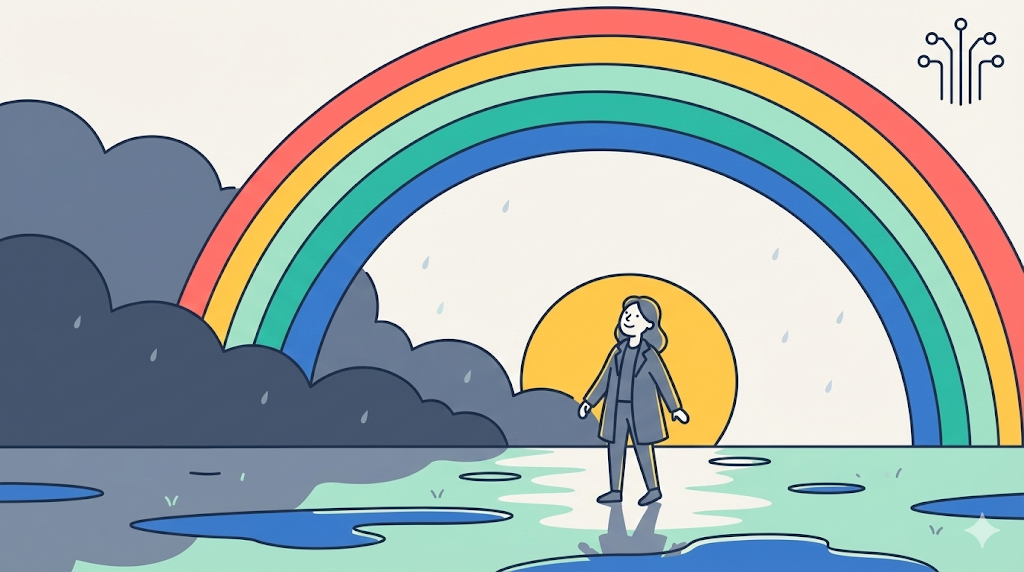
Emma steps outside after a short storm. The street is wet. Leaves shine with small drops. The sky is still gray, but the sun breaks through. Then she sees it: a rainbow.

A rainbow is not a real “thing” hanging in the air. It is light. It happens when sunlight meets many tiny water drops in the sky. Sunlight looks white, but it has many colors inside it.

When light goes from air into water, it bends. In a drop, the light bends and splits into colors. Then it bounces once inside the drop. After that, the light comes out and travels to your eyes.

This is why rainbows often appear after rain. After rain, many small drops stay in the air. At the same time, the sun can come out again. You also need the right position. The sun must be behind you, and the drops must be in front of you. If you walk to the side, the rainbow can move. It may look like it follows you.

She points to the colors: red, orange, yellow, green, blue. They curve like a soft bridge in the sky. She knows she cannot touch the “end,” and that is okay.

Emma smiles. The storm is gone. The rainbow feels like a quiet message: after dark weather, light can return.


Key Points

  • A rainbow appears when sunlight meets tiny water droplets after rain.
  • You see it best when the sun is behind you and drops are in front.

Words to Know

rainbow /ˈreɪnboʊ/ (n) — colored arc in the sky
sunlight /ˈsʌnlaɪt/ (n) — light from the sun
droplet /ˈdrɑːplət/ (n) — a very small drop of water
bend /bend/ (v) — change direction
reflect /rɪˈflekt/ (v) — bounce back (like light in a mirror)
behind /bɪˈhaɪnd/ (prep/adv) — at the back of something
arc /ɑːrk/ (n) — a curved shape


📝 Practice Questions

A1 – True/False

  1. A rainbow is made from sunlight and water droplets.
  2. You can see a rainbow best when the sun is in front of you.
  3. A rainbow usually looks like a curved arc.

A1 – Multiple Choice

  1. When do rainbows often appear?
    A. After rain when the sun comes out
    B. Only at night
    C. Only in winter

  2. What do water droplets do to sunlight?
    A. They turn it off
    B. They split it into colors
    C. They make it louder

  3. Where should the sun be to see a rainbow?
    A. Behind you
    B. Under you
    C. Inside the rainbow

A1 – Short Answer

  1. What is a rainbow made of?
  2. What must be in the air after rain?
  3. What shape does a rainbow often have?

A1 – True/False

  1. True
  2. False
  3. True

A1 – Multiple Choice

  1. A
  2. B
  3. A

A1 – Short Answer

  1. sunlight and water droplets
  2. tiny water droplets
  3. an arc
A2 Level

Sun behind you, droplets in front, and colors appear.

Why Rainbows Show Up After Rain

Sun behind you, droplets in front, and colors appear.

Liam walks to the bus stop after a quick shower. The air still smells fresh. Ahead of him, the clouds open, and sunlight hits the wet trees. A bright rainbow appears, and he turns his head in surprise.

The sun must be behind you

Liam tries to take a photo. He steps left, then right. The rainbow changes. His friend says, “Stand with the sun behind you.” Liam turns around and sees the sun at his back. The rainbow is always on the opposite side of the sky. If the sun is in front of you, you will not see it.

Tiny drops make big color

After rain, many water droplets stay in the air. Each droplet acts like a tiny prism. White sunlight enters the droplet and bends (refraction). Inside, the light spreads into different colors (dispersion). Then the light reflects once inside the droplet, like a small mirror. Finally, it exits and travels to your eyes.

Because the rainbow appears at a fixed angle, it can seem to “move” when you move. You are not chasing one rainbow. You are simply changing which droplets send colored light to you. That is why two people standing a few meters apart can see a slightly different rainbow.

Sometimes the best time is late afternoon, when the sun is lower. At noon, the sun is high, so the rainbow angle points more “down,” and the ground can hide it. You may also see a rainbow in mist near a waterfall or a garden spray. If the sunlight is strong and the droplets are small, the colors look clearer. In rare moments, Liam may spot a second, faint arc above the first one.

NASA often explains light as energy that can bend and spread into a spectrum of colors. A rainbow is a calm example of that science in everyday life. Liam smiles again. The storm passed, and the sky is teaching him something simple and beautiful.


Key Points

  • A rainbow appears opposite the sun, so the sun should be behind you.
  • Droplets bend, split, and reflect sunlight into colors.
  • Your movement changes the angle, so the rainbow seems to move too.

Words to Know

opposite /ˈɑːpəzɪt/ (adj) — on the other side
prism /ˈprɪzəm/ (n) — a shape that can split light into colors
refraction /rɪˈfrækʃən/ (n) — bending of light when it enters a new material
dispersion /dɪˈspɝːʒən/ (n) — colors spreading out from white light
spectrum /ˈspektrəm/ (n) — the range of colors in light
angle /ˈæŋɡəl/ (n) — the direction/tilt of a line or view
mist /mɪst/ (n) — tiny water drops floating in air
faint /feɪnt/ (adj) — not strong; hard to see
fixed /fɪkst/ (adj) — not changing


📝 Practice Questions

A2 – True/False

  1. A rainbow appears on the opposite side of the sky from the sun.
  2. Dispersion means all colors bend in the same way.
  3. A rainbow can look different when you move.

A2 – Multiple Choice

  1. What is refraction?
    A. Light bending when it enters water
    B. Water turning into ice
    C. Wind pushing clouds

  2. Why can two people see slightly different rainbows?
    A. They stand in different places
    B. They have different phones
    C. They look at different suns

  3. Where might you also see a rainbow, even without rain?
    A. In mist near a waterfall
    B. In a dark room
    C. Under a blanket

A2 – Short Answer

  1. What must be behind you to see a rainbow?
  2. Why is a rainbow not a “fixed object”?
  3. Where have you seen a rainbow before?

A2 – True/False

  1. True
  2. False
  3. True

A2 – Multiple Choice

  1. A
  2. A
  3. A

A2 – Short Answer

  1. the sun
  2. it depends on your angle
  3. (personal answer)
B1 Level

Why an arc of color appears—and why it won’t stay in one place.

The Science Behind Rainbows After Rain

Why an arc of color appears—and why it won’t stay in one place.

After a summer storm, Emma and her neighbor Mark step onto the balcony. The city looks washed clean. Sunlight slips under the clouds, and an arc of color rises over the buildings. Mark laughs and says, “It looks so close. Where does it end?”

White light is many colors

Sunlight may look white, but it is a mix of colors. You can see this idea with a simple prism, or even a glass of water in a sunny window. When light changes direction, hidden colors can separate into a rainbow-like spread.

What a raindrop does to light

A raindrop is like a tiny round lens. First, sunlight enters the droplet and bends. This bending is called refraction. Next, the colors separate because different colors bend by different amounts. That spreading is dispersion. Then the light reflects inside the droplet, like a mirror on a curved wall. Finally, the light leaves the droplet and heads toward your eyes.

Why the rainbow “moves”

Here is the strange part: the rainbow depends on angle. You see it when the sun is behind you and droplets are in front of you. Each color leaves the droplet at a particular viewing angle, so your eye receives a band of colors from many different droplets. When you move, the set of droplets sending light to you changes. That is why you cannot walk to the rainbow’s end. Two people can stand a few steps apart and still see “their” own rainbow.

The shape is also part of the angle story. A full rainbow is actually a circle around the point directly opposite the sun, but the ground usually hides the lower part, so we see an arc. Rainbows are easier to see when the sun is low, in the morning or late afternoon. When the sun is high at noon, the rainbow’s circle is mostly below the horizon.

Sometimes a second rainbow appears above the first. This “double rainbow” happens when light reflects twice inside the droplet. The second arc is fainter, and its colors are reversed.

Weather also matters. After rain, the air can hold fine droplets while sunlight returns, creating perfect conditions. Education sites like NOAA and the UK Met Office often use rainbows to show how light and weather work together. Emma watches the colors fade as the clouds shift. The science feels clear, but the feeling stays: nature can follow rules and still look like magic.


Key Points

  • A raindrop bends, splits, reflects, and releases sunlight as color.
  • The rainbow depends on viewing angle, so it changes when you move.
  • Many rainbows are strongest after rain when sunlight returns and droplets remain.

Words to Know

refraction /rɪˈfrækʃən/ (n) — bending of light entering water
dispersion /dɪˈspɝːʒən/ (n) — splitting light into colors
reflection /rɪˈflekʃən/ (n) — light bouncing off a surface
lens /lenz/ (n) — something that bends light
viewpoint /ˈvjuːpɔɪnt/ (n) — where you are looking from
horizon /həˈraɪzən/ (n) — the line where land/sea meets sky
arc /ɑːrk/ (n) — a curved line or shape
reverse /rɪˈvɝːs/ (v/adj) — turn to the opposite order
faint /feɪnt/ (adj) — weak or not bright
circle /ˈsɝːkəl/ (n) — a round shape
condition /kənˈdɪʃən/ (n) — a situation that allows something to happen


📝 Practice Questions

B1 – True/False

  1. A raindrop can act like a tiny lens for light.
  2. At noon, rainbows are often easier to see than in late afternoon.
  3. In a double rainbow, the second arc is usually fainter.

B1 – Multiple Choice

  1. Which process means colors spread out from white light?
    A. Dispersion
    B. Evaporation
    C. Rotation

  2. Why can’t you walk to the end of a rainbow?
    A. The rainbow depends on viewing angle
    B. The rainbow is blocked by trees
    C. The rainbow is made of smoke

  3. Why do we usually see an arc, not a full circle?
    A. The ground hides the lower part
    B. The sun makes only half a rainbow
    C. Droplets exist only in the upper sky

B1 – Short Answer

  1. Name the three steps inside a droplet after refraction.
  2. When is the sun position best for seeing a rainbow?
  3. What happens to colors in the second rainbow?

B1 – True/False

  1. True
  2. False
  3. True

B1 – Multiple Choice

  1. A
  2. A
  3. A

B1 – Short Answer

  1. dispersion, reflection, exit
  2. morning or late afternoon
  3. the colors are reversed
B2 Level

Light, droplets, and the observer create a “moving” picture.

Why Rainbows Appear After Rain

Light, droplets, and the observer create a “moving” picture.

Two friends stand on a wet hiking path after rain. Sarah points to the rainbow and says, “It ends near that tree.” David shakes his head. “No, it ends near the river.” They walk forward, and the “end” slides away again, as if the rainbow is politely refusing to be caught.

A rainbow is geometry, not a place

A rainbow is an optical effect built from three partners: sunlight, water droplets, and an observer. The key is the viewing angle. Imagine a line from the sun, through your head, and out in front of you. The point directly opposite the sun on that line is sometimes called the antisolar point. The bright colors of a primary rainbow arrive from droplets that send light to your eyes at a very specific angle around that antisolar point. Because your position sets the angle, the rainbow cannot stay fixed on one tree or one river. It depends on where you stand.

This also explains a surprising fact: each person sees their own rainbow. You and your friend may look at the same sky, but your eyes receive light from different droplets. Stand a few meters apart, and the droplets that match the right angle are not the same. The picture overlaps, so it feels shared, but it is still personal.

Inside a droplet: prism plus mirror

The droplet’s job is to reshape white sunlight into a spectrum. First, light enters water and bends (refraction). Next, it spreads because colors bend by different amounts (dispersion). Then it reflects inside the droplet (internal reflection). Finally, it exits back toward you. This is why the sun must be behind you and the droplets must be in front.

Strength matters too. A rainbow looks clearer when sunlight is strong and the droplets are small and evenly spread, like light mist after a shower. Big, heavy drops can blur the colors. This is one reason rainbows often look sharp after a quick rain when the sky clears fast. NASA uses this kind of example when explaining light and color.

Double rainbows and reversed colors

Sometimes you see a second, fainter arc above the first. In a double rainbow, the light reflects twice inside the droplet before leaving. That extra bounce sends light out at a different angle, so the second arc appears wider and dimmer. Because the path changes, the color order flips in the outer bow.

If you could see from high above—say, in an airplane—you might notice that a rainbow is actually a circle. On the ground, the lower part is blocked by the horizon. The “arc” is simply the visible top of a larger ring of light.

Groups like the American Meteorological Society use rainbows to show how basic optics connects with weather. Sarah and David stop walking and just watch. The rainbow is still not an object, but it feels real in a different way: it is a rule-made picture, drawn by light and water, and finished by where you stand. Understanding that does not reduce the wonder. It teaches a deeper kind of wonder—one that travels with you.


Key Points

  • A rainbow is formed at a specific angle around the antisolar point.
  • Each observer receives light from different droplets, so the rainbow is “personal.”
  • Double rainbows come from extra internal reflection, creating a dimmer outer arc.

Words to Know

observer /əbˈzɝːvər/ (n) — a person who watches or measures
geometry /dʒiˈɑːmətri/ (n) — shapes and spatial relationships
antisolar point /ˌæntiˈsoʊlər pɔɪnt/ (n) — point opposite the sun from you
viewing angle /ˈvjuːɪŋ ˈæŋɡəl/ (n) — the direction you must look to see something
spectrum /ˈspektrəm/ (n) — full range of colors in light
refraction /rɪˈfrækʃən/ (n) — bending of light entering water
dispersion /dɪˈspɝːʒən/ (n) — colors separating from white light
internal reflection /ɪnˈtɝːnəl rɪˈflekʃən/ (n) — light bouncing inside a droplet
overlap /ˌoʊvərˈlæp/ (v) — cover the same space partly
intensity /ɪnˈtensəti/ (n) — strength or brightness
dim /dɪm/ (adj) — not bright
ring /rɪŋ/ (n) — a circle shape
horizon /həˈraɪzən/ (n) — line where Earth and sky seem to meet

📝 Practice Questions

B2 – True/False

  1. The antisolar point is opposite the sun from the observer.
  2. Each observer receives rainbow light from the exact same droplets.
  3. A double rainbow forms when light reflects twice inside droplets.

B2 – Multiple Choice

  1. What mainly decides where you see the rainbow?
    A. Your viewing angle
    B. The color of the clouds
    C. The temperature of the ground

  2. Why is the outer rainbow dimmer?
    A. More reflection losses inside the droplet
    B. The sun becomes weaker
    C. The droplets disappear instantly

  3. From an airplane, a rainbow can look more like a:
    A. Full circle
    B. Square
    C. Straight line

B2 – Short Answer

  1. Explain in one sentence why a rainbow “moves” when you move.
  2. What two weather-light conditions make colors look stronger?
  3. Have you ever tried to photograph a rainbow? What happened?

B2 – True/False

  1. True
  2. False
  3. True

B2 – Multiple Choice

  1. A
  2. A
  3. A

B2 – Short Answer

  1. Your position changes which droplets send light to your eyes.
  2. strong sunlight and small, even droplets
  3. (personal answer)