Why Rainbows Appear After Rain
Light, droplets, and the observer create a “moving” picture.
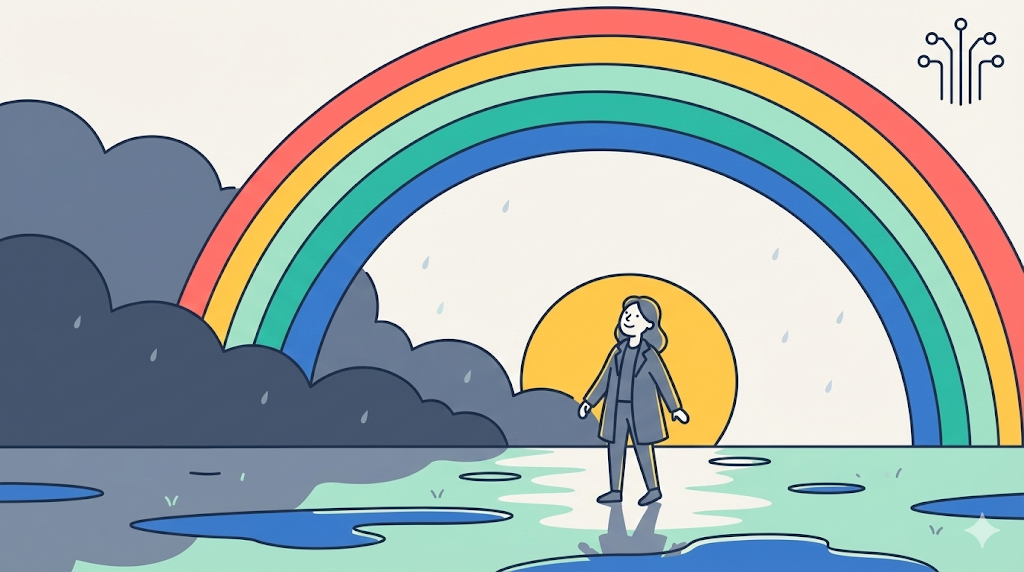
Two friends stand on a wet hiking path after rain. Sarah points to the rainbow and says, “It ends near that tree.” David shakes his head. “No, it ends near the river.” They walk forward, and the “end” slides away again, as if the rainbow is politely refusing to be caught.
A rainbow is geometry, not a place
A rainbow is an optical effect built from three partners: sunlight, water droplets, and an observer. The key is the viewing angle. Imagine a line from the sun, through your head, and out in front of you. The point directly opposite the sun on that line is sometimes called the antisolar point. The bright colors of a primary rainbow arrive from droplets that send light to your eyes at a very specific angle around that antisolar point. Because your position sets the angle, the rainbow cannot stay fixed on one tree or one river. It depends on where you stand.
This also explains a surprising fact: each person sees their own rainbow. You and your friend may look at the same sky, but your eyes receive light from different droplets. Stand a few meters apart, and the droplets that match the right angle are not the same. The picture overlaps, so it feels shared, but it is still personal.
Inside a droplet: prism plus mirror
The droplet’s job is to reshape white sunlight into a spectrum. First, light enters water and bends (refraction). Next, it spreads because colors bend by different amounts (dispersion). Then it reflects inside the droplet (internal reflection). Finally, it exits back toward you. This is why the sun must be behind you and the droplets must be in front.
Strength matters too. A rainbow looks clearer when sunlight is strong and the droplets are small and evenly spread, like light mist after a shower. Big, heavy drops can blur the colors. This is one reason rainbows often look sharp after a quick rain when the sky clears fast. NASA uses this kind of example when explaining light and color.
Double rainbows and reversed colors
Sometimes you see a second, fainter arc above the first. In a double rainbow, the light reflects twice inside the droplet before leaving. That extra bounce sends light out at a different angle, so the second arc appears wider and dimmer. Because the path changes, the color order flips in the outer bow.
If you could see from high above—say, in an airplane—you might notice that a rainbow is actually a circle. On the ground, the lower part is blocked by the horizon. The “arc” is simply the visible top of a larger ring of light.
Groups like the American Meteorological Society use rainbows to show how basic optics connects with weather. Sarah and David stop walking and just watch. The rainbow is still not an object, but it feels real in a different way: it is a rule-made picture, drawn by light and water, and finished by where you stand. Understanding that does not reduce the wonder. It teaches a deeper kind of wonder—one that travels with you.
Key Points
- A rainbow is formed at a specific angle around the antisolar point.
- Each observer receives light from different droplets, so the rainbow is “personal.”
- Double rainbows come from extra internal reflection, creating a dimmer outer arc.
Words to Know
observer /əbˈzɝːvər/ (n) — a person who watches or measures
geometry /dʒiˈɑːmətri/ (n) — shapes and spatial relationships
antisolar point /ˌæntiˈsoʊlər pɔɪnt/ (n) — point opposite the sun from you
viewing angle /ˈvjuːɪŋ ˈæŋɡəl/ (n) — the direction you must look to see something
spectrum /ˈspektrəm/ (n) — full range of colors in light
refraction /rɪˈfrækʃən/ (n) — bending of light entering water
dispersion /dɪˈspɝːʒən/ (n) — colors separating from white light
internal reflection /ɪnˈtɝːnəl rɪˈflekʃən/ (n) — light bouncing inside a droplet
overlap /ˌoʊvərˈlæp/ (v) — cover the same space partly
intensity /ɪnˈtensəti/ (n) — strength or brightness
dim /dɪm/ (adj) — not bright
ring /rɪŋ/ (n) — a circle shape
horizon /həˈraɪzən/ (n) — line where Earth and sky seem to meet