Why “Multitasking” Is Mostly Self-Inflicted Drag
The problem isn’t effort. It’s constant context switching.
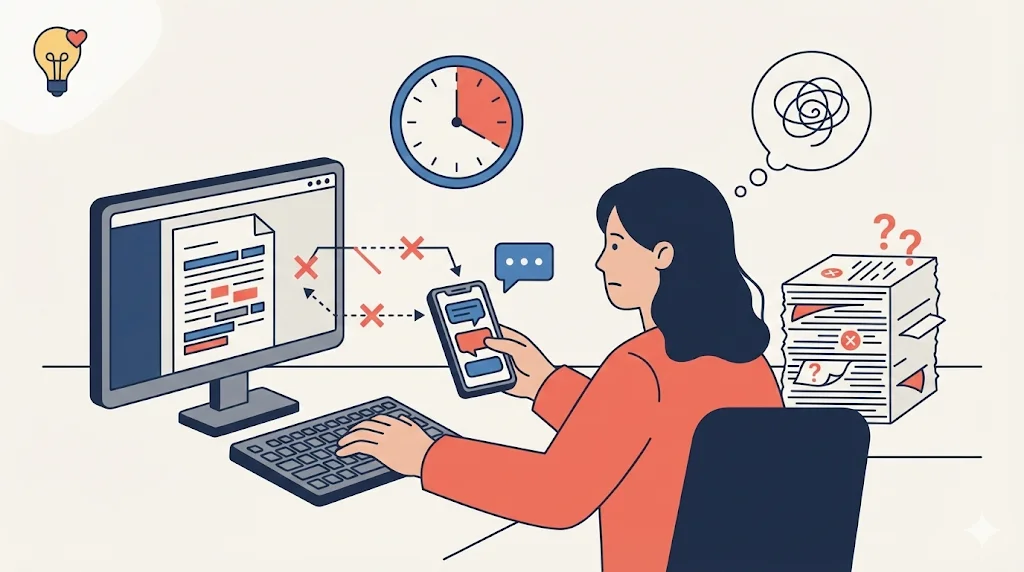
Jamie’s afternoon looks impressive from the outside. Her cursor never stops moving. A report is open. Chat messages keep arriving. She answers fast, adds a line to the report, then answers again. She feels responsible and active.
But when she finally scrolls through the report, something feels wrong. The structure is uneven. A paragraph repeats an idea she already wrote. A key number is missing. Jamie did a lot of work—and still has a lot left.
Multitasking is a story we tell ourselves
In many modern jobs, “multitasking” sounds like a strength. Yet most of the time, it is not two skills running in parallel. It is rapid switching: document → chat → email → meeting note → back to document. The brain must keep changing its “current goal,” and that change breaks the sense of depth. You may feel busy and important, but your attention becomes thin.
The restart cost you don’t see
Each switch carries a restart cost (sometimes called a re-entry cost). You spend time getting back into the thread: What was my argument? Which number did I choose? What did I promise the team? This cost is not only time. It is also quality. When you re-enter quickly, you may miss small details, so you re-check more. Your working memory becomes crowded with unfinished pieces, which makes errors more likely. Then you pay again—through correction, apology, and extra meetings to “align.”
The trap is emotional, too. Fast switching can give a short feeling of progress: you clear a message, you close a tab. But the deeper task (writing, planning, learning) needs uninterrupted attention to move forward.
One-track design: practical, not extreme
The solution is not to disappear offline forever. It is to design your day with one track at a time.
- Batch small tasks: group messages and emails into a few check windows.
- Use short focus blocks: protect 25–45 minutes for one task, then take a brief reset.
- Reduce interruptions with simple boundaries: silence non-urgent alerts, keep one “main tab,” and communicate response times (for example, “I check chat at :00 and :30”).
When Jamie tries this, she may reply a bit later—but she writes a cleaner report faster. The surprising lesson is gentle: focus is not a personality trait. It is an environment you build, so your brain can do what it does best—one clear thing at a time.
Key Points
- Multitasking is usually rapid task-switching that feels productive but breaks focus.
- Switching has a restart cost: time loss, detail loss, and more re-checking.
- One-track habits help: batching, focus blocks, and simple interruption boundaries.
Words to Know
context /ˈkɑːntekst/ (n) — the situation your brain is working inside
parallel /ˈpærəlel/ (adj) — happening at the same time
thin /θɪn/ (adj) — weak or spread out (about attention)
re-entry /ˌriːˈentri/ (n) — getting back into a task after leaving it
thread /θred/ (n) — the main line of an idea or conversation
quality /ˈkwɑːləti/ (n) — how good or accurate something is
align /əˈlaɪn/ (v) — to agree and match plans with others
progress /ˈprɑːɡres/ (n) — moving forward toward a goal
boundary /ˈbaʊndəri/ (n) — a limit that protects time and focus
window /ˈwɪndoʊ/ (n) — a set time period for an activity
reset /ˌriːˈset/ (n) — a short break that refreshes attention
silence /ˈsaɪləns/ (v) — to stop sounds or alerts
non-urgent /ˌnɑːn ˈɜːrdʒənt/ (adj) — not needed right away
crowded /ˈkraʊdɪd/ (adj) — too full
trait /treɪt/ (n) — a stable personal feature