Deep Work as a Career Advantage
Results grow in quiet time, not in constant reaction.
Jun used to be proud of his fast replies.
In meetings, people said, “Jun always answers.”
His manager liked his speed and visibility.
But slowly, something changed.
His biggest projects began to stall.
He was present everywhere, yet he was building less.
His reputation started to shift from “strong builder” to “quick responder.”
One evening, Jun opened his calendar and saw the pattern:
his day was broken into tiny pieces.
Even when he had two free hours, he rarely used them as one block.
They were filled with pings, quick questions, and “just one more thing.”
Deep work vs. shallow work
Deep work is effort that creates new value: analysis, writing, designing, solving, learning.
It needs time to warm up, because your brain must build a full mental model.
That model is fragile. Interruptions shake it.
Shallow work is not useless.
Emails, chat, and coordination keep a team moving.
The problem is when shallow work expands to fill every minute.
Then deep work becomes “something you do later,” which often means never.
Many modern workplaces reward speed, visibility, and instant response.
But long-term value—innovation, quality, trust—usually comes from work you can point to.
Some OECD discussions about productivity and skills have highlighted how knowledge work depends on learning and capability, not only activity.
Deep work supports that capability.
Designing a focus system you can defend
Jun decides to treat attention like a limited resource, not an unlimited mood.
He makes three lists:
- Deep tasks (high value, hard thinking)
- Shallow tasks (necessary maintenance)
- Noise (things that feel urgent but are optional)
Then he builds rules:
- Protect prime hours: two 60–90 minute deep blocks, most days.
- Batch communication: check messages at set windows, not all day.
- Use clear signals: “Heads down until 11:00. Ping me if urgent.”
- Reduce open loops: write the next step before leaving a task, so returning is easier.
Team norms that make deep work possible
Jun also learns a truth: focus is not only personal. It is cultural.
If the team expects instant replies, one person’s deep work will always feel “selfish.”
So he suggests small team agreements:
- Fewer meetings, better agendas.
- Short “office hours” for quick questions.
- Quiet blocks on shared calendars.
- A clear definition of “urgent.”
These changes help everyone.
People reply a bit slower, but with better answers.
Projects move with fewer errors.
The team feels less tense.
In the end, Jun still responds and supports others.
He simply stops confusing reaction with progress.
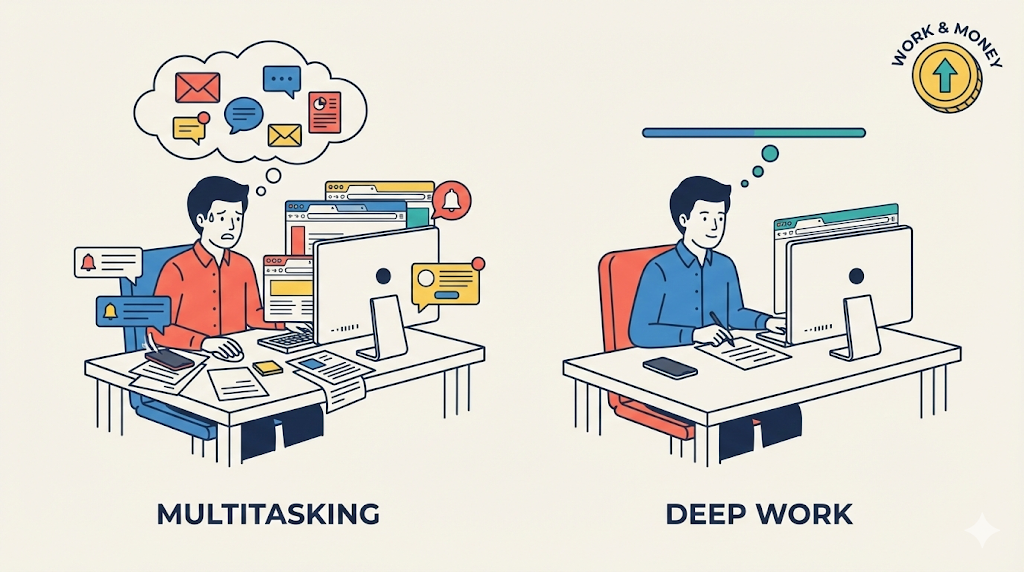
Multitasking can feel like control, but it often hides friction you cannot see.
Deep work is quieter and harder to protect—but it produces outcomes that last.
Key Points
- Deep work creates durable value because it protects complex thinking and learning.
- Shallow work should be timed and contained, or it will consume the day.
- Focus improves when teams build norms that respect attention, not just speed.
Words to Know
advantage /ədˈvæn.tɪdʒ/ (n) — a helpful edge over others
visibility /ˌvɪz.əˈbɪl.ə.t̬i/ (n) — being seen and noticed at work
mental model /ˈmen.t̬əl ˈmɑː.dəl/ (n) — a clear inner picture of a problem
fragile /ˈfrædʒ.əl/ (adj) — easily damaged or broken
innovation /ˌɪn.əˈveɪ.ʃən/ (n) — new ideas that create value
capability /ˌkeɪ.pəˈbɪl.ə.t̬i/ (n) — ability to do something well
resource /rɪˈsɔːrs/ (n) — something limited that you use
urgent /ˈɝː.dʒənt/ (adj) — needing action right now
agenda /əˈdʒen.də/ (n) — a plan for a meeting
agreement /əˈɡriː.mənt/ (n) — a shared rule or decision
coordination /koʊˌɔːr.dənˈeɪ.ʃən/ (n) — organizing work with others
friction /ˈfrɪk.ʃən/ (n) — small problems that slow things down
outcome /ˈaʊt.kʌm/ (n) — the final result
priority design /praɪˈɔːr.ə.t̬i dɪˈzaɪn/ (n) — planning what matters most and when
norm /nɔːrm/ (n) — a common shared behavior in a group