Wisdom English Learn about the world. Grow your English.
Work & Money

Why Deep Work Beats Constant Multitasking

A1 A2 B1 B2

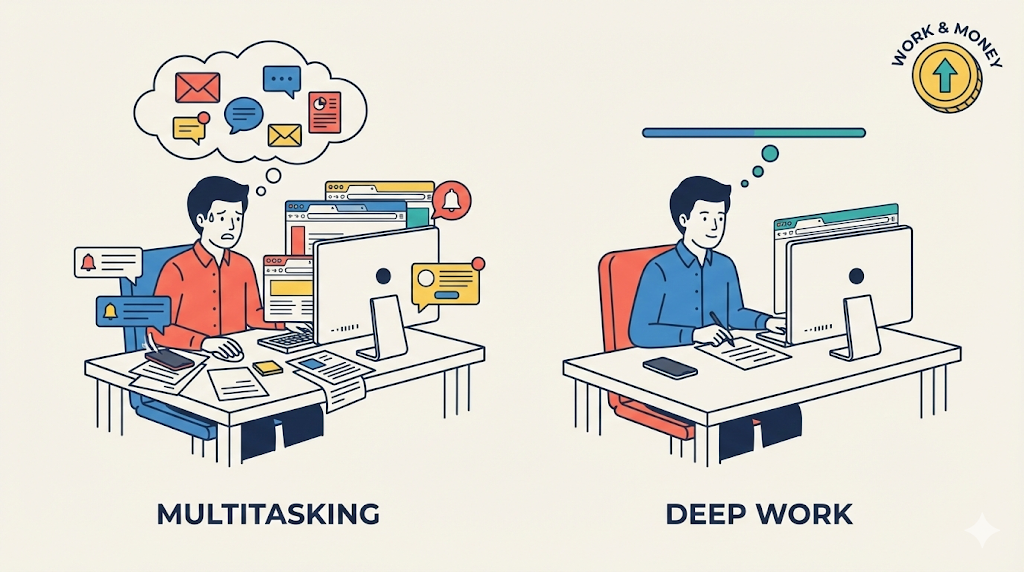
Multitasking often means switching, not doing two things at once. Deep work protects your attention, reduces mistakes, and helps you finish meaningful work with less stress.

A1 Level

Less switching, more finishing.

Deep Work: One Thing at a Time

Less switching, more finishing.

Jun sits at his desk.
His computer has many open tabs.
His phone keeps pinging.
He starts a report. Then he checks an email.
Then a chat message appears.
He opens a new task again.

After one hour, Jun feels busy.
But he did not finish anything.
His mind feels messy and tired.

At lunch, he tries something new.
He closes most tabs.
He turns off phone sounds.
He writes one small goal: “Finish page one.”
Then he works for 20 minutes.

At first, it feels strange.
Jun wants to check messages.
But he stays with the report.
After 20 minutes, he has real progress.
He can see clear sentences on the screen.

This is deep work.
Deep work means you do one hard thing in a quiet time.
Multitasking is often not “many things at once.”
It is switching again and again.
Each switch makes you start over in your head.

In the end, Jun feels calm.
He is not doing more.
He is finishing more.


Key Points

  • Multitasking often means switching, and switching makes work slower.
  • Deep work helps you finish one important task with a calm mind.

Words to Know

focus /ˈfoʊ.kəs/ (n) — attention on one thing
deep /diːp/ (adj) — needing strong thinking
task /tæsk/ (n) — a piece of work
switch /swɪtʃ/ (v) — change from one thing to another
interrupt /ˌɪn.təˈrʌpt/ (v) — stop someone’s work for a moment
finish /ˈfɪn.ɪʃ/ (v) — complete something
mistake /mɪˈsteɪk/ (n) — an error
quiet /ˈkwaɪ.ət/ (adj) — with little noise or distraction


📝 Practice Questions

A1 – True/False

  1. Jun finishes many tasks quickly when he keeps switching.
  2. Deep work means doing one hard task in quiet time.
  3. Closing extra tabs can help Jun focus.

A1 – Multiple Choice

  1. What makes Jun feel tired at first?
    A. He does one task for 20 minutes
    B. He keeps switching between tasks
    C. He takes a quiet break

  2. What does Jun do before deep work?
    A. Opens more tabs
    B. Turns on more notifications
    C. Closes most tabs

  3. Deep work helps you _____.
    A. finish important work
    B. read every message fast
    C. start many tasks at once

A1 – Short Answer

  1. How long does Jun focus in one block?
  2. What does Jun turn off on his phone?
  3. What happens when you switch tasks often?

A1 – True/False

  1. False
  2. True
  3. True

A1 – Multiple Choice

  1. B
  2. C
  3. A

A1 – Short Answer

  1. 20 minutes
  2. notifications / phone sounds
  3. You lose time
A2 Level

Busy is not the same as progress.

Why Deep Work Helps You Work Better

Busy is not the same as progress.

Jun is writing a report on his laptop.
A team chat pops up. Then another message.
He answers fast because he wants to be “helpful.”
But his report moves very slowly.

Sara, his teammate, notices it.
She says, “Let’s try a new rule today.”
They choose two message times: 10 a.m. and 4 p.m.
Between those times, they use “Do Not Disturb.”

The hidden problem: switching

Jun thinks he can do many things at once.
But most of the time, he is switching.
He goes from report → chat → email → report again.
Each time, his brain needs a moment to “load” the report again.
He forgets small details, like a number or a key idea.
Then he checks it again. This takes more time.

A simple plan that works

Sara sets a timer for 25 minutes.
During that time, Jun does only the report.
He keeps one tab open, not ten.
When the timer ends, he takes a short break.
Then he checks messages at the planned time.

That day, something changes.
Jun writes faster, with fewer mistakes.
He also gives better replies later, because he is not rushing.

Deep work is not magic.
It is a small wall around your attention.
When you protect that space, your work feels lighter—and your results feel real.


Key Points

  • “Multitasking” is often fast switching, and switching steals time.
  • Deep work blocks help you think clearly and make fewer errors.
  • Checking messages at set times can reduce stress.

Words to Know

multitask /ˌmʌl.tiˈtæsk/ (v) — try to do many tasks at once
attention /əˈten.ʃən/ (n) — mental focus
notification /ˌnoʊ.t̬ə.fɪˈkeɪ.ʃən/ (n) — a message alert on a device
timer /ˈtaɪ.mɚ/ (n) — a tool that counts time
routine /ruːˈtiːn/ (n) — a regular way of doing things
priority /praɪˈɔːr.ə.t̬i/ (n) — the most important thing
distraction /dɪˈstræk.ʃən/ (n) — something that pulls your focus away
break /breɪk/ (n) — short rest time
reply /rɪˈplaɪ/ (n) — an answer message


📝 Practice Questions

A2 – True/False

  1. Jun checks messages only at planned times in the new rule.
  2. Switching tasks can make you forget small details.
  3. Deep work means answering chat messages faster all day.

A2 – Multiple Choice

  1. What is Sara’s main idea?
    A. Reply to every message instantly
    B. Set times to check messages
    C. Work with ten tabs open

  2. What tool do Jun and Sara use for focus blocks?
    A. A timer
    B. A calculator
    C. A music app

  3. What is a common result of task switching?
    A. Clearer memory of details
    B. Less need to re-check work
    C. Slower progress on the main task

A2 – Short Answer

  1. When do they check messages in the story?
  2. Why does switching steal time?
  3. What improves when Jun replies later?

A2 – True/False

  1. True
  2. True
  3. False

A2 – Multiple Choice

  1. B
  2. A
  3. C

A2 – Short Answer

  1. At 10 and 4
  2. The brain must reload the task
  3. The quality of his replies
B1 Level

Switching feels fast, but it can be expensive.

The Real Cost of Multitasking

Switching feels fast, but it can be expensive.

Jun’s day looks “productive” from the outside.
He answers messages quickly. He joins meetings.
He updates small tasks. His chat status is always green.

But at 6 p.m., his main project still feels unfinished.
Worse, he feels tired in a special way—like his mind has been pulled in ten directions.

Multitasking is often “task switching”

Most knowledge work is not like driving and talking at the same time.
It uses the same mental space: attention and working memory.
When Jun switches from the report to the chat, his brain drops part of the report.
When he returns, he must rebuild the “problem picture” again:
What was my point? Where was the data? What is the next step?

This restart cost is small once.
But across a day, it becomes large.

Quality drops, and rework grows

Switching also increases mistakes.
Jun may copy the wrong number, forget a detail, or misunderstand a request.
Later, he fixes problems that did not need to exist.
That is rework—time you pay twice.

Some researchers at Stanford have described how divided attention can reduce performance and learning.
Even without reading studies, many workers feel it: switching makes you slower than you think.

Deep work and batching: a balanced day

Deep work is time for tasks that need thinking: writing, planning, designing, solving.
Shallow work is necessary too: messages, simple updates, scheduling.

The key is timing.
Jun blocks two deep work sessions in his best hours.
He batches shallow tasks after lunch and near the end of the day.
He tells the team: “I’m offline for 45 minutes, then I’ll reply.”

Over time, his work becomes clearer.
He feels less scattered.
And he starts to trust his own mind again.


Key Points

  • Task switching creates a “restart cost” in time and mental energy.
  • Divided attention raises mistakes, which leads to rework.
  • Deep work plus batching shallow tasks creates calmer, higher-quality days.

Words to Know

switching cost /ˈswɪtʃ.ɪŋ kɔːst/ (n) — extra time/energy lost when changing tasks
working memory /ˈwɝː.kɪŋ ˈmem.ə.ri/ (n) — the mind’s short-term “hold” space
divided /dɪˈvaɪ.dɪd/ (adj) — split into parts
performance /pɚˈfɔːr.məns/ (n) — how well you do a task
rework /ˌriːˈwɝːk/ (n) — fixing work because of earlier errors
batch /bætʃ/ (v) — group similar tasks together
shallow /ˈʃæl.oʊ/ (adj) — simple, not needing deep thinking
block /blɑːk/ (n) — set time reserved for one purpose
boundary /ˈbaʊn.dɚ.i/ (n) — a clear limit or rule
craft /kræft/ (n) — skilled, careful work
signal /ˈsɪɡ.nəl/ (n) — a sign that tells others something
stalled /stɔːld/ (adj) — stopped before finishing


📝 Practice Questions

B1 – True/False

  1. Task switching can create a restart cost in working memory.
  2. Rework means finishing a task only one time.
  3. Batching shallow tasks can help a day feel more controlled.

B1 – Multiple Choice

  1. What is the “restart cost”?
    A. The time needed to rebuild task focus after switching
    B. The money you pay for new software
    C. The break time after lunch

  2. Why does divided attention increase rework?
    A. It makes more mistakes likely
    B. It removes all deadlines
    C. It makes meetings shorter

  3. Which is an example of shallow work?
    A. Designing a complex plan
    B. Writing a difficult report section
    C. Scheduling and simple message replies

B1 – Short Answer

  1. What does the brain need time to “load” again after switching?
  2. What can rise when attention is divided?
  3. How does Jun tell his team about his focus time?

B1 – True/False

  1. True
  2. False
  3. True

B1 – Multiple Choice

  1. A
  2. A
  3. C

B1 – Short Answer

  1. The “problem picture” / task focus
  2. Errors / mistakes
  3. He says he’s offline for 45 minutes
B2 Level

Results grow in quiet time, not in constant reaction.

Deep Work as a Career Advantage

Results grow in quiet time, not in constant reaction.

Jun used to be proud of his fast replies.
In meetings, people said, “Jun always answers.”
His manager liked his speed and visibility.

But slowly, something changed.
His biggest projects began to stall.
He was present everywhere, yet he was building less.
His reputation started to shift from “strong builder” to “quick responder.”

One evening, Jun opened his calendar and saw the pattern:
his day was broken into tiny pieces.
Even when he had two free hours, he rarely used them as one block.
They were filled with pings, quick questions, and “just one more thing.”

Deep work vs. shallow work

Deep work is effort that creates new value: analysis, writing, designing, solving, learning.
It needs time to warm up, because your brain must build a full mental model.
That model is fragile. Interruptions shake it.

Shallow work is not useless.
Emails, chat, and coordination keep a team moving.
The problem is when shallow work expands to fill every minute.
Then deep work becomes “something you do later,” which often means never.

Many modern workplaces reward speed, visibility, and instant response.
But long-term value—innovation, quality, trust—usually comes from work you can point to.
Some OECD discussions about productivity and skills have highlighted how knowledge work depends on learning and capability, not only activity.
Deep work supports that capability.

Designing a focus system you can defend

Jun decides to treat attention like a limited resource, not an unlimited mood.

He makes three lists:

  1. Deep tasks (high value, hard thinking)
  2. Shallow tasks (necessary maintenance)
  3. Noise (things that feel urgent but are optional)

Then he builds rules:

  • Protect prime hours: two 60–90 minute deep blocks, most days.
  • Batch communication: check messages at set windows, not all day.
  • Use clear signals: “Heads down until 11:00. Ping me if urgent.”
  • Reduce open loops: write the next step before leaving a task, so returning is easier.

Team norms that make deep work possible

Jun also learns a truth: focus is not only personal. It is cultural.
If the team expects instant replies, one person’s deep work will always feel “selfish.”

So he suggests small team agreements:

  • Fewer meetings, better agendas.
  • Short “office hours” for quick questions.
  • Quiet blocks on shared calendars.
  • A clear definition of “urgent.”

These changes help everyone.
People reply a bit slower, but with better answers.
Projects move with fewer errors.
The team feels less tense.

In the end, Jun still responds and supports others.
He simply stops confusing reaction with progress.
Multitasking can feel like control, but it often hides friction you cannot see.
Deep work is quieter and harder to protect—but it produces outcomes that last.


Key Points

  • Deep work creates durable value because it protects complex thinking and learning.
  • Shallow work should be timed and contained, or it will consume the day.
  • Focus improves when teams build norms that respect attention, not just speed.

Words to Know

advantage /ədˈvæn.tɪdʒ/ (n) — a helpful edge over others
visibility /ˌvɪz.əˈbɪl.ə.t̬i/ (n) — being seen and noticed at work
mental model /ˈmen.t̬əl ˈmɑː.dəl/ (n) — a clear inner picture of a problem
fragile /ˈfrædʒ.əl/ (adj) — easily damaged or broken
innovation /ˌɪn.əˈveɪ.ʃən/ (n) — new ideas that create value
capability /ˌkeɪ.pəˈbɪl.ə.t̬i/ (n) — ability to do something well
resource /rɪˈsɔːrs/ (n) — something limited that you use
urgent /ˈɝː.dʒənt/ (adj) — needing action right now
agenda /əˈdʒen.də/ (n) — a plan for a meeting
agreement /əˈɡriː.mənt/ (n) — a shared rule or decision
coordination /koʊˌɔːr.dənˈeɪ.ʃən/ (n) — organizing work with others
friction /ˈfrɪk.ʃən/ (n) — small problems that slow things down
outcome /ˈaʊt.kʌm/ (n) — the final result
priority design /praɪˈɔːr.ə.t̬i dɪˈzaɪn/ (n) — planning what matters most and when
norm /nɔːrm/ (n) — a common shared behavior in a group

📝 Practice Questions

B2 – True/False

  1. Shallow work is always useless and should be removed completely.
  2. Deep work often needs time to “warm up” before high output appears.
  3. Team norms can make deep work easier for everyone.

B2 – Multiple Choice

  1. What problem does Jun notice in his calendar?
    A. One long focus block every morning
    B. His time is broken into tiny pieces
    C. Too many vacations

  2. What is one rule in Jun’s focus system?
    A. Check messages nonstop
    B. Protect prime hours for deep blocks
    C. Keep every meeting without an agenda

  3. Why can workplaces over-reward fast replies?
    A. Speed is visible, but deep results are quieter
    B. Fast replies always create better ideas
    C. Deep work is impossible in knowledge jobs

B2 – Short Answer

  1. What are two examples of deep tasks from the article?
  2. What is one team agreement that protects attention?
  3. In your life, what is one “noise” item you could limit?

B2 – True/False

  1. False
  2. True
  3. True

B2 – Multiple Choice

  1. B
  2. B
  3. A

B2 – Short Answer

  1. Writing, analysis, designing, solving, learning (any two)
  2. Quiet blocks on calendars / fewer meetings with agendas / office hours (any one)
  3. Personal answer

Generated using the required Wisdom Topics structure and level rules.