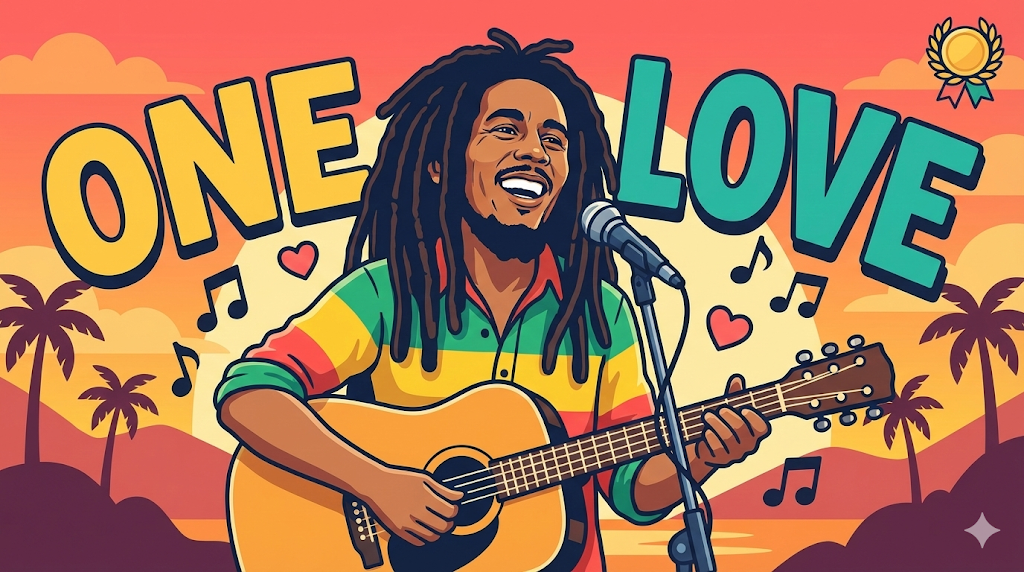
Bob Marley and the Social Power of a Simple Chorus
Music can build group identity faster than arguments can.
“It’s just music,” Alex says, folding his arms as the documentary plays. “A nice beat, a famous voice.”
“No,” Priya answers quietly. “This is social power.” On the screen, a crowd sings the same chorus. For a moment, thousands of strangers breathe and move together. The camera shows faces that were tense minutes ago. Now they look softer.
A life shaped by division—and a choice for unity
Bob Marley came from Jamaica, a place shaped by colonial history, poverty, and sharp political conflict in his era. Many people lived close to danger and felt that society was split into hard camps. Marley did not write from a calm distance. He wrote from inside the pressure, and that gave his songs weight. He named struggle and injustice, but he aimed his voice toward peace, dignity, and shared humanity. He was not saying, “Everyone agrees.” He was saying, “We can refuse to treat each other as enemies.”
Music as a “social technology”
We often think of technology as machines. But music can work like a tool, too. It changes attention, emotion, and group behavior quickly. Three simple features help explain Marley’s unity effect:
First, rhythm. Reggae’s steady beat is easy to follow. When bodies keep time together, people feel connected without needing the same opinions. The body learns togetherness before the mind finishes its arguments.
Second, repetition. Many Marley choruses use short lines with strong repeats. Repetition builds memory fast. A phrase becomes a shared “handle” people can hold at a stressful moment. It is easier to remember a chorus than a speech, and people can repeat it in the street, at work, or at home.
Third, shared singing. When many voices join one chorus, the distance between “us” and “them” can shrink. This connects to ideas psychologists discuss about group identity and emotional contagion: feelings spread through groups, especially when people synchronize. A chorus offers one simple action for everyone—sing the same words. That shared action can lower “enemy thinking,” even if only for a while.
Local meanings, global ears
Marley’s music traveled worldwide through radio, records, and later new media. But global listeners do not all hear the same story. In one country, a song may feel like comfort after loss. In another, it may sound like protest against unfair power. In a third place, it might simply be a warm soundtrack for daily life. This flexibility helped the message cross cultures, but it also creates a real tension: people can repeat a unity slogan without doing unity work.
That is why context matters. In places shaped by inequality and political tension, unity messages can be risky but necessary. They ask people to imagine a wider “we” when the social system rewards division. Museums and cultural writers, including collections like the Smithsonian, often highlight how music carries identity and history across borders. Magazine voices such as The Economist have also noted how culture can influence politics indirectly, by shaping what people feel is normal and possible.
Alex watches the crowd again. “So the chorus is practice,” he says.
“Yes,” Priya replies. “A short practice of belonging.” Marley’s gift was making that practice simple enough for anyone to join, yet serious enough to matter. A song cannot replace policy, justice, or daily respect. But it can reopen a closed heart—and that is often where change begins.
Key Points
- Marley’s unity message worked because it was simple, but rooted in real struggle.
- Rhythm, repetition, and shared singing can quickly build group feeling.
- Unity in music is powerful, but real unity still needs daily action.
Words to Know
colonial /kəˈləʊniəl/ (adj) — linked to rule by foreign powers
identity /aɪˈdentəti/ (n) — who a person or group is
interpret /ɪnˈtɜːprɪt/ (v) — to understand meaning
contagion /kənˈteɪdʒən/ (n) — spreading from person to person
slogan /ˈsləʊɡən/ (n) — a short repeated phrase
context /ˈkɒntekst/ (n) — the situation around something
indirectly /ˌɪndəˈrektli/ (adv) — not in a direct way
dignity /ˈdɪɡnɪti/ (n) — basic human worth
synchronize /ˈsɪŋkrənaɪz/ (v) — move together in time
division /dɪˈvɪʒən/ (n) — separation into groups
legacy /ˈleɡəsi/ (n) — what remains after someone’s life
bridge /brɪdʒ/ (n) — something that connects groups
belonging /bɪˈlɒŋɪŋ/ (n) — feeling accepted in a group