Wisdom English Learn about the world. Grow your English.
Mind & Habits

Why Bad Habits Are So Hard to Break

A1 A2 B1 B2

Bad habits repeat because the brain loves quick comfort and easy routines. Learn how triggers start the loop—and how small, steady changes can build a new path.

A1 Level

Your brain likes the easy loop

Why Bad Habits Feel So Strong

Your brain likes the easy loop

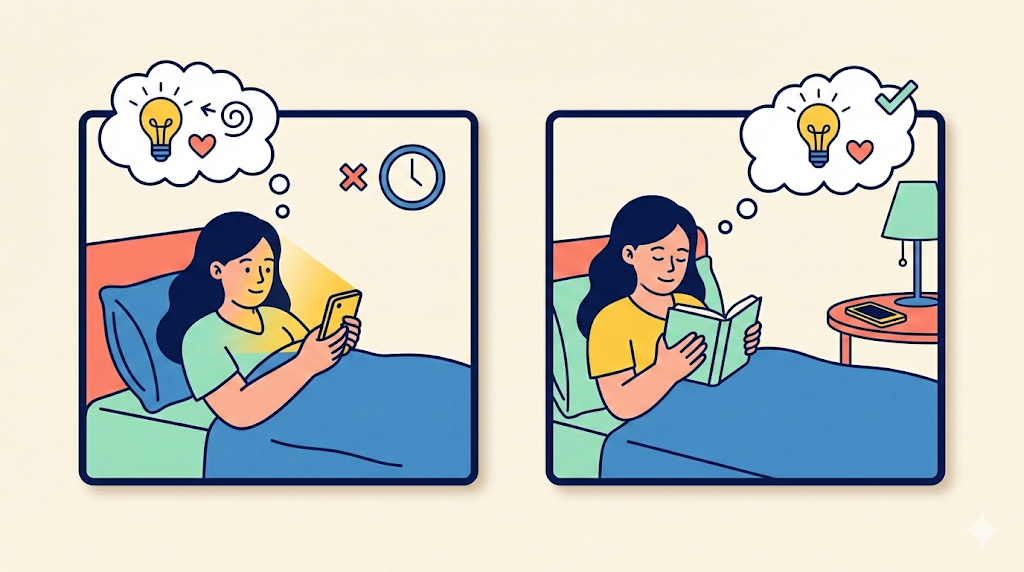
Mina gets into bed. She feels tired. She tells herself, “I will sleep now.”
But her phone is in her hand. One message appears. Then another. She scrolls and scrolls. Soon it is very late. The next morning, she feels slow and angry at herself.

This happens because habits are often automatic. Your brain likes to save energy. It likes the same pattern again and again.

Many habits follow a simple loop: cue → routine → reward.
A cue is a trigger. It can be a time, a place, or a feeling. For Mina, the cue is “bed + phone.”
The routine is the action: scrolling.
The reward is quick: fun, comfort, or less stress.

Bad habits are hard to stop because the reward is fast. The bad result is slow. Also, when you are tired or stressed, your brain chooses the easy path.

Mina tries one small change. She puts her phone on a table across the room before she gets into bed. Now the cue is weaker. She picks a new routine: three pages of a simple book. After a week, sleep feels easier.

You are not “weak.” You are human. Small changes can start a new loop.


Key Points

  • Bad habits repeat because the brain likes easy, automatic loops.
  • Change is easier when you change the cue and swap the routine.

Words to Know

habit /ˈhæbɪt/ (n) — something you do often
cue /kjuː/ (n) — a small sign that starts an action
routine /ruːˈtiːn/ (n) — the usual action you do
reward /rɪˈwɔːrd/ (n) — a good feeling after an action
stress /stres/ (n) — pressure that makes you feel tense
automatic /ˌɔːtəˈmætɪk/ (adj) — happening without thinking
swap /swɑːp/ (v) — change one thing for another


📝 Practice Questions

A1 – True/False

  1. A bad habit can follow a cue → routine → reward loop.
  2. Bad habits are easy to stop when you feel tired.
  3. Moving your phone can make scrolling less likely.

A1 – Multiple Choice

  1. What is a “cue”?
    A. A trigger that starts a habit
    B. A long-term goal
    C. A punishment after a mistake
  2. What is the “reward” in a habit loop?
    A. A quick good feeling
    B. A new smartphone
    C. A hard task you avoid
  3. What small change did Mina try?
    A. She put her phone across the room
    B. She bought more snacks
    C. She studied all night

A1 – Short Answer

  1. What starts the habit loop?
  2. What is Mina’s late-night habit?
  3. Where did Mina put her phone?

A1 – True/False

  1. True
  2. False
  3. True

A1 – Multiple Choice

  1. A
  2. A
  3. A

A1 – Short Answer

  1. A cue / a trigger
  2. Scrolling her phone in bed
  3. On a table across the room
A2 Level

The loop is strong, but you can edit it

Why Bad Habits Are Hard to Break

The loop is strong, but you can edit it

After work, Mina walks to the subway. She is tired and a little stressed. On the way, she often stops at a store and buys sweet snacks. She eats them fast on the train. For a few minutes, she feels calm. Later, she feels heavy and disappointed.

This is a common habit story. Many people do something similar: late-night scrolling, smoking, online shopping, or skipping exercise. The habit can feel like it “just happens.”

The habit loop

A habit often follows a loop:

Cue (trigger) → Routine (action) → Reward (good feeling)

The cue can be a time (“after dinner”), a place (“in the car”), a mood (“I feel lonely”), or people (“with friends”).
For Mina, the cue is “after work + tired.”
The routine is “buy snacks.”
The reward is “quick comfort.”

The brain learns fast rewards well. It remembers, “This helps me right now.”

Why willpower is not enough

When people say, “Just stop,” they forget one thing: stress and tiredness make self-control weaker. In those moments, the brain picks the easy, familiar path.

So the best plan is not only “try harder.” It is “make the loop easier to change.”

A simple replacement plan

Mina tries three steps:

  1. Notice the cue: “I buy sweets when I’m tired.”
  2. Swap the routine: water + nuts, or fruit at home.
  3. Reduce cues: she walks a different route past fewer stores.

She still has a bad day sometimes. But she learns from it and starts again. Over time, the new routine feels more natural.


Key Points

  • Habits repeat through cue → routine → reward loops.
  • Stress and tiredness make the brain choose the easy path.
  • Replacing the routine works better than “just stopping.”

Words to Know

trigger /ˈtrɪɡər/ (n) — something that starts an action
loop /luːp/ (n) — a pattern that repeats
craving /ˈkreɪvɪŋ/ (n) — a strong want
relief /rɪˈliːf/ (n) — a feeling of less pain or stress
willpower /ˈwɪlˌpaʊər/ (n) — strength to control actions
environment /ɪnˈvaɪrənmənt/ (n) — the place and things around you
reduce /rɪˈduːs/ (v) — make smaller or less
replace /rɪˈpleɪs/ (v) — put one thing instead of another
consistent /kənˈsɪstənt/ (adj) — steady over time


📝 Practice Questions

A2 – True/False

  1. Stress can make self-control weaker.
  2. Replacing a routine can help change a habit.
  3. The cue is always a reward.

A2 – Multiple Choice

  1. In the snack story, what is Mina’s cue?
    A. After work and feeling tired
    B. Winning a prize
    C. Sleeping early
  2. What is the best simple plan for change?
    A. Notice cues, swap routine, reduce cues
    B. Feel guilty every day
    C. Make one perfect decision once
  3. Why is willpower alone often not enough?
    A. Tiredness and stress push automatic choices
    B. Rewards disappear forever
    C. Cues stop by themselves

A2 – Short Answer

  1. Name one type of cue (time/place/mood/people).
  2. What was Mina’s replacement snack idea?
  3. Why does the brain repeat the loop?

A2 – True/False

  1. True
  2. True
  3. False

A2 – Multiple Choice

  1. A
  2. A
  3. A

A2 – Short Answer

  1. Time / place / mood / people
  2. Water + nuts (or fruit at home)
  3. Because the reward is quick and familiar
B1 Level

Your brain wants comfort with low effort

Why Bad Habits Pull Us Back

Your brain wants comfort with low effort

On Monday, Mina decides, “No snacks after work.”
On Tuesday and Wednesday, she does well. She feels proud.

Then Thursday arrives. Her boss adds a last-minute task. The day feels heavy. Mina walks to the subway and—without thinking—she is holding a bag of sweets again. She eats them fast and feels relief. Later, she feels guilt and says, “I failed.”

But the story is not about failure. It is about how the brain works.

The brain saves energy

The brain likes automatic patterns. They use less effort. When life is calm, you can choose more carefully. When you are stressed, hungry, or tired, the brain tries to protect you with the fastest comfort it knows.

That is why “weak moments” matter. A bad habit often returns there.

Craving is an expectation

Craving is not only “I want sugar.” It is also “My brain expects a reward.”
When the cue appears—after work, in the same place—the brain predicts the good feeling. This prediction can feel stronger than your long-term goal.

Harvard Health Publishing often explains that stress can push people toward comfort habits, because the body and mind want quick relief.

Change the situation, not only the feeling

Mina notices something interesting:
At home, she snacks. At a quiet library, she rarely does. Same person. Different environment.

So she builds a simple “weak-moment plan”:

  • If she is stressed, she texts her friend Sarah for a quick check-in.
  • She carries nuts in her bag, so the new routine is ready.
  • She avoids the store area on the hardest days.

A relapse becomes information: “Which cue was strong today?” Then she adjusts. That is real progress.


Key Points

  • Bad habits feel automatic because the brain saves energy, especially under stress.
  • Cravings often come from expecting a reward when a cue appears.
  • A “weak-moment plan” and environment changes make new habits easier.

Words to Know

pattern /ˈpætərn/ (n) — a repeated way of doing things
effort /ˈefərt/ (n) — energy you use to do something
predict /prɪˈdɪkt/ (v) — guess what will happen next
expectation /ˌekspekˈteɪʃən/ (n) — belief that something will happen
self-control /ˌself kənˈtroʊl/ (n) — ability to manage your actions
adjust /əˈdʒʌst/ (v) — change a little to improve
setback /ˈsetˌbæk/ (n) — a step backward
relapse /rɪˈlæps/ (n) — returning to an old habit
strategy /ˈstrætədʒi/ (n) — a plan to reach a goal
cue /kjuː/ (n) — a trigger that starts the loop
routine /ruːˈtiːn/ (n) — the action you repeat


📝 Practice Questions

B1 – True/False

  1. Craving can be an expectation of reward when a cue appears.
  2. The same person can act differently in a different environment.
  3. A relapse always means you should quit trying.

B1 – Multiple Choice

  1. What often makes bad habits stronger?
    A. Stress, hunger, and tiredness
    B. Fresh air and sunlight
    C. A quiet room
  2. What is a “weak-moment plan”?
    A. A plan for times when control is lower
    B. A plan to never feel stress again
    C. A plan to do everything fast
  3. What did Mina learn from the library example?
    A. Environment can change behavior
    B. Goals do not matter
    C. Snacks are always healthy

B1 – Short Answer

  1. Why does the brain like automatic patterns?
  2. What can craving include besides “wanting”?
  3. Give one part of Mina’s weak-moment plan.

B1 – True/False

  1. True
  2. True
  3. False

B1 – Multiple Choice

  1. A
  2. A
  3. A

B1 – Short Answer

  1. They use less effort and save energy
  2. Expecting a reward when the cue appears
  3. Texting Sarah / carrying nuts / avoiding the store route
B2 Level

In modern life, the loop is everywhere

Why Bad Habits Are So Hard to Break

In modern life, the loop is everywhere

At night, Mina says she will read for ten minutes. But her phone lights up. A message. A short video. A “recommended” clip. Suddenly, it is 1 a.m.

The next day, she orders sweet drinks because they arrive fast. After work, she shops online because it feels like a small reward. Mina starts to wonder: “Is this really only my personal problem—or is my day designed to pull me?”

That question matters.

Fast rewards beat slow goals

Bad habits often win because they pay right away. The reward can be pleasure, but it can also be relief: less anxiety, less boredom, less loneliness. The long-term cost is real, but it arrives later—so the brain discounts it.

In many modern products, the reward is not only the reward itself. It is the anticipation. Your brain starts to feel good before the action, because it expects the hit of comfort. People often connect this to dopamine in a simple way: dopamine helps drive “wanting” and seeking, not just enjoying.

Environment design beats hero willpower

Stanford’s Behavior Design ideas (often linked to BJ Fogg) focus on a practical truth: behavior changes more easily when you change what is easy and what is hard.

Mina runs a one-week “cue check”:

  • Time: late evening, after stressful meetings
  • Place: bed, couch, subway platform
  • Mood: tired, anxious, lonely
  • People: certain group chats that never stop

Then she redesigns the path.

Add friction to the bad habit

  • She turns off most notifications.
  • She logs out of the most tempting app each night.
  • She keeps snacks out of eye level.
  • She removes saved credit cards from shopping apps.

Each step adds a small delay. That delay is powerful. It gives her brain time to choose.

Reduce friction for the good habit

  • A book is on the pillow in the morning (not the phone).
  • Fruit is washed and ready in the fridge.
  • Walking shoes are by the door.
  • She makes a short “after work” routine: water, shower, then dinner.

Identity grows from small wins

Many people try to change by saying, “I must be perfect.” That is a trap. A better approach is identity-based: “I’m becoming someone who protects my attention.” One small win becomes evidence. Evidence becomes belief. Belief becomes a new default.

When Mina slips, she stops saying “I’m weak.” She says, “The old path is deep because I walked it for years. Today I learned which cue was strongest.” Then she edits the environment again.

Over time, the new path becomes the easy path. That is what lasting change looks like.


Key Points

  • Bad habits win because fast rewards and anticipation beat slow goals.
  • “Friction design” can make bad habits harder and good habits easier.
  • Small wins build identity, and relapse can be used as data.

Words to Know

anticipation /ænˌtɪsɪˈpeɪʃən/ (n) — feeling something good is coming
discount /ˈdɪskaʊnt/ (v) — treat as less important now
friction /ˈfrɪkʃən/ (n) — a small difficulty that slows an action
design /dɪˈzaɪn/ (v) — plan something on purpose
notification /ˌnoʊtɪfɪˈkeɪʃən/ (n) — a phone alert message
temptation /tempˈteɪʃən/ (n) — a strong wish to do something risky
default /dɪˈfɔːlt/ (n) — the usual choice if nothing changes
identity /aɪˈdentəti/ (n) — your sense of who you are
evidence /ˈevɪdəns/ (n) — proof that something is true
delay /dɪˈleɪ/ (n) — waiting time before action
attention /əˈtenʃən/ (n) — focus of the mind
relapse /rɪˈlæps/ (n) — returning to an old habit
cue /kjuː/ (n) — a trigger that starts a behavior
routine /ruːˈtiːn/ (n) — a repeated action pattern

📝 Practice Questions

B2 – True/False

  1. Anticipation can make a habit feel stronger before you even act.
  2. Adding friction can help reduce a bad habit.
  3. Identity-based change means you must be perfect every day.

B2 – Multiple Choice

  1. What does “friction” mean in habit change?
    A. Small difficulty that slows the bad action
    B. A loud sound from your phone
    C. A reward you get at the end
  2. Which is an example of adding friction?
    A. Logging out of a tempting app at night
    B. Putting candy on the table
    C. Turning on all notifications
  3. What is a healthier way to think after a relapse?
    A. “I learned which cue was strongest.”
    B. “I’m hopeless forever.”
    C. “I should hide from everyone.”

B2 – Short Answer

  1. Why do fast rewards beat slow goals for many people?
  2. Give one way to reduce friction for a good habit.
  3. How can small wins change your identity over time?

B2 – True/False

  1. True
  2. True
  3. False

B2 – Multiple Choice

  1. A
  2. A
  3. A

B2 – Short Answer

  1. They feel good now; costs come later
  2. Shoes by the door / book ready / fruit prepped
  3. They become evidence you’re “someone who” does the new habit

Generated following the required Wisdom Topics structure and level rules.