Why Bad Habits Are So Hard to Break
In modern life, the loop is everywhere
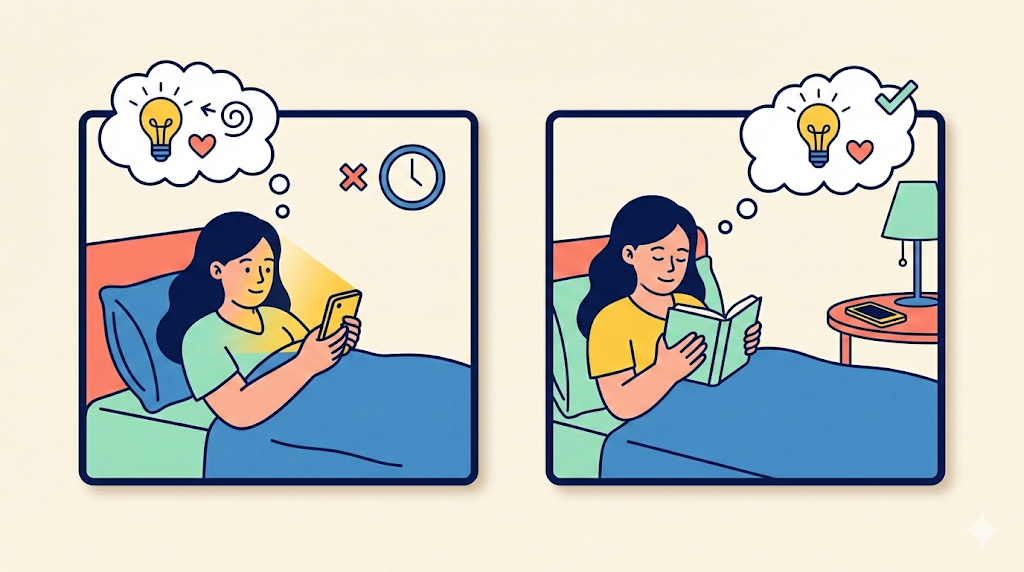
At night, Mina says she will read for ten minutes. But her phone lights up. A message. A short video. A “recommended” clip. Suddenly, it is 1 a.m.
The next day, she orders sweet drinks because they arrive fast. After work, she shops online because it feels like a small reward. Mina starts to wonder: “Is this really only my personal problem—or is my day designed to pull me?”
That question matters.
Fast rewards beat slow goals
Bad habits often win because they pay right away. The reward can be pleasure, but it can also be relief: less anxiety, less boredom, less loneliness. The long-term cost is real, but it arrives later—so the brain discounts it.
In many modern products, the reward is not only the reward itself. It is the anticipation. Your brain starts to feel good before the action, because it expects the hit of comfort. People often connect this to dopamine in a simple way: dopamine helps drive “wanting” and seeking, not just enjoying.
Environment design beats hero willpower
Stanford’s Behavior Design ideas (often linked to BJ Fogg) focus on a practical truth: behavior changes more easily when you change what is easy and what is hard.
Mina runs a one-week “cue check”:
- Time: late evening, after stressful meetings
- Place: bed, couch, subway platform
- Mood: tired, anxious, lonely
- People: certain group chats that never stop
Then she redesigns the path.
Add friction to the bad habit
- She turns off most notifications.
- She logs out of the most tempting app each night.
- She keeps snacks out of eye level.
- She removes saved credit cards from shopping apps.
Each step adds a small delay. That delay is powerful. It gives her brain time to choose.
Reduce friction for the good habit
- A book is on the pillow in the morning (not the phone).
- Fruit is washed and ready in the fridge.
- Walking shoes are by the door.
- She makes a short “after work” routine: water, shower, then dinner.
Identity grows from small wins
Many people try to change by saying, “I must be perfect.” That is a trap. A better approach is identity-based: “I’m becoming someone who protects my attention.” One small win becomes evidence. Evidence becomes belief. Belief becomes a new default.
When Mina slips, she stops saying “I’m weak.” She says, “The old path is deep because I walked it for years. Today I learned which cue was strongest.” Then she edits the environment again.
Over time, the new path becomes the easy path. That is what lasting change looks like.
Key Points
- Bad habits win because fast rewards and anticipation beat slow goals.
- “Friction design” can make bad habits harder and good habits easier.
- Small wins build identity, and relapse can be used as data.
Words to Know
anticipation /ænˌtɪsɪˈpeɪʃən/ (n) — feeling something good is coming
discount /ˈdɪskaʊnt/ (v) — treat as less important now
friction /ˈfrɪkʃən/ (n) — a small difficulty that slows an action
design /dɪˈzaɪn/ (v) — plan something on purpose
notification /ˌnoʊtɪfɪˈkeɪʃən/ (n) — a phone alert message
temptation /tempˈteɪʃən/ (n) — a strong wish to do something risky
default /dɪˈfɔːlt/ (n) — the usual choice if nothing changes
identity /aɪˈdentəti/ (n) — your sense of who you are
evidence /ˈevɪdəns/ (n) — proof that something is true
delay /dɪˈleɪ/ (n) — waiting time before action
attention /əˈtenʃən/ (n) — focus of the mind
relapse /rɪˈlæps/ (n) — returning to an old habit
cue /kjuː/ (n) — a trigger that starts a behavior
routine /ruːˈtiːn/ (n) — a repeated action pattern