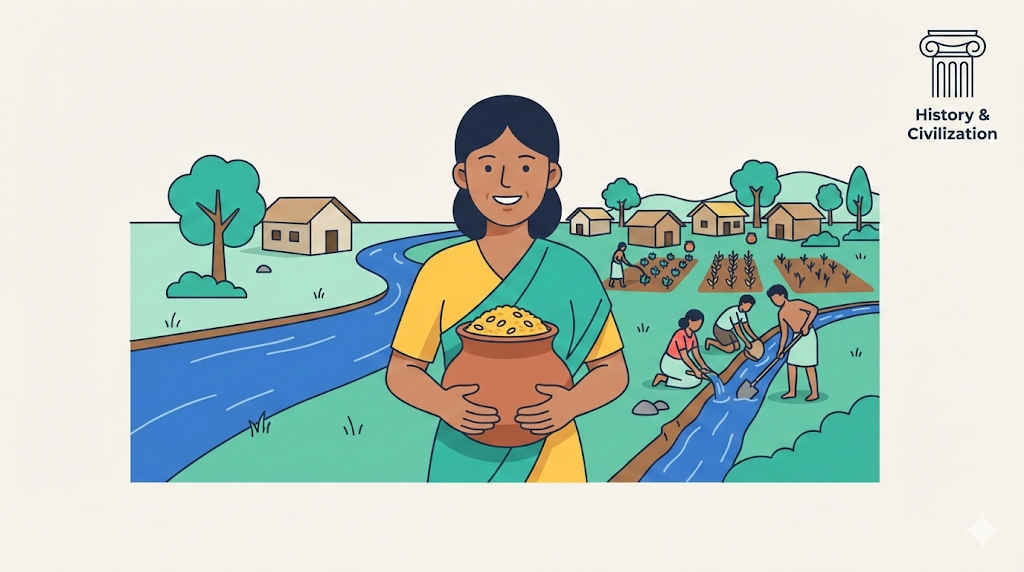
Why Agriculture Built the First Civilizations
Surplus food, stored power, and the trade-offs of settled life
The river is low this year. In a busy river-valley city, the council meets in a shaded room. A farmer speaks first. “If the water comes late,” she says, “my field fails. If my field fails, my family fails.” Outside, workers wait for orders: who will repair the canal, who will guard the storehouse, and who will receive grain if the harvest is poor?
This scene captures a deep truth: civilization is not only stone buildings. It is a system for managing food, water, people, and power.
Surplus Becomes Institutions
Agriculture can produce a surplus—more food than is needed right away. Surplus changes time. When grain can be stored, a city can plan across seasons. It can feed builders during construction. It can support scribes who keep records. It can pay soldiers who defend the walls.
Over time, “managing surplus” becomes an institution. Storage needs rules. Irrigation needs schedules. Taxes appear as a practical tool: a portion of grain is collected to fund shared work. Bureaucracy grows because someone must count, measure, and decide. In this sense, surplus does not just fill stomachs. It builds administration.
Land, Class, and the Price of Stability
Settled farming also changes who owns what. Land becomes property, and property becomes a source of status. If one group controls the best fields or the water gates, inequality can widen. Some people become owners, officials, or merchants. Others become laborers tied to land, debt, or obligation.
Health can also shift. Dense settlements bring disease risk. Close contact with domesticated animals can spread new infections. Diet can narrow when people rely heavily on one staple crop. The city may feel safer than a wandering life, yet it can be fragile. A flood, drought, or pest outbreak can cause famine.
Modern readers may recognize this “trade-off logic.” Analysts at the OECD often discuss how stable food systems support complex economies, but also how shocks—climate, conflict, supply chains—can threaten stability. The basic pattern is ancient: food security supports order, and food insecurity tests it.
Networks, Power, and Long-Term Change
Once farming towns grow, they rarely stay isolated. Surplus invites trade. Grain can be exchanged for metals, timber, salt, or cloth. Trade networks spread ideas, tools, and beliefs. They also spread rivalry. A city with full granaries can fund armies, build monuments, and claim authority.
Researchers writing in journals like Science and Nature often describe early agriculture as a turning point in human history because it reshaped landscapes and social organization for thousands of years. That long view helps us avoid a simple story of “progress.” Agriculture enabled writing, mathematics, and engineering. It also helped create war over fields, heavier labor, and deeper social hierarchy.
Back in the council room, the decision is concrete. Water will go first to the oldest canal section, because it serves the most fields. Grain will be released to families with small children. A scribe will mark each jar. These choices look ordinary, but they are the heart of civilization: turning food into coordination.
Agriculture did not automatically create the first civilizations, but it made large, settled life possible. When people could store food, they could also store power—through land, rules, and records. Civilization begins as a hope for safety, and it grows into a world of systems: helpful, impressive, and sometimes unfair.
Key Points
- Surplus food supports institutions like storage rules, taxes, and bureaucracy.
- Settled farming can increase stability, but also inequality and disease risk.
- Trade networks grow from surplus and can spread both ideas and conflict.
Words to Know
institution /ˌɪn.stɪˈtuː.ʃən/ (n) — organized system in society
bureaucracy /bjʊˈrɑː.krə.si/ (n) — administration with rules and offices
inequality /ˌɪn.ɪˈkwɑː.lə.ti/ (n) — unfair difference in wealth or power
obligation /ˌɑː.bləˈɡeɪ.ʃən/ (n) — duty you must do
hierarchy /ˈhaɪə.rɑːr.ki/ (n) — ranked levels of power
granary /ˈɡræn.ər.i/ (n) — building for storing grain
staple /ˈsteɪ.pəl/ (n) — main food eaten often
famine /ˈfæm.ɪn/ (n) — extreme hunger from food shortage
rivalry /ˈraɪ.vəl.ri/ (n) — competition between groups
coordination /koʊˌɔːr.dəˈneɪ.ʃən/ (n) — organizing people to act together
domesticate /dəˈmes.tɪ.keɪt/ (v) — raise plants/animals under human control
supply chain /səˈplaɪ tʃeɪn/ (n) — path from production to delivery
shock /ʃɑːk/ (n) — sudden damaging change
landscape /ˈlænd.skeɪp/ (n) — land and environment of a region