What Makes the Sky Blue?
Rayleigh scattering explains blue skies—and why air quality changes color.
A student named Jae takes a photo of the sky at noon. It is a clean, bold blue. Later, Jae takes another photo at sunset. Now the horizon is orange, and the blue above it looks softer. “It’s the same sky,” Jae thinks. “So why does it change so fast?”
Light meets air, and the color is “made”
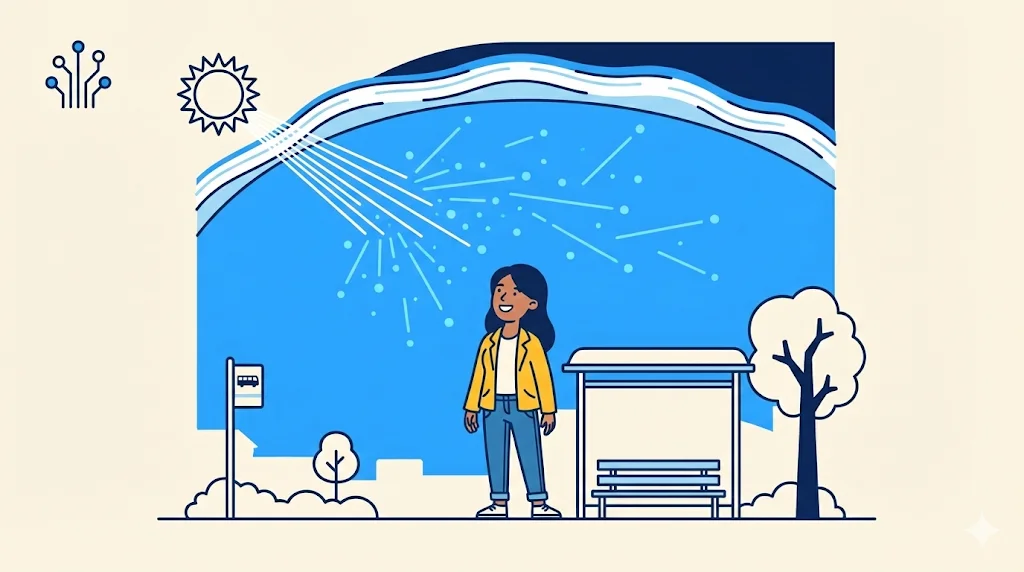
Sunlight is a mix of many colors. In physics, these colors are different wavelengths of light. When sunlight enters Earth’s atmosphere, it collides with tiny gas molecules—mostly nitrogen and oxygen. Those molecules scatter short wavelengths more strongly than long ones. This process is often called Rayleigh scattering. The key idea is simple: blue light gets spread widely, like a fine mist spreading in all directions.
Because of this spreading, your eyes receive blue light from almost every direction you look. The sky is not holding blue paint. The blue is a result of light being redirected into your line of sight.
Why blue, not violet?
Some people ask, “If short waves scatter most, why isn’t the sky violet?” Two reasons help. First, sunlight has more blue light than violet light. Second, human eyes are more sensitive to blue than to violet. So the scattered light that feels strongest to us is blue.
Sun angle, longer path, warmer sunsets
When the sun is low, sunlight travels through more atmosphere before it reaches you. More of the short blue light is scattered away from the direct path. The remaining light is richer in longer wavelengths, so reds and oranges become stronger near the horizon. Encyclopaedia Britannica explains this basic pattern as a simple interaction between light, air, and distance.
Clouds, aerosols, and a changing sky
Clouds are different because water droplets are much larger than gas molecules. They scatter many wavelengths more evenly, so clouds look white, or gray when light is weak. Aerosols—tiny particles like dust, pollution, or wildfire smoke—can also change what you see. They can make the daytime sky look milky, and they can make sunsets look unusually intense. NASA and weather agencies track aerosols with satellites because they affect visibility, weather, and climate.
Seeing is receiving
It also helps to remember what “seeing” really is. Your eyes do not send a signal out to the sky. They receive light that enters the eye. So when you look up, you are collecting scattered light that the air has redirected toward you. In a sense, the atmosphere is acting like a giant light diffuser.
Why photos can look different
Jae notices that one phone photo looks more turquoise than real life. Cameras and screens make choices too. The camera adjusts exposure and “white balance,” and the screen shows its own colors. That is why two people can share sunset photos that look slightly different.
Technology makes the sky easier to study, but it also reminds us to be careful. On one hand, satellites and air-quality sensors can warn people about smoke and pollution, helping health and safety. On the other hand, pollution that makes sunsets beautiful is still pollution. The same particles that scatter light can also harm lungs and warm the climate.
Jae puts the phone away and watches the real sunset. The science does not remove the beauty. It makes the beauty feel even more real.
Key Points
- Rayleigh scattering spreads short blue wavelengths across the sky.
- Sunsets turn warm because the sun’s light travels through more air.
- Aerosols (dust, smoke, pollution) can change sky colors and visibility.
Words to Know
physics /ˈfɪzɪks/ (n) — the science of matter and energy
nitrogen /ˈnaɪtrədʒən/ (n) — a main gas in Earth’s air
oxygen /ˈɑːksɪdʒən/ (n) — a gas we breathe, also in air
collide /kəˈlaɪd/ (v) — to hit something
redirect /ˌriːdəˈrɛkt/ (v) — to send in a new direction
sensitive /ˈsɛnsətɪv/ (adj) — able to notice small changes
diffuser /dɪˈfjuːzər/ (n) — something that spreads light
exposure /ɪkˈspoʊʒər/ (n) — how bright a photo is set to be
white balance /waɪt ˈbælենս/ (n) — camera setting for “true” whites
satellite /ˈsætəˌlaɪt/ (n) — an object that orbits Earth
climate /ˈklaɪmət/ (n) — long-term weather patterns
aerosols /ˈerəˌsɔːlz/ (n) — tiny particles floating in air
turquoise /ˈtɝːkwɔɪz/ (adj) — blue-green color
misconception /ˌmɪskənˈsɛpʃən/ (n) — a wrong idea people believe