Wisdom English Learn about the world. Grow your English.
Science, Tech & Future

What Makes the Sky Blue

A1 A2 B1 B2

On a clear day, the sky feels like it has its own color. But blue comes from sunlight meeting air, spreading short light waves across the whole sky.

A1 Level

Sunlight and air make the blue color we see.

What Makes the Sky Blue?

Sunlight and air make the blue color we see.

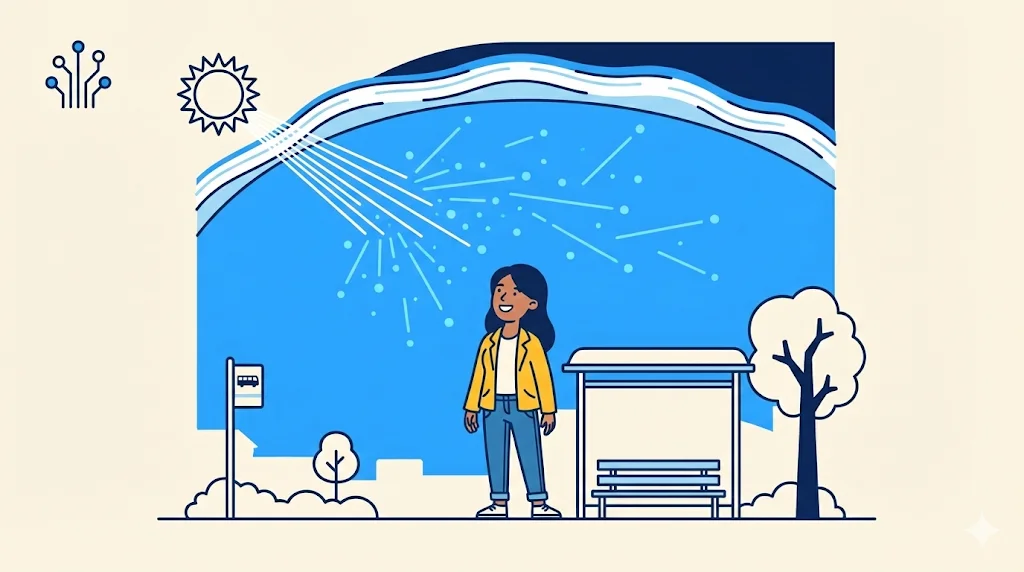
Mina waits at a morning bus stop. The air feels cool. She looks up and smiles. The sky is a deep blue today. Mina lifts her hand to cover her eyes. She looks again. “Why is it blue?” she asks.

A friend stands next to her. He points to the bright sun. “Sunlight looks white,” he says. “But it has many colors inside.”

Then he talks about the air. Earth has air all around us. The air is made of tiny pieces. They are too small to see. When sunlight goes into the air, the air spreads some light. It spreads blue light more than red light. So blue light goes in many directions.

That is why Mina can see blue from everywhere. She is not only looking at the sun. She is looking at blue light that comes from the whole sky.

Later, Mina remembers another time. At sunset, the sky looks orange and red. Her friend says, “At sunset, sunlight travels through more air. The blue light spreads away. More red and orange light reaches your eyes.”

Mina smiles again. The sky is not painted blue. It is light and air working together.

On some days, clouds cover the sun. Then the sky looks white or gray. But on a clear day, the blue can shine strongly.


Key Points

  • Sunlight has many colors inside it.
  • Air spreads blue light in many directions, so we see a blue sky.

Words to Know

sky /skaɪ/ (n) — the space above you
sunlight /ˈsʌnlaɪt/ (n) — light from the sun
air /ɛr/ (n) — the gas around Earth
color /ˈkʌlər/ (n) — what we see as red, blue, etc.
blue /bluː/ (adj) — the color of a clear daytime sky
spread /sprɛd/ (v) — to move out in many directions
travel /ˈtrævəl/ (v) — to move from one place to another
sunset /ˈsʌnˌsɛt/ (n) — the time when the sun goes down


📝 Practice Questions

A1 – True/False

  1. Sunlight looks white but has many colors inside.
  2. Air spreads blue light more than red light.
  3. At sunset, more blue light reaches your eyes than red light.

A1 – Multiple Choice

  1. Why does the sky look blue?
    A. Air spreads blue light in many directions
    B. The sky is painted blue
    C. The sun is blue

  2. What happens at sunset?
    A. Sunlight travels through more air
    B. The air disappears
    C. The sun gets closer to Earth

  3. On cloudy days, the sky often looks ____.
    A. blue and bright
    B. white or gray
    C. green and purple

A1 – Short Answer

  1. What color is the daytime sky?
  2. What spreads blue light?
  3. When is the sky orange and red?

A1 – True/False

  1. True
  2. True
  3. False

A1 – Multiple Choice

  1. A
  2. A
  3. B

A1 – Short Answer

  1. Blue
  2. Air
  3. At sunset
A2 Level

The sky’s color comes from sunlight moving through air.

What Makes the Sky Blue?

The sky’s color comes from sunlight moving through air.

Ken and Aisha walk outside during lunch. The sky is bright and clean. Ken looks up and laughs. “It looks like someone painted the sky blue,” he says.

Aisha shakes her head. “It is not paint,” she says. “It is sunlight and air.”

Sunlight has many colors

Sunlight looks white, but it is made of many colors. You can see this with a rainbow after rain. When sunlight enters Earth’s air, it meets tiny gas molecules. These molecules are very small, but they can still spread light.

Air spreads blue light

Aisha picks up a clear water bottle. “Imagine light like tiny waves,” she says. “Some waves are short. Some are long.” Short waves (blue) spread more easily in the air than long waves (red). So blue light is scattered into many directions. Your eyes receive that scattered blue light from the whole sky.

Ken tries a small demo idea. He shines his phone flashlight through a cup of water with a drop of milk. The light looks a little bluish from the side. Aisha smiles. “It is not perfect, but it helps you imagine scattering.”

Why sunsets look orange

Aisha points to the far horizon. “At sunset, sunlight travels through more air,” she says. “More blue light is scattered away before it reaches you. So you get more red and orange light.”

NASA Space Place explains this idea in simple words for young learners too. Ken nods. “So the sky changes color because the path of light changes,” he says.

Sometimes the sky looks pale, not deep blue. That can happen when there is dust, smoke, or pollution in the air. These extra tiny pieces can scatter light in different ways. They can also make sunsets look stronger and more dramatic.

Ken looks up one more time. “The sky is like a big screen,” he says. “But the real show is light traveling through air.”


Key Points

  • Sunlight looks white, but it contains many colors.
  • Air molecules scatter blue light strongly, so the sky looks blue.
  • At sunset, light travels farther in air, so warm colors are stronger.

Words to Know

molecule /ˈmɑːlɪˌkjuːl/ (n) — a very tiny piece of matter
scatter /ˈskætər/ (v) — to send in many directions
wave /weɪv/ (n) — a moving shape, like in water or light
short /ʃɔːrt/ (adj) — not long
long /lɔːŋ/ (adj) — not short
horizon /həˈraɪzən/ (n) — the line where sky meets land or sea
dust /dʌst/ (n) — very small dry pieces in the air
smoke /smoʊk/ (n) — gray air from fire
pollution /pəˈluːʃən/ (n) — dirty air from human activity


📝 Practice Questions

A2 – True/False

  1. Blue light has shorter waves than red light.
  2. Scattered blue light comes from many parts of the sky.
  3. Dust and smoke can never change sky colors.

A2 – Multiple Choice

  1. What is sunlight made of?
    A. many colors
    B. only blue
    C. only red

  2. Why do sunsets look orange?
    A. Blue light is scattered away on a longer path
    B. The sun changes its color
    C. The clouds turn into fire

  3. What can make the sky look pale?
    A. dust or pollution
    B. more rainbows
    C. colder oceans

A2 – Short Answer

  1. What happens to blue light in air?
  2. Give one time you see warm sky colors.
  3. Name one thing that can change sky colors.

A2 – True/False

  1. True
  2. True
  3. False

A2 – Multiple Choice

  1. A
  2. A
  3. A

A2 – Short Answer

  1. It is scattered (spread) in many directions.
  2. At sunrise or at sunset.
  3. Dust, smoke, or pollution.
B1 Level

The sky’s blue is a message from light traveling through air.

What Makes the Sky Blue?

The sky’s blue is a message from light traveling through air.

A traveler arrives in a small mountain town in the morning. The air feels crisp. The sky above the peaks is a strong, deep blue. A week later, the same traveler stands in a big city. The sky is lighter, almost white. “Is the sky different here?” the traveler wonders.

White light, many colors

Sunlight may look white, but it contains many colors. If you split light with a prism, you can see a color band, like a rainbow. This matters because the sky’s color is not stored in the sky. It is created when sunlight meets the atmosphere.

Why blue spreads more

Earth’s air is made of tiny gas molecules. When sunlight enters the air, these molecules scatter light—meaning they send it in many directions. Shorter waves scatter more than longer waves. Blue light has a shorter wavelength than red light, so it is scattered more strongly. That scattered blue light reaches your eyes from many parts of the sky, so the whole sky looks blue.

NASA Space Place uses this idea to explain “Rayleigh scattering” in a friendly way for general readers. You do not need math to understand the main point: small molecules spread short blue light very well.

Why sunsets turn warm

At sunrise and sunset, the sun is low. Sunlight travels through more air before it reaches you. Along the way, much of the blue light is scattered out of the direct path. The light that keeps going is richer in reds and oranges, so the horizon can glow. Weather services often describe how haze, humidity, or dust can make these colors stronger on some evenings.

Clouds and city haze

Clouds look white or gray because water droplets are much bigger than gas molecules. They scatter many colors more evenly, so the light becomes “mixed” again. In cities, dust and smoke add extra scattering. This can wash out the deep blue at midday and change how sunsets look.

That afternoon, the traveler checks a weather app and sees a note about air quality. On days with wildfire smoke or heavy pollution, the sun may look softer and more orange even before sunset. The National Weather Service and other agencies often share alerts when smoke or dust is moving through a region.

Next time you are outside, try a small comparison. Look at the sky at noon, then again near sunset. If the day is clear, the blue may feel “deeper.” If the air is hazy, the blue may fade. The same sun is shining, but the air is telling a different story.

The traveler smiles, realizing something simple: when air changes, what we see above us can change too.


Key Points

  • Blue light scatters more because it has a shorter wavelength.
  • Sunsets look warm because sunlight travels through more air.
  • Dust, smoke, and clouds change how strongly we see sky colors.

Words to Know

atmosphere /ˈætməˌsfɪr/ (n) — the air around Earth
wavelength /ˈweɪvˌlɛŋθ/ (n) — the length of a light wave
Rayleigh /ˈreɪli/ (adj) — relating to scattering by small molecules
prism /ˈprɪzəm/ (n) — glass that splits light into colors
direct /dəˈrɛkt/ (adj) — straight, not bent
humidity /hjuːˈmɪdəti/ (n) — water in the air
haze /heɪz/ (n) — light mist or dirty air that reduces clarity
droplet /ˈdrɑːplət/ (n) — a very small drop of liquid
visibility /ˌvɪzəˈbɪləti/ (n) — how well you can see far away
aerosol /ˈerəˌsɔːl/ (n) — tiny particles floating in air
alert /əˈlɝːt/ (n) — a warning message


📝 Practice Questions

B1 – True/False

  1. Blue light scatters more because it has a shorter wavelength.
  2. Clouds look white because droplets scatter many colors more evenly.
  3. City air always makes the sky darker blue.

B1 – Multiple Choice

  1. What is the main reason the whole sky looks blue?
    A. Scattered blue light reaches your eyes from many directions
    B. Oceans reflect blue light upward
    C. The sun sends only blue light

  2. Why can haze change sunsets?
    A. It adds extra scattering in the air
    B. It turns off the sun
    C. It removes all clouds

  3. Which is most likely in very clean air?
    A. a deeper blue midday sky
    B. a green midday sky
    C. a black midday sky

B1 – Short Answer

  1. Explain in one sentence why sunsets turn red-orange.
  2. What is one difference between clouds and gas molecules?
  3. How can air quality affect what you see in the sky?

B1 – True/False

  1. True
  2. True
  3. False

B1 – Multiple Choice

  1. A
  2. A
  3. A

B1 – Short Answer

  1. Light travels through more air, so blue scatters away and reds remain.
  2. Droplets are much bigger than gas molecules.
  3. Haze or smoke can wash out blue and strengthen warm sunsets.
B2 Level

Rayleigh scattering explains blue skies—and why air quality changes color.

What Makes the Sky Blue?

Rayleigh scattering explains blue skies—and why air quality changes color.

A student named Jae takes a photo of the sky at noon. It is a clean, bold blue. Later, Jae takes another photo at sunset. Now the horizon is orange, and the blue above it looks softer. “It’s the same sky,” Jae thinks. “So why does it change so fast?”

Light meets air, and the color is “made”

Sunlight is a mix of many colors. In physics, these colors are different wavelengths of light. When sunlight enters Earth’s atmosphere, it collides with tiny gas molecules—mostly nitrogen and oxygen. Those molecules scatter short wavelengths more strongly than long ones. This process is often called Rayleigh scattering. The key idea is simple: blue light gets spread widely, like a fine mist spreading in all directions.

Because of this spreading, your eyes receive blue light from almost every direction you look. The sky is not holding blue paint. The blue is a result of light being redirected into your line of sight.

Why blue, not violet?

Some people ask, “If short waves scatter most, why isn’t the sky violet?” Two reasons help. First, sunlight has more blue light than violet light. Second, human eyes are more sensitive to blue than to violet. So the scattered light that feels strongest to us is blue.

Sun angle, longer path, warmer sunsets

When the sun is low, sunlight travels through more atmosphere before it reaches you. More of the short blue light is scattered away from the direct path. The remaining light is richer in longer wavelengths, so reds and oranges become stronger near the horizon. Encyclopaedia Britannica explains this basic pattern as a simple interaction between light, air, and distance.

Clouds, aerosols, and a changing sky

Clouds are different because water droplets are much larger than gas molecules. They scatter many wavelengths more evenly, so clouds look white, or gray when light is weak. Aerosols—tiny particles like dust, pollution, or wildfire smoke—can also change what you see. They can make the daytime sky look milky, and they can make sunsets look unusually intense. NASA and weather agencies track aerosols with satellites because they affect visibility, weather, and climate.

Seeing is receiving

It also helps to remember what “seeing” really is. Your eyes do not send a signal out to the sky. They receive light that enters the eye. So when you look up, you are collecting scattered light that the air has redirected toward you. In a sense, the atmosphere is acting like a giant light diffuser.

Why photos can look different

Jae notices that one phone photo looks more turquoise than real life. Cameras and screens make choices too. The camera adjusts exposure and “white balance,” and the screen shows its own colors. That is why two people can share sunset photos that look slightly different.

Technology makes the sky easier to study, but it also reminds us to be careful. On one hand, satellites and air-quality sensors can warn people about smoke and pollution, helping health and safety. On the other hand, pollution that makes sunsets beautiful is still pollution. The same particles that scatter light can also harm lungs and warm the climate.

Jae puts the phone away and watches the real sunset. The science does not remove the beauty. It makes the beauty feel even more real.


Key Points

  • Rayleigh scattering spreads short blue wavelengths across the sky.
  • Sunsets turn warm because the sun’s light travels through more air.
  • Aerosols (dust, smoke, pollution) can change sky colors and visibility.

Words to Know

physics /ˈfɪzɪks/ (n) — the science of matter and energy
nitrogen /ˈnaɪtrədʒən/ (n) — a main gas in Earth’s air
oxygen /ˈɑːksɪdʒən/ (n) — a gas we breathe, also in air
collide /kəˈlaɪd/ (v) — to hit something
redirect /ˌriːdəˈrɛkt/ (v) — to send in a new direction
sensitive /ˈsɛnsətɪv/ (adj) — able to notice small changes
diffuser /dɪˈfjuːzər/ (n) — something that spreads light
exposure /ɪkˈspoʊʒər/ (n) — how bright a photo is set to be
white balance /waɪt ˈbælենս/ (n) — camera setting for “true” whites
satellite /ˈsætəˌlaɪt/ (n) — an object that orbits Earth
climate /ˈklaɪmət/ (n) — long-term weather patterns
aerosols /ˈerəˌsɔːlz/ (n) — tiny particles floating in air
turquoise /ˈtɝːkwɔɪz/ (adj) — blue-green color
misconception /ˌmɪskənˈsɛpʃən/ (n) — a wrong idea people believe

📝 Practice Questions

B2 – True/False

  1. Rayleigh scattering happens mainly because tiny gas molecules scatter short wavelengths.
  2. The sky looks violet because humans are most sensitive to violet light.
  3. Satellites can help track aerosols like smoke and dust.

B2 – Multiple Choice

  1. Why is the sky blue instead of violet?
    A. We receive more blue light, and our eyes notice blue more strongly
    B. Violet light cannot travel in air
    C. Only blue light exists in sunlight

  2. What best describes “seeing” the sky’s color?
    A. Your eyes receive redirected light from the atmosphere
    B. Your eyes send light into the sky
    C. Your brain paints color without light

  3. What is one real risk linked to aerosols?
    A. They can harm lungs and affect climate
    B. They make all clouds disappear
    C. They stop sunlight completely

B2 – Short Answer

  1. Explain Rayleigh scattering in 10–20 words.
  2. Why can two sunset photos look different on two phones?
  3. Give one benefit and one problem of aerosols in the sky.

B2 – True/False

  1. True
  2. False
  3. True

B2 – Multiple Choice

  1. A
  2. A
  3. A

B2 – Short Answer

  1. Tiny air molecules spread short blue wavelengths in many directions across the sky.
  2. Cameras and screens change exposure and white balance, so colors can shift.
  3. Benefit: warnings and tracking; Problem: health harm and climate warming.