Decision Fatigue: The Quiet Force Behind Bad Choices (B2)
When your day is full of choices, your “decision budget” can run low.
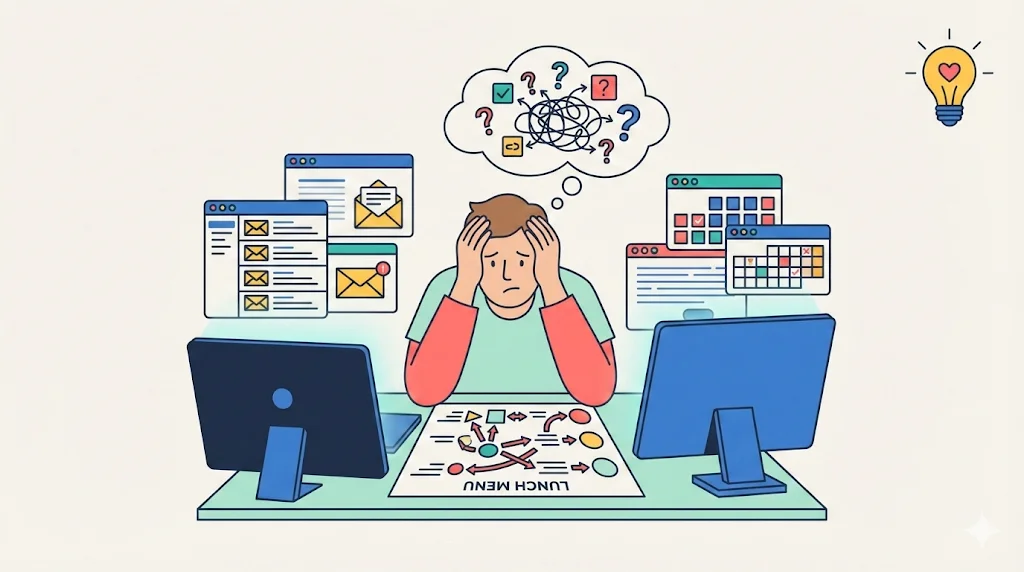
Alex has not had a dramatic crisis. His day is normal—just crowded. Messages, meetings, small requests, quick approvals, tiny edits. Each one is a decision. By lunchtime, he opens a menu and feels a surprising wave of stress. He is not choosing a life path. He is choosing a sandwich. So why does it feel so hard?
What decision fatigue really is
Decision fatigue is a mental slowdown after many choices without real recovery. Think of it like a daily “decision budget.” When you spend it all morning, you may have less patience and less mental space later.
In real life, decision fatigue often looks like:
- Heavy small choices: even simple decisions feel unusually hard.
- Avoidance and delay: you push decisions away because your brain wants relief.
- The easiest exit: you choose the fastest option, not the best one, just to close the task.
This can happen to anyone, especially when life is noisy, digital, and full of options.
Why it matters across your whole life
Decision fatigue matters because tired decision-making does not stay in one area. It spreads.
- Work: Late in the day, you may accept unclear tasks, answer too quickly, or stop checking details. You may also avoid a choice that needs courage—like giving feedback or setting a boundary—because it feels like “too much.”
- Money: A tired mind can prefer short-term comfort: quick purchases, skipping price checks, or forgetting a plan you made when you were calm.
- Health habits: When you are drained, cooking, exercise, and sleep routines can feel like extra decisions. It becomes easier to pick sugary snacks, stay up scrolling, or skip movement.
- Relationships: Decision fatigue can reduce emotional skill. You may choose silence instead of a gentle talk, or choose sharp words instead of clear ones—especially at night.
Notice the pattern: the problem is not intelligence. It is timing and energy.
Practical ways to reduce it (without “one perfect hack”)
The goal is not to control every moment. The goal is to protect energy for the decisions that matter.
-
Limit unnecessary options.
Fewer tabs. Fewer apps. Fewer “maybe” plans. Even small reductions lower the daily load.
-
Decide important things earlier.
Put key choices in your “fresh hours”: planning, budgeting, hard conversations, and complex work.
-
Use routines and defaults.
Create “automatic answers” for repeated decisions: a weekday breakfast, a simple lunch list, a standard workout time, a checklist for common work tasks. Defaults are not boring—they are protection.
-
Build short recovery breaks.
Real recovery is small but consistent: a 3-minute walk, water, stretching, slow breathing, or quiet time between meetings. These breaks reset attention.
A warm truth: decision fatigue is normal. When you design your day with fewer choices and better timing, you do not just feel calmer—you make room for wiser decisions.
Key Points
- Decision fatigue can look like heavy small choices, delays, or choosing the easiest exit.
- It matters because tired decisions can lower quality in work, money, health, and relationships.
- Reduce it by limiting options, deciding early, using routines/defaults, and taking short recovery breaks.
Words to Know
decision budget /dɪˈsɪʒən ˈbʌdʒ.ɪt/ (n) — your daily limit for good decisions
fatigue /fəˈtiːɡ/ (n) — tiredness after effort
overload /ˈoʊ.vɚ.loʊd/ (n) — too much to handle
avoidance /əˈvɔɪ.dəns/ (n) — staying away from a hard choice
impulsive /ɪmˈpʌl.sɪv/ (adj) — fast and not well planned
boundary /ˈbaʊn.dɚ.i/ (n) — a clear limit you set with others
short-term /ˌʃɔːrtˈtɝːm/ (adj) — happening soon, not later
default /dɪˈfɔːlt/ (n) — the standard choice
routine /ruːˈtiːn/ (n) — a repeated daily plan
recovery /rɪˈkʌv.ɚ.i/ (n) — getting energy back
reset /riːˈset/ (v) — to return to a better state
priority /praɪˈɔːr.ə.t̬i/ (n) — what matters most
clarity /ˈkler.ə.t̬i/ (n) — clearness and understanding