Heat and Temperature: The Difference Your Skin Can’t See
Why “feels hotter” is not always “is hotter”
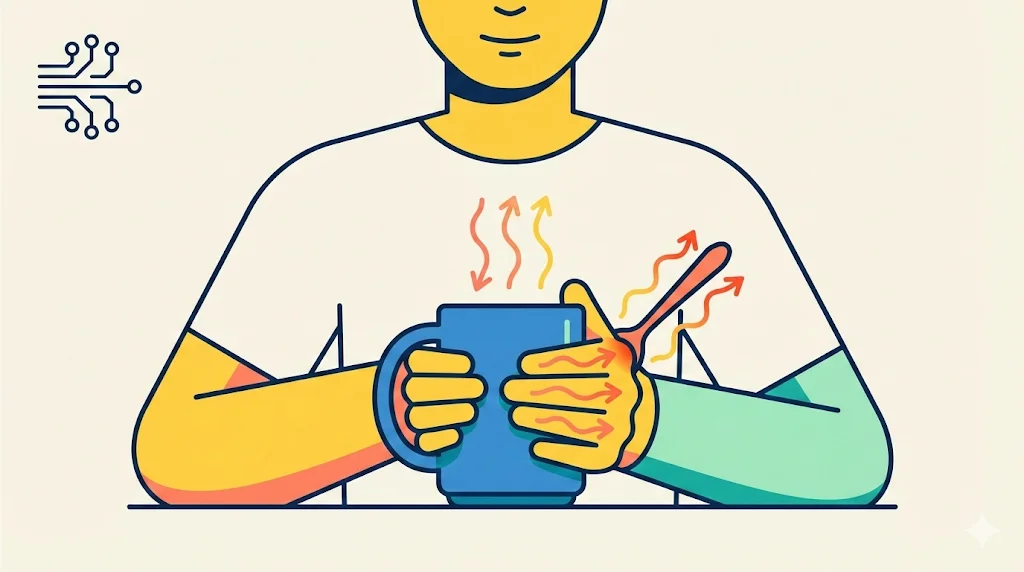
Alex sits at a kitchen table with a warm mug of tea. A metal spoon rests beside it.
Out of curiosity, Alex touches both. The mug feels gently warm. The spoon feels intense—almost “hot.”
Alex pulls back and laughs: “How can they feel so different?”
That small moment reveals a common confusion: we often use heat and temperature as the same word, but they are not the same idea.
Temperature is a state you can describe
Temperature measures how hot or cold something is at a given time.
It describes the object’s condition—like saying, “This mug is warm.”
Temperature is not a movement. It is not traveling from place to place.
It is simply a way to describe “how hot” something is right now.
Heat is energy in transfer
Heat is energy moving because there is a temperature difference.
When two things touch, energy can flow from the warmer one to the cooler one.
That flow is heat.
This is why your hand matters in the story. Your skin has its own temperature.
If the spoon is cooler than your skin, heat flows from your hand into the spoon.
If the spoon is warmer than your skin, heat flows from the spoon into your hand.
Either way, your brain is noticing the flow of energy, not just the number we call temperature.
The same heat does not change everything equally
Here is the deeper idea: even if the same amount of heat energy is involved, different materials can change temperature by different amounts.
Some materials absorb energy in a way that makes their temperature rise quickly.
Others can absorb a lot of energy with a smaller temperature change.
Also, the size and thickness of an object matters. A small spoon can change temperature faster than a large mug with liquid inside.
On top of that, some materials move energy through themselves quickly.
Metal often passes energy fast, so your skin can warm up or cool down quickly at the contact point.
That quick change can feel “strong,” even if the spoon and mug are at similar temperatures.
So what was “actually hotter”?
The best answer is: your feeling alone cannot prove it.
To know temperature, you need a measurement.
But your hand is still giving you useful information: it is sensing how quickly heat is flowing.
Alex finishes the tea with a new habit of mind:
Use temperature for “how hot.” Use heat for “energy moving.”
And when two objects feel different, remember to ask: “Is the temperature different—or is the heat flow different?”
Key Points
- Temperature measures hot/cold; it is a state of a thing, not a movement.
- Heat is energy in transfer, moving from warmer to cooler objects.
- The same heat can change different materials by different amounts because they absorb energy differently.
Words to Know
curiosity /ˌkjʊriˈɑːsəti/ (n) — a strong wish to know
intense /ɪnˈtɛns/ (adj) — very strong
confusion /kənˈfjuːʒən/ (n) — not understanding clearly
describe /dɪˈskraɪb/ (v) — explain what something is like
measure /ˈmɛʒər/ (v) — find the amount or level of something
given /ˈɡɪvən/ (adj) — fixed; specific
difference /ˈdɪfərəns/ (n) — how things are not the same
flow /floʊ/ (n) — movement from one place to another
involved /ɪnˈvɑːlvd/ (adj) — part of a situation
absorb /əbˈzɔːrb/ (v) — take in
thickness /ˈθɪknəs/ (n) — how thick something is
contact /ˈkɑːntækt/ (n) — touch between things
prove /pruːv/ (v) — show something is true
measurement /ˈmɛʒərmənt/ (n) — the act of measuring