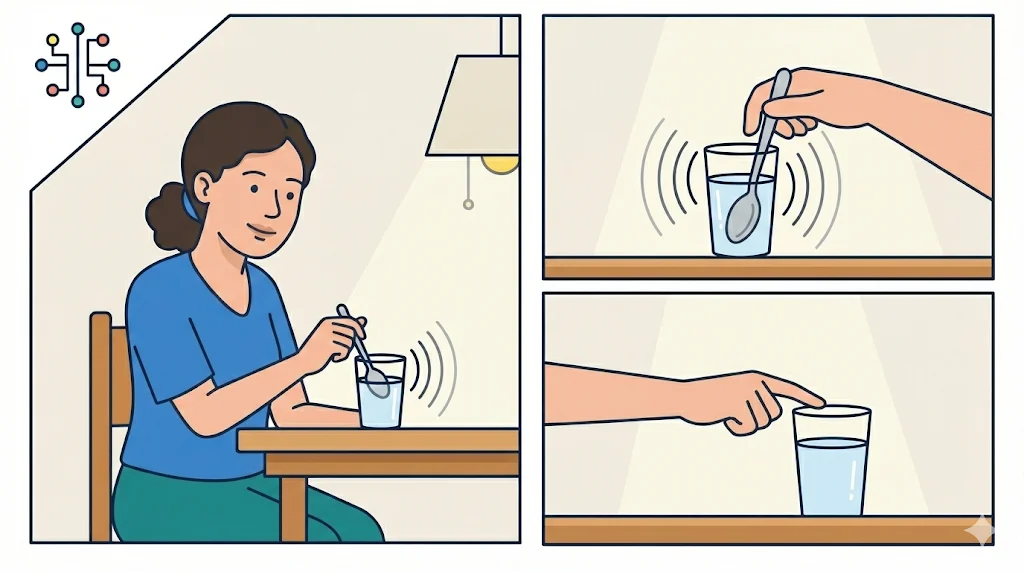
The Same Song, Three Different Worlds
Sound is physics in the air—music is meaning in people.
Ana records a short song on her phone. At home, she listens with earbuds. The sound feels close, like it is “inside” her head. In a car, the bass grows heavy and warm. Later, on a small speaker in a busy room, the song becomes thin. It is the same file, but it feels like three different songs.
Why?
Waves in a medium, shaped by space
Sound is energy moving as a wave through a medium—air, water, or solid materials. But real spaces change waves. Walls reflect them. Soft curtains absorb them. Big rooms can create echo. Even crowds matter: human bodies absorb sound too. This is why a concert hall and a subway station feel so different, even with the same music.
Microphones and speakers: changing form, not meaning
Technology adds another layer. A microphone turns air vibration into an electrical signal. A speaker turns that signal back into vibration. Each device has limits. Some speakers push low sounds strongly. Others make high sounds clearer. This is one reason recordings are “mixed” and “mastered”—engineers try to make music sound good across many listening places.
Researchers publish this kind of work in acoustics and hearing science, and major journals like Science and Nature often cover related discoveries about perception and the brain.
Hearing limits, noise, and health
Human hearing is powerful, but not endless. Very loud sound can damage hearing over time. The World Health Organization (WHO) warns about listening too loudly for too long, especially with headphones. In modern cities, noise is also a daily health topic: traffic, construction, and crowded public spaces can keep the body in a stressed state.
Why rhythm feels so strong across cultures
Across the world, rhythm shows up everywhere: drums at festivals, clapping in sports stadiums, work songs, dance music, prayer chanting, lullabies. Rhythm is simple physics (repeated timing), but it becomes social glue. When people move together, they often feel together.
Sound is invisible, but it touches us every day. It can warn us, calm us, and connect us through music. The science is simple—vibration and waves—but the human meaning is huge. In a noisy world, wisdom may be learning when to turn sound up for joy, and when to turn it down for health.
Key Points
- Spaces and materials shape sound by reflecting and absorbing waves.
- Microphones and speakers convert vibration to signals and back, with limits.
- Noise and hearing health matter, and rhythm connects people across cultures.
Words to Know
medium /ˈmiːdiəm/ (n) — material sound travels through
reflect /rɪˈflɛkt/ (v) — to bounce back from a surface
absorb /əbˈzɔːrb/ (v) — to take in energy and reduce it
echo /ˈekoʊ/ (n) — repeated sound from reflection
microphone /ˈmaɪkrəfoʊn/ (n) — tool that turns sound into a signal
speaker /ˈspiːkər/ (n) — tool that turns a signal into sound
signal /ˈsɪɡnəl/ (n) — carried message (often electrical)
mix /mɪks/ (v) — to balance sounds in a recording
noise /nɔɪz/ (n) — unwanted or stressful sound
perception /pərˈsɛpʃən/ (n) — how the brain understands what we sense
hearing /ˈhɪrɪŋ/ (n) — the ability to detect sound
protect /prəˈtɛkt/ (v) — to keep safe from harm
culture /ˈkʌltʃər/ (n) — shared life and traditions
pattern /ˈpætərn/ (n) — repeated shape or order