Wilma Rudolph: Greatness Built in Private
How healing, structure, and opportunity create champions
A finish line built from tiny steps
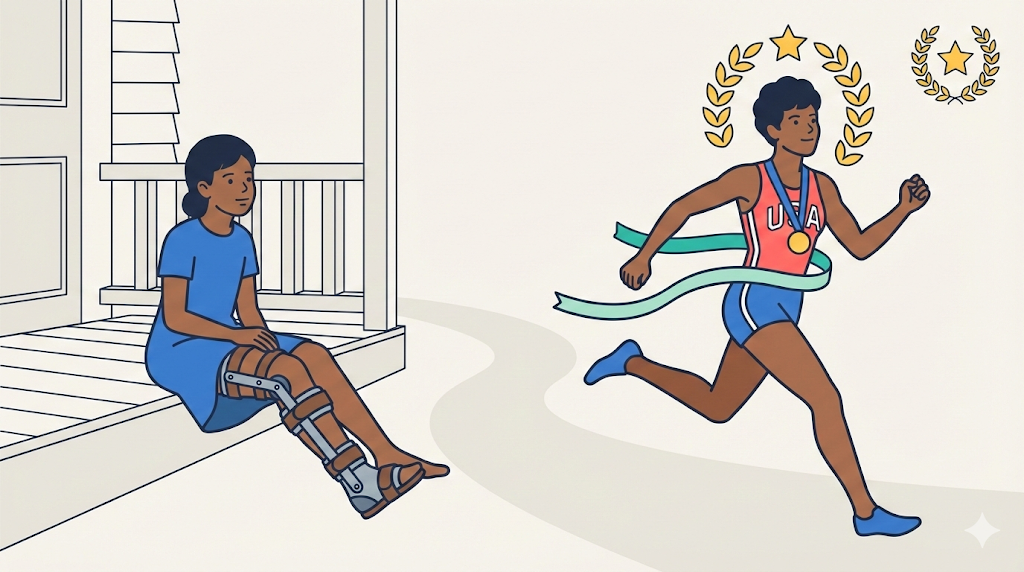
The stadium noise at the 1960 Rome Olympics was sharp and bright—like sunlight on metal. Wilma Rudolph walked to her lane with calm shoulders, but her past walked with her too. Long before the cameras, there was a porch in Tennessee, a stiff leg brace, and a child learning how to trust one step.
The hidden years: recovery before victory
Rudolph’s childhood illness left her with serious movement limits. To many people, that sounded like a final label. Yet recovery is not only “getting better.” It is learning again. Physical therapy uses repetition to rebuild strength, balance, and coordination. You do the same safe movement until the body makes it smoother and more natural. It can feel boring, even humiliating, because progress is small and slow.
In Rudolph’s case, progress also needed people. Family members helped with daily care. Clinics and therapists supported her rehabilitation. When the brace finally came off, her body had a new foundation: patience, routine, and the belief that effort was worth something even when no one was watching.
Speed is engineered, not wished for
Sprinting looks like pure talent, but it is also design. A sprinter trains the start, the first steps, the arm swing, the rhythm of the stride, and recovery between hard sessions. Small changes matter. A relaxed face can mean a relaxed shoulder. A better start can win a race in the first seconds.
Rudolph trained within a strong system, including Coach Ed Temple at Tennessee State University. That kind of coaching is not just “motivation.” It is feedback and structure: drills, meets, rest days, and a steady belief that the athlete can handle more than she thinks. The result is confidence that comes from evidence—hours of practice—not from positive words alone.
Opportunity shapes who gets to become great
It is tempting to tell her story as a simple message: “Try hard and you will win.” But the deeper lesson is about access. Not every child has the same chances to heal, train, and compete. Health outcomes improve with basic support—family help, medical care, safe places to move, and adults who notice potential. When these supports exist, “talent” has room to grow.
That is why Rudolph’s Olympic moment mattered culturally. In 1960 America, women’s sports had fewer doors, and Black athletes faced heavy discrimination. Her three gold medals did not erase inequality, but they widened imagination. Millions of viewers saw a Black woman athlete not as a side story, but as the main event. The International Olympic Committee (IOC) preserves her results in Olympic history, and institutions like the Smithsonian highlight her legacy in the story of American sport.
Rudolph later used her public voice to encourage young people, especially girls, to enter sports and education. In a way, she turned her personal recovery into social permission: “Yes, you can belong here.”
Her life challenges the myth that champions are simply born. Her speed was real, but so was the slow work: healing, repetition, coaching, and courage when progress looked almost invisible. The most human truth in her story is not “be strong alone,” but “build strength with time, help, and practice.”
Key Points
- Recovery is built through repetition, time, and human support.
- Sprint speed is shaped by structure: technique, feedback, and rest.
- Opportunity and access help decide who gets to become “great.”
Words to Know
access /ˈæk.ses/ (n) — the chance to use or reach something
inequality /ˌɪn.ɪˈkwɑː.lə.t̬i/ (n) — unfair difference in chances or treatment
representation /ˌrep.rɪ.zenˈteɪ.ʃən/ (n) — being seen and included publicly
structure /ˈstrʌk.tʃɚ/ (n) — an organized system or plan
evidence /ˈev.ə.dəns/ (n) — proof or clear signs
resilience /rɪˈzɪl.jəns/ (n) — the ability to recover and continue
rehabilitation /ˌriː.həˌbɪl.ɪˈteɪ.ʃən/ (n) — rebuilding ability after injury/illness
rhythm /ˈrɪð.əm/ (n) — a steady pattern of movement
discrimination /dɪˌskrɪm.əˈneɪ.ʃən/ (n) — unfair treatment of people
foundation /faʊnˈdeɪ.ʃən/ (n) — a strong base to build on
myth /mɪθ/ (n) — a story people believe too simply
visible /ˈvɪz.ə.bəl/ (adj) — able to be seen
permission /pɚˈmɪʃ.ən/ (n) — being allowed to do something
humiliate /hjuːˈmɪl.i.eɪt/ (v) — to make someone feel ashamed