Wisdom English Learn about the world. Grow your English.
Great Lives

How Wilma Rudolph Ran Past Illness to Olympic Gold

A1 A2 B1 B2

Wilma Rudolph began with illness and a leg brace, then rebuilt strength through therapy and training. Her three gold medals in Rome became a symbol of patience, support, and earned confidence.

A1 Level

From a leg brace to Olympic gold

Wilma Rudolph and One More Step

From a leg brace to Olympic gold

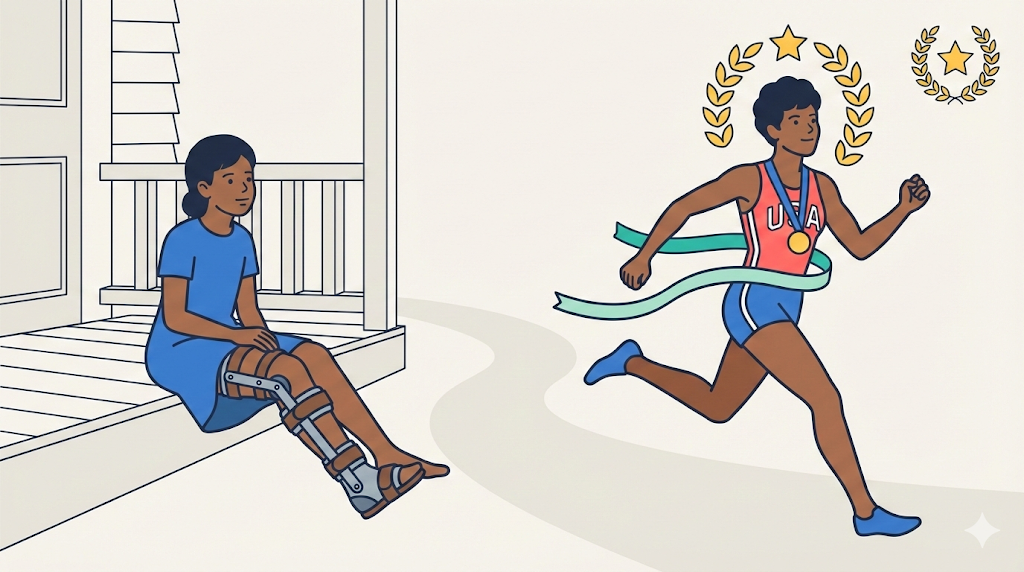
On a warm morning in Tennessee, a little girl sits on a porch step. Other kids run past. Wilma watches them. Her leg feels weak. A heavy brace holds her knee and ankle. She wants to join the game, but her body says, “Not yet.”

Inside, her family helps her again. They rub her leg. They guide her foot. They tell her, “One more step.” Wilma stands. She holds the wall. She takes a small step. It is slow, but it is real. Day after day, she practices walking. She falls. She stands again.

Years later, the same girl runs on a track. The air smells like dust and summer grass. A coach says, “Ready.” Wilma leans forward. The gun sounds. Her feet hit the ground fast—tap, tap, tap. She is not thinking about the brace now. She is thinking about the finish line.

Wilma Rudolph grew up with serious illness. For a time, she could not walk normally. But she kept working. Her family and doctors helped her. She trained again and again. In 1960, she ran at the Olympics in Rome. She won gold medals. The world saw a fast, strong woman. But Wilma remembered the first small step.

Her story says something simple: a hard start is not the end. With help, patience, and practice, a weak beginning can become strength.


Key Points

  • Wilma worked step by step to get strong again.
  • She trained for years and won Olympic gold.

Words to Know

illness /ˈɪl.nəs/ (n) — being sick
brace /breɪs/ (n) — a hard support for a body part
practice /ˈpræk.tɪs/ (n/v) — doing something many times to improve
step /step/ (n) — one move of your foot when walking
train /treɪn/ (v) — practice for a sport or skill
race /reɪs/ (n) — a running competition
win /wɪn/ (v) — to be the best and succeed


📝 Practice Questions

A1 – True/False

  1. Wilma Rudolph wore a leg brace when she was young.
  2. Wilma stopped practicing because it was slow.
  3. Wilma won gold medals at the Olympics.

A1 – Multiple Choice

  1. Where did Wilma win gold medals?
    A. The Olympics
    B. A hospital race
    C. A classroom game

  2. What helped Wilma get strong again?
    A. Daily practice and support
    B. Buying new shoes
    C. Watching races on TV

  3. What sound started the race in the story?
    A. A starting gun
    B. A bell on a bike
    C. A dog barking

A1 – Short Answer

  1. What did Wilma wear on her leg?
  2. What big event did she race in?
  3. What did her family say to her?

A1 – True/False

  1. True
  2. False
  3. True

A1 – Multiple Choice

  1. A
  2. A
  3. A

A1 – Short Answer

  1. A leg brace
  2. The Olympics
  3. “One more step”
A2 Level

Small daily work that became world-class running

Wilma Rudolph: Healing Into Speed

Small daily work that became world-class running

Healing step by step

In Clarksville, Tennessee, a young Wilma Rudolph watched other children play outside. She wanted to run with them, but her leg was weak. After a serious illness in childhood, she wore a leg brace for a time. Walking was hard, and running felt impossible. Some people expected her to stay on the side.

At home, her family helped her practice. They did gentle massage and simple exercises. Wilma tried the same movements again and again. Some days were painful and slow. But her body learned step by step. The brace came off. Her balance improved. Her legs grew stronger. Recovery often works like this: not one big miracle, but many small days of effort and support.

From practice to Olympic gold

When Wilma became a teenager, she found the track. At first, she was simply happy to move freely. In a small school race, she surprised herself by finishing near the front. Sprinting looked like pure speed, but it was also skill. She learned how to start quickly, how to lift her knees, and how to keep her shoulders relaxed. A coach guided her training and gave clear goals. She practiced starts, sprints, and easy jogging for fitness. On meet days, she felt nervous, but she learned a simple routine: warm up, breathe, and focus on the first steps. Each race became a lesson, not just a test.

Wilma also learned to rest, drink water, and return to practice after tired days. Little habits built big results. In 1960, she raced at the Olympic Games in Rome and won three gold medals. People saw a champion who looked fearless. But Wilma knew the truth behind that moment: her speed came from years of healing and training.

Later, she spoke to young people and encouraged girls to try sports. Her life shows a hopeful message: your start does not have to decide your end.


Key Points

  • Recovery can be slow, but small daily work builds strength.
  • Sprinting success comes from skill, habits, and training over time.
  • Support from family and coaches can change a future.

Words to Know

recovery /rɪˈkʌv.ər.i/ (n) — getting better after illness or injury
therapy /ˈθer.ə.pi/ (n) — treatment that helps the body heal
support /səˈpɔːrt/ (n) — help from people around you
coach /koʊtʃ/ (n) — a person who trains athletes
sprint /sprɪnt/ (n/v) — a very fast short run
balance /ˈbæl.əns/ (n) — the ability to stay steady
routine /ruːˈtiːn/ (n) — a set of regular actions
goal /ɡoʊl/ (n) — something you aim to achieve
medal /ˈmed.əl/ (n) — a prize for winning


📝 Practice Questions

A2 – True/False

  1. Recovery can happen through many small days of work.
  2. Wilma never felt nervous at races.
  3. Wilma won three gold medals in Rome in 1960.

A2 – Multiple Choice

  1. Which habit helped Wilma’s training?
    A. Rest and drinking water
    B. Skipping practice
    C. Staying up very late

  2. Sprinting is built from ______.
    A. Skill and practice
    B. Luck only
    C. Expensive clothes

  3. Why did Wilma’s family help her exercise at home?
    A. To support her healing
    B. To punish her
    C. To make her famous quickly

A2 – Short Answer

  1. Name one thing Wilma practiced for sprinting.
  2. What did Wilma focus on when she felt nervous?
  3. What is one small habit you can practice daily?

A2 – True/False

  1. True
  2. False
  3. True

A2 – Multiple Choice

  1. A
  2. A
  3. A

A2 – Short Answer

  1. Starts / short sprints (any one is OK)
  2. Her first steps (or the first steps)
  3. Answers will vary
B1 Level

Recovery, coaching, and the courage to compete

Wilma Rudolph: The Work Behind the Medal

Recovery, coaching, and the courage to compete

The brace, the porch, and a promise

In a small Tennessee neighborhood, Wilma Rudolph once sat and listened to the sound of other children running. Her leg brace felt like a loud message: “You are different.” But her family treated the brace as temporary. They helped her do daily exercises and kept saying the same thing: keep going.

Recovery is a skill, not a mood

Rudolph’s early illness left her with weak movement, and she needed time to rebuild strength and coordination. Physical therapy works in a simple way: repeat safe movements until the body learns them again. It is not exciting work. It is patient work. For Wilma, that patience became a kind of training before she ever joined a team.

Training turns effort into speed

When she began track, she did not become fast overnight. Sprinting is built from details: a strong start, quick steps, good posture, and relaxed breathing under pressure. A coach can see small problems—tight shoulders, a late arm swing, a head that lifts too early—and fix them with drills. The famous coach Ed Temple later guided her at Tennessee State University, helping her grow as an athlete and as a confident competitor.

Competition added another lesson: nerves are normal. On meet day, the body can feel heavy, and the mind can feel loud. Runners learn routines—warm-up, deep breaths, focus on the first ten meters—so they can run their best when it matters.

The Olympic moment people remember

At the 1960 Rome Olympics, Rudolph won three gold medals and became a global star. The International Olympic Committee (IOC) records her victories as part of Olympic history, and museums like the Smithsonian highlight her as a key figure in American sports and women’s athletics.

Why her wins mattered beyond the track

In 1960, many women athletes still fought for respect and resources. In the United States, the civil-rights movement was also pushing the country to see Black Americans more fairly. Rudolph’s success did not solve these problems, but it changed what many people imagined. A young Black woman from a poor Southern town stood on the biggest sports stage and looked completely in control.

After her Olympic fame, she spoke at schools and worked with young athletes. She often pointed back to the basics: good help, good habits, and the courage to return after setbacks.

What makes her story powerful is not only the medals. It is the long chain behind them: family support, medical care, steady practice, good coaching, and years of quiet belief. Rudolph shows that “talent” is often what effort looks like after it has had time to grow.


Key Points

  • Recovery takes repetition, patience, and support.
  • Sprinting speed is built through technique, routines, and coaching.
  • Her Olympic wins changed what many people believed was possible.

Words to Know

disability /ˌdɪs.əˈbɪl.ə.ti/ (n) — a condition that limits activity
rehabilitation /ˌriː.həˌbɪl.ɪˈteɪ.ʃən/ (n) — training the body to work well again
technique /tekˈniːk/ (n) — a skillful way of doing something
posture /ˈpɑːs.tʃɚ/ (n) — how you hold your body
pressure /ˈpreʃ.ɚ/ (n) — stress from a hard situation
compete /kəmˈpiːt/ (v) — to try to win against others
routine /ruːˈtiːn/ (n) — a regular set of actions
perseverance /ˌpɝː.səˈvɪr.əns/ (n) — continuing despite difficulty
inspire /ɪnˈspaɪɚ/ (v) — to give someone hope or energy
legacy /ˈleɡ.ə.si/ (n) — what you are remembered for
discrimination /dɪˌskrɪm.əˈneɪ.ʃən/ (n) — unfair treatment of people


📝 Practice Questions

B1 – True/False

  1. Physical therapy often uses repeated safe movements.
  2. Coach Ed Temple guided Wilma at Tennessee State University.
  3. Wilma’s Olympic gold medals were won in 1970.

B1 – Multiple Choice

  1. Why do runners use routines on meet day?
    A. To manage nerves and focus
    B. To avoid warming up
    C. To make the race longer

  2. Which two institutions are mentioned in the article?
    A. IOC and Smithsonian
    B. NASA and WHO
    C. World Bank and UNESCO

  3. Which is a sprint technique detail mentioned?
    A. A strong start
    B. Holding your breath
    C. Closing your eyes

B1 – Short Answer

  1. Why can progress feel slow during recovery?
  2. What did Rudolph’s wins change for many people’s imagination?
  3. Name two supports that helped Wilma succeed.

B1 – True/False

  1. True
  2. True
  3. False

B1 – Multiple Choice

  1. A
  2. A
  3. A

B1 – Short Answer

  1. Because the body learns through repeated small steps over time.
  2. It widened what people imagined for women and Black athletes.
  3. Family support and coaching (also OK: medical care, steady practice).
B2 Level

How healing, structure, and opportunity create champions

Wilma Rudolph: Greatness Built in Private

How healing, structure, and opportunity create champions

A finish line built from tiny steps

The stadium noise at the 1960 Rome Olympics was sharp and bright—like sunlight on metal. Wilma Rudolph walked to her lane with calm shoulders, but her past walked with her too. Long before the cameras, there was a porch in Tennessee, a stiff leg brace, and a child learning how to trust one step.

The hidden years: recovery before victory

Rudolph’s childhood illness left her with serious movement limits. To many people, that sounded like a final label. Yet recovery is not only “getting better.” It is learning again. Physical therapy uses repetition to rebuild strength, balance, and coordination. You do the same safe movement until the body makes it smoother and more natural. It can feel boring, even humiliating, because progress is small and slow.

In Rudolph’s case, progress also needed people. Family members helped with daily care. Clinics and therapists supported her rehabilitation. When the brace finally came off, her body had a new foundation: patience, routine, and the belief that effort was worth something even when no one was watching.

Speed is engineered, not wished for

Sprinting looks like pure talent, but it is also design. A sprinter trains the start, the first steps, the arm swing, the rhythm of the stride, and recovery between hard sessions. Small changes matter. A relaxed face can mean a relaxed shoulder. A better start can win a race in the first seconds.

Rudolph trained within a strong system, including Coach Ed Temple at Tennessee State University. That kind of coaching is not just “motivation.” It is feedback and structure: drills, meets, rest days, and a steady belief that the athlete can handle more than she thinks. The result is confidence that comes from evidence—hours of practice—not from positive words alone.

Opportunity shapes who gets to become great

It is tempting to tell her story as a simple message: “Try hard and you will win.” But the deeper lesson is about access. Not every child has the same chances to heal, train, and compete. Health outcomes improve with basic support—family help, medical care, safe places to move, and adults who notice potential. When these supports exist, “talent” has room to grow.

That is why Rudolph’s Olympic moment mattered culturally. In 1960 America, women’s sports had fewer doors, and Black athletes faced heavy discrimination. Her three gold medals did not erase inequality, but they widened imagination. Millions of viewers saw a Black woman athlete not as a side story, but as the main event. The International Olympic Committee (IOC) preserves her results in Olympic history, and institutions like the Smithsonian highlight her legacy in the story of American sport.

Rudolph later used her public voice to encourage young people, especially girls, to enter sports and education. In a way, she turned her personal recovery into social permission: “Yes, you can belong here.”

Her life challenges the myth that champions are simply born. Her speed was real, but so was the slow work: healing, repetition, coaching, and courage when progress looked almost invisible. The most human truth in her story is not “be strong alone,” but “build strength with time, help, and practice.”


Key Points

  • Recovery is built through repetition, time, and human support.
  • Sprint speed is shaped by structure: technique, feedback, and rest.
  • Opportunity and access help decide who gets to become “great.”

Words to Know

access /ˈæk.ses/ (n) — the chance to use or reach something
inequality /ˌɪn.ɪˈkwɑː.lə.t̬i/ (n) — unfair difference in chances or treatment
representation /ˌrep.rɪ.zenˈteɪ.ʃən/ (n) — being seen and included publicly
structure /ˈstrʌk.tʃɚ/ (n) — an organized system or plan
evidence /ˈev.ə.dəns/ (n) — proof or clear signs
resilience /rɪˈzɪl.jəns/ (n) — the ability to recover and continue
rehabilitation /ˌriː.həˌbɪl.ɪˈteɪ.ʃən/ (n) — rebuilding ability after injury/illness
rhythm /ˈrɪð.əm/ (n) — a steady pattern of movement
discrimination /dɪˌskrɪm.əˈneɪ.ʃən/ (n) — unfair treatment of people
foundation /faʊnˈdeɪ.ʃən/ (n) — a strong base to build on
myth /mɪθ/ (n) — a story people believe too simply
visible /ˈvɪz.ə.bəl/ (adj) — able to be seen
permission /pɚˈmɪʃ.ən/ (n) — being allowed to do something
humiliate /hjuːˈmɪl.i.eɪt/ (v) — to make someone feel ashamed

📝 Practice Questions

B2 – True/False

  1. Sprinting success is only about being born fast.
  2. Access to care and safe training spaces can shape outcomes.
  3. Rudolph won at the 1960 Rome Olympics.

B2 – Multiple Choice

  1. What is the deeper lesson in Rudolph’s story?
    A. Opportunity and support help greatness grow
    B. Champions never need help
    C. Winning is mostly luck

  2. “Confidence from evidence” mainly means ______.
    A. Confidence built from hours of practice
    B. Confidence built from popularity
    C. Confidence built from fear

  3. Which is part of “access” in the article?
    A. Medical care and safe places to train
    B. A louder stadium speaker
    C. A different color uniform

B2 – Short Answer

  1. In one sentence, why did her Olympic moment matter culturally?
  2. Name one kind of support that helps people grow after setbacks.
  3. What simple myth about champions does her story challenge?

B2 – True/False

  1. False
  2. True
  3. True

B2 – Multiple Choice

  1. A
  2. A
  3. A

B2 – Short Answer

  1. It showed a Black woman athlete leading the biggest stage, widening imagination beyond old limits.
  2. Answers will vary
  3. The myth that champions are simply born, not made