Wisdom English Learn about the world. Grow your English.
Work & Money

How to Plan Your Week With a Simple Calendar

A1 A2 B1 B2

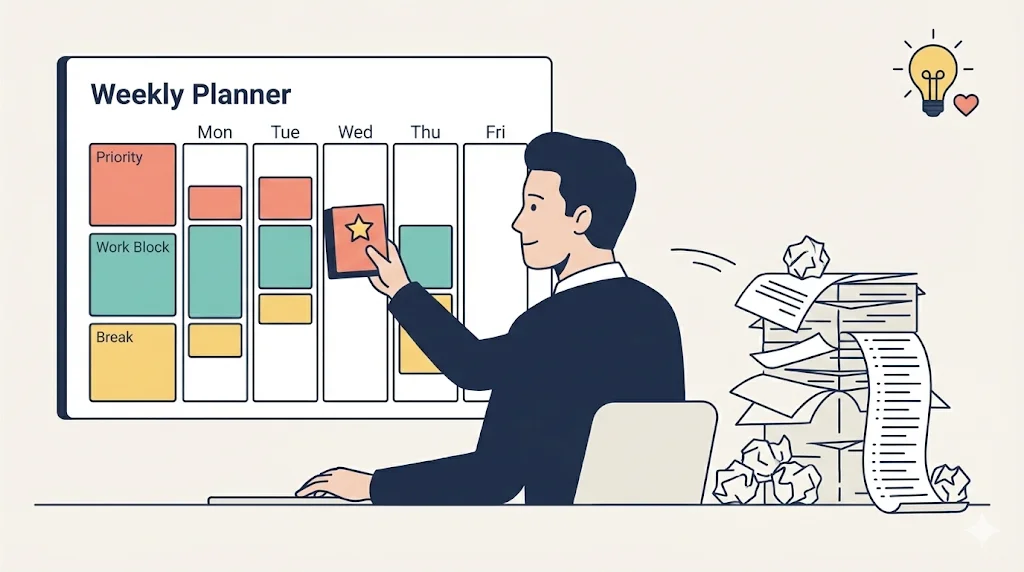
A simple weekly calendar shows your real time. Place priorities first, use small blocks, and adjust midweek to reduce stress and stay focused.

A1 Level

Small steps make busy days calmer.

Plan Your Week With a Simple Calendar

Small steps make busy days calmer.

Alex often says, “I’m busy.”
On Wednesday, he feels worried.
A deadline is close.
Then he sees the problem.
He never put his most important task on his calendar.

A simple calendar can help.
It shows your real time in the week.
First, choose three main outcomes.
These are the most important things.
Put them on the calendar first.

Next, use small time blocks.
Do not make a long to-do list.
Plan short blocks for work, travel, and breaks.
This feels more real and possible.

On Wednesday or Thursday, review and adjust.
Life changes.
Move tasks if you need to.
You are not “behind.”
You are just updating your plan.

At the end of the week, Alex feels calmer.
His calendar is simple.
His mind is clear.


Key Points

  • Pick three main outcomes and place them first.
  • Use small time blocks and adjust midweek.

Words to Know

  • plan /plæn/ (v) — decide what to do before
  • calendar /ˈkæl.ən.dɚ/ (n) — a tool that shows days and time
  • outcome /ˈaʊt.kʌm/ (n) — a result you want
  • block /blɑːk/ (n) — a short time period
  • review /rɪˈvjuː/ (v) — look again and check
  • adjust /əˈdʒʌst/ (v) — change a little
  • stress /stres/ (n) — worry or pressure

📝 Practice Questions

A1 – True/False

  1. A simple calendar shows real time.
  2. Alex planned his most important task first.
  3. You should never move tasks.

A1 – Multiple Choice

  1. What should you pick first for the week?
    A. Three main outcomes
    B. Many small tasks
    C. Free time only
  2. What should you use instead of a long list?
    A. No plan
    B. Small time blocks
    C. Big goals only
  3. When should you review the plan?
    A. Only Sunday
    B. Never
    C. Midweek

A1 – Short Answer

  1. How many main outcomes should you choose?
  2. What tool shows your time?
  3. What can you do if plans change?

A1 – True/False

  1. True
  2. False
  3. False

A1 – Multiple Choice

  1. A
  2. B
  3. C

A1 – Short Answer

  1. Three
  2. A calendar
  3. Move tasks
A2 Level

See your time before it disappears.

Planning Your Week the Simple Way

See your time before it disappears.

Alex feels busy every week.
By Wednesday, stress grows.
He checks his calendar and learns a lesson.
His most important task was never scheduled.

A simple weekly calendar shows real time.
Start by choosing three main outcomes.
These are the results you want by Sunday.
Place them on the calendar first.
This protects your priorities.

Use Small Time Blocks

Do not write a long to-do list.
Instead, plan small and realistic blocks.
Include travel, short breaks, and rest.
This makes the plan honest and human.

Review and Adjust

Midweek, stop and review.
Plans change.
Move tasks to new times.
This is normal, not failure.
Adjusting keeps stress low.

Alex learns to plan, not to rush.
His week feels clearer.
The calendar works for him.


Key Points

  • Choose three weekly outcomes and schedule them first.
  • Use small time blocks instead of long lists.
  • Review midweek and move tasks calmly.

Words to Know

  • priority /praɪˈɔːr.ə.t̬i/ (n) — something most important
  • schedule /ˈskedʒ.uːl/ (v) — put into a plan with time
  • realistic /ˌrɪəˈlɪs.tɪk/ (adj) — possible in real life
  • break /breɪk/ (n) — short rest time
  • review /rɪˈvjuː/ (v) — check again
  • adjust /əˈdʒʌst/ (v) — change a little
  • deadline /ˈded.laɪn/ (n) — last time to finish
  • stress /stres/ (n) — worry or pressure

📝 Practice Questions

A2 – True/False

  1. A calendar can reduce stress.
  2. Small blocks ignore breaks.
  3. Adjusting a plan is normal.

A2 – Multiple Choice

  1. What should be scheduled first?
    A. Emails
    B. Three main outcomes
    C. Small tasks
  2. What makes a plan realistic?
    A. Small time blocks
    B. Long lists
    C. Late nights
  3. When is a good time to review?
    A. Next month
    B. Midweek
    C. After the year ends

A2 – Short Answer

  1. Why are long to-do lists a problem?
  2. Name one thing to include in time blocks.
  3. How does adjusting help stress?

A2 – True/False

  1. True
  2. False
  3. True

A2 – Multiple Choice

  1. B
  2. A
  3. B

A2 – Short Answer

  1. They ignore real time
  2. Breaks or travel
  3. It lowers pressure
B1 Level

Turn busy days into clear time.

A Simple Calendar for a Better Workweek

Turn busy days into clear time.

Alex always feels busy.
On Wednesday, he notices something missing.
His most important task is not on the calendar.
The deadline is close, and stress rises.

A simple weekly calendar helps you see real time.
Begin by picking three main outcomes.
These outcomes guide your week.
Place them on the calendar first, before small tasks.

Plan With Time Blocks

Avoid long to-do lists.
They hide the truth about time.
Use small, realistic blocks instead.
Include travel, short breaks, and buffer time.
This makes your plan workable.

Adjust Without Guilt

Midweek, review your plan.
Meetings change.
Energy changes.
Move tasks to new times.
This is not falling behind.
It is smart planning.

By Friday, Alex feels lighter.
The calendar did not control him.
It helped him choose.


Key Points

  • Pick three weekly outcomes and protect them on the calendar.
  • Use small time blocks, including breaks and travel.
  • Review midweek and adjust without guilt.

Words to Know

  • outcome /ˈaʊt.kʌm/ (n) — the result you want
  • buffer /ˈbʌf.ɚ/ (n) — extra time for safety
  • protect /prəˈtekt/ (v) — keep safe from loss
  • energy /ˈen.ɚ.dʒi/ (n) — strength to work
  • guilt /ɡɪlt/ (n) — feeling bad for not meeting rules
  • flexible /ˈflek.sə.bəl/ (adj) — able to change
  • clarity /ˈkler.ə.t̬i/ (n) — clear understanding
  • priority /praɪˈɔːr.ə.t̬i/ (n) — most important thing
  • schedule /ˈskedʒ.uːl/ (v) — plan with time
  • stress /stres/ (n) — pressure or worry

📝 Practice Questions

B1 – True/False

  1. Time blocks show the limits of time.
  2. Adjusting means failure.
  3. Priorities should be protected first.

B1 – Multiple Choice

  1. What hides the truth about time?
    A. Small blocks
    B. A simple calendar
    C. Long to-do lists
  2. What should you do midweek?
    A. Add more tasks
    B. Review and adjust
    C. Stop planning
  3. What helps reduce stress?
    A. Perfection
    B. Guilt
    C. Clear next steps

B1 – Short Answer

  1. Why include buffer time?
  2. What happens when priorities are scheduled first?
  3. How did Alex feel by Friday?

B1 – True/False

  1. True
  2. False
  3. True

B1 – Multiple Choice

  1. C
  2. B
  3. C

B1 – Short Answer

  1. To handle changes
  2. They stay protected
  3. He felt lighter
B2 Level

How a simple calendar reduces stress.

Planning Your Week Without the Pressure

How a simple calendar reduces stress.

Alex says he is busy, but the calendar tells a different story.
By Wednesday, a deadline appears suddenly.
The truth is simple: the task was never scheduled.

A simple weekly calendar reveals real time.
Start by choosing three main outcomes.
These outcomes reflect what truly matters.
Place them on the calendar first, before emails and small tasks.

From Lists to Time

Long to-do lists create false comfort.
They ignore limits.
Small, realistic time blocks respect reality.
Add travel, breaks, and recovery time.
This prevents overload and burnout.

Adjust, Don’t Judge

Midweek review is essential.
Work changes.
Life interrupts.
Move tasks to new slots.
Adjustment is not weakness.
It is a skill used by effective professionals (OECD).

By the end of the week, stress drops.
Vague pressure becomes clear next steps.
A simple calendar does not promise perfection.
It offers direction.


Key Points

  • Choose three meaningful outcomes and schedule them first.
  • Replace long lists with small, realistic time blocks.
  • Review midweek and adjust without self-judgment.

Words to Know

  • vague /veɪɡ/ (adj) — not clear
  • outcome /ˈaʊt.kʌm/ (n) — desired result
  • overload /ˌoʊ.vɚˈloʊd/ (n) — too much work
  • burnout /ˈbɝːn.aʊt/ (n) — deep work exhaustion
  • adjust /əˈdʒʌst/ (v) — change to fit
  • interruption /ˌɪn.təˈrʌp.ʃən/ (n) — break in activity
  • professional /prəˈfeʃ.ən.əl/ (n) — working adult
  • priority /praɪˈɔːr.ə.t̬i/ (n) — most important task
  • schedule /ˈskedʒ.uːl/ (v) — plan with time
  • clarity /ˈkler.ə.t̬i/ (n) — clear understanding
  • realistic /ˌrɪəˈlɪs.tɪk/ (adj) — possible
  • reflect /rɪˈflekt/ (v) — think carefully

📝 Practice Questions

B2 – True/False

  1. A calendar promises a perfect routine.
  2. Adjustment is a professional skill.
  3. Time blocks respect human limits.

B2 – Multiple Choice

  1. What creates false comfort?
    A. Clear outcomes
    B. Long to-do lists
    C. Midweek reviews
  2. What reduces burnout?
    A. Overloading days
    B. Ignoring breaks
    C. Realistic time blocks
  3. What turns pressure into action?
    A. Vague plans
    B. More guilt
    C. Clear next steps

B2 – Short Answer

  1. Why schedule outcomes before small tasks?
  2. How does midweek review change mindset?
  3. What does a simple calendar truly offer?

B2 – True/False

  1. False
  2. True
  3. True

B2 – Multiple Choice

  1. B
  2. C
  3. C

B2 – Short Answer

  1. They protect what matters most
  2. It replaces guilt with choice
  3. Direction and clarity