Designing Deep Focus in a Message-Driven Workplace
Deep work blocks, availability negotiation, and long-term value
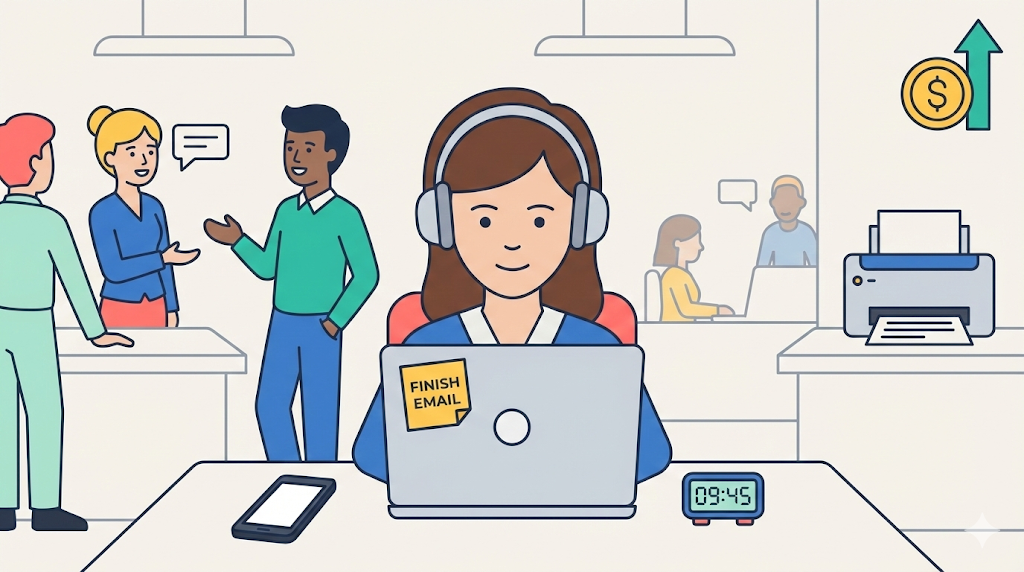
Mina has just been promoted. Her new role is not only to “do tasks,” but to solve problems and make better decisions. She needs long thinking time. Yet her workplace feels louder than ever: open desks, meetings, and three messaging apps that never sleep. She goes home with a full day behind her and a fear in her mind: “Did I actually create anything?”
Deep work and shallow work
Mina starts by naming two types of work. Deep work is hard thinking: planning, writing, analyzing, designing, learning. Shallow work is quick and necessary: routine email, small updates, scheduling, simple replies. Both matter, but they cannot live in the same minute. When Mina mixes them, deep work disappears.
So she stops asking, “Can I focus?” and asks, “When will I protect deep work?”
Attention design: build a weekly system
She redesigns her week like a map. Three mornings are for deep work blocks, 90 minutes each. Afternoons hold meetings and message windows. She groups shallow tasks into batches, so her brain does not restart all day.
She also changes her environment. In the office, she chooses a desk farther from the main walkway. She keeps one “work screen” and one “message screen,” not ten. In remote work, she closes chat and turns off pop-up alerts during deep blocks.
Small rules make a big difference:
- One clear goal per block
- One place for notes and next steps
- One planned time to check messages
Mina also protects energy. After each deep block, she takes a real break: a short walk, water, light stretching, or quiet breathing. Breaks are not wasted time. They reset the brain, so the next block can be strong too.
Make focus a shared norm, not a private hobby
Mina realizes something uncomfortable: focus is not only personal. It is cultural. Modern work often rewards fast replies, visible busyness, and constant availability. But long-term value comes from outcomes: reports that change decisions, designs that reduce errors, plans that save time for everyone. Many discussions in places like the OECD and the World Economic Forum highlight that knowledge work depends on attention, learning, and high-quality thinking.
Mina begins to negotiate availability with her team. She tells them, “I will answer messages at 11:30 and 4:30. If it is urgent, call me.” She also creates a simple meeting rule: no meetings in the first 90 minutes of the day unless there is a true emergency. At first, people worry. Then they notice the results: clearer documents, fewer rework cycles, and calmer project flow.
She uses signals with respect. A calendar block is not a wall; it is a promise: “I will deliver something after this time.” When Mina protects focus, she protects trust. Over time, coworkers stop interrupting “just for a second,” because they learn that her focused time creates value for them too.
In a noisy workplace, you may not control the room. But you can control your system. Protect deep work, contain shallow work, and communicate your boundaries clearly. The strongest signal is not the fastest reply. It is steady results that matter.
Key Points
- Deep work needs protected time; shallow work needs clear limits.
- A weekly focus system reduces restart costs and improves outcomes.
- Focus grows when teams treat attention as a shared professional norm.
Words to Know
deep work /diːp wɜːrk/ (n) — hard thinking work that needs full attention
shallow work /ˈʃæloʊ wɜːrk/ (n) — quick tasks that do not need deep thinking
availability /əˌveɪləˈbɪləti/ (n) — when you can be reached
negotiate /nɪˈɡoʊʃieɪt/ (v) — talk to agree on rules
outcome /ˈaʊtkʌm/ (n) — the real result you create
batch /bætʃ/ (n) — a group of similar tasks done together
channel /ˈtʃænəl/ (n) — a communication path like email or chat
boundary /ˈbaʊndəri/ (n) — a clear limit with others
norm /nɔːrm/ (n) — a shared rule people follow
reset /riːˈsɛt/ (v) — return to a good state again
deliver /dɪˈlɪvər/ (v) — produce and give a finished result
interrupt /ˌɪntəˈrʌpt/ (v) — stop someone’s work for a moment
priority /praɪˈɔːrəti/ (n) — what matters most first