Wisdom English Learn about the world. Grow your English.
Work & Money

How to Build Focus in a Noisy Workplace

A1 A2 B1 B2

Learn how to stay focused in a noisy workplace with small attention rules: one clear task, short focus blocks, fewer alerts, and friendly boundaries that reduce interruptions and improve work quality.

A1 Level

Small steps to protect your attention today

One Task at a Time in a Noisy Office

Small steps to protect your attention today

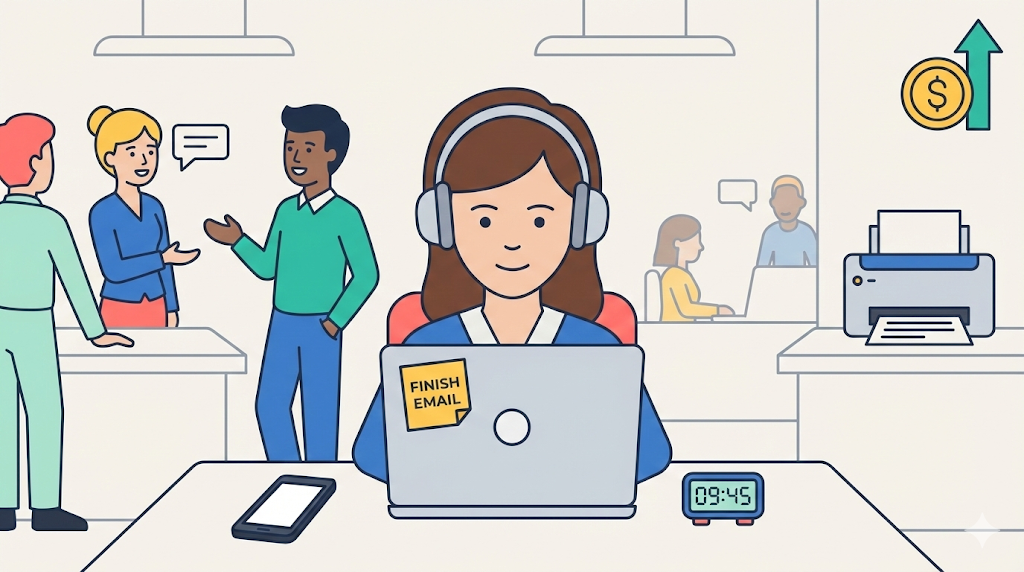
Mina sits at her desk in a busy office. People are talking nearby. A printer is running. Her phone keeps buzzing. She wants to write one important email, but her eyes jump to every sound and every light on the screen.

She takes a slow breath. She writes one small goal on a sticky note: “Finish this email.” Then she makes her space calmer. She puts her phone on silent and moves it a little far away. She closes extra tabs. She turns her chair a little away from the busy walkway. She also wears soft headphones, even with no music, just to signal “quiet time.”

Next, she uses a short timer. She works for 10 minutes on only the email. When her mind runs away, she comes back to the next line. She does not open chat. She does not check new messages. When the timer ends, she stands up, drinks water, and takes a 1-minute break.

A coworker walks over with a quick question. Mina smiles and says, “I can talk in 20 minutes. I’m focusing now.” The coworker nods and leaves.

In a noisy workplace, noise is not only sound. It is also interruptions and quick switches. Mina cannot stop all noise. But she can protect her attention. One task. One short time block. Fewer interruptions. After 30 minutes, the email is done. Mina feels lighter. Small focus habits can change a whole day.


Key Points

  • Choose one task and remove small distractions.
  • Use short timers and small breaks to stay steady.

Words to Know

focus /ˈfoʊkəs/ (n) — attention on one thing
noise /nɔɪz/ (n) — loud or busy sound
interrupt /ˌɪntəˈrʌpt/ (v) — stop someone’s work for a moment
task /tæsk/ (n) — a job you need to do
timer /ˈtaɪmər/ (n) — a tool that counts time
break /breɪk/ (n) — short rest time
finish /ˈfɪnɪʃ/ (v) — complete something


📝 Practice Questions

A1 – True/False

  1. Mina’s phone keeps buzzing while she tries to work.
  2. Mina checks chat messages during her 10-minute timer.
  3. Mina tells a coworker she can talk later because she is focusing.

A1 – Multiple Choice

  1. What is Mina’s first small goal?
    A. Finish this email
    B. Clean the whole office
    C. Buy a new phone

  2. What does Mina do to reduce distractions?
    A. Opens more tabs
    B. Puts her phone on silent
    C. Talks louder

  3. What happens after Mina’s timer ends?
    A. She takes a short break
    B. She starts a meeting
    C. She watches videos

A1 – Short Answer

  1. What does Mina use to count time?
  2. Where does Mina move her phone?
  3. What does Mina finish in the end?

A1 – True/False

  1. True
  2. False
  3. True

A1 – Multiple Choice

  1. A
  2. B
  3. A

A1 – Short Answer

  1. A timer
  2. Far away / away from her hand
  3. The email
A2 Level

Timers, message windows, and kind boundaries

A Simple Focus System for Busy Workplaces

Timers, message windows, and kind boundaries

Mina works in an open office. People walk past her desk all day. Phones ring. Chat messages pop up. By 5 p.m., she feels tired, but her “real work” is still not finished.

What noise really means

In a workplace, noise is more than sound. It is also small interruptions: a “quick question,” a new email, a ping from a group chat. Each time Mina switches, her brain needs time to restart. She loses minutes, and she also loses calm. Many workers feel this in offices, shops, hospitals, and even at home during remote work.

A simple focus plan

Mina tries a small system. First, she chooses one clear task: “Finish the report summary.” She also writes the next step: “Write the first three points.” Clear next steps make it easier to begin.

Next, she removes tiny triggers. She turns off notifications on her phone and computer. She closes extra browser tabs. She keeps only one document open.

Then she uses a timer. She works for 25 minutes. After that, she takes a 5-minute break. During the break, she stretches, drinks water, and rests her eyes. She repeats this two times. Only then does she check messages. She plans two message windows: one before lunch and one late afternoon.

A friendly signal to others

Mina also sets a kind boundary with her coworker Tom. Tom often interrupts her “for one minute,” many times. Mina says, “I will help at 3:00. Now is focus time.” She puts a small “Focus” sign on her desk, and she wears headphones. Tom starts to wait, because the rule is clear.

Mina does not become perfect. The office is still busy. But her day feels more controlled. A short plan, repeated every day, can protect attention in a noisy workplace—and help you end work with fewer mistakes and less stress.


Key Points

  • Turn off alerts and start with one clear next step.
  • Use focus blocks, breaks, and message windows.
  • Make boundaries visible so people interrupt less.

Words to Know

distraction /dɪˈstrækʃən/ (n) — something that pulls your attention away
notification /ˌnoʊtɪfɪˈkeɪʃən/ (n) — an alert from a phone or app
priority /praɪˈɔːrəti/ (n) — the most important thing first
boundary /ˈbaʊndəri/ (n) — a clear limit with others
timer /ˈtaɪmər/ (n) — a tool that counts time
break /breɪk/ (n) — short rest time
stretch /strɛtʃ/ (v) — move your body to relax muscles
routine /ruːˈtiːn/ (n) — a habit you repeat
interrupt /ˌɪntəˈrʌpt/ (v) — stop someone’s work for a moment


📝 Practice Questions

A2 – True/False

  1. In the article, “noise” can mean pings and quick questions.
  2. Mina checks messages only after working in focus blocks.
  3. Mina plans to check messages every five minutes.

A2 – Multiple Choice

  1. What is Mina’s timer pattern?
    A. 25 minutes work, 5 minutes break
    B. 5 minutes work, 25 minutes break
    C. 60 minutes work, no break

  2. What is Mina’s next step after choosing her task?
    A. Turn on more notifications
    B. Remove small triggers like extra tabs
    C. Start talking with everyone

  3. What time does Mina say she will help Tom?
    A. 9:00
    B. 12:00
    C. 3:00

A2 – Short Answer

  1. Name one “tiny trigger” Mina removes.
  2. When does Mina plan message windows?
  3. What is one alert you can turn off?

A2 – True/False

  1. True
  2. True
  3. False

A2 – Multiple Choice

  1. A
  2. B
  3. C

A2 – Short Answer

  1. Notifications / extra tabs / pop-ups
  2. Before lunch and late afternoon
  3. Phone notifications / chat alerts / email pop-ups
B1 Level

Switching costs, priorities, and visible focus rules

Why Noise Breaks Focus—and How to Rebuild It

Switching costs, priorities, and visible focus rules

At 9 a.m., Mina feels ready to work. At 11 a.m., she feels like she has been running, even though she has not left her chair. She has answered six chat messages, checked email ten times, and joined two short calls. Yet her main project is still half done.

The hidden cost of switching

In a noisy workplace, attention gets pulled in many directions. Every switch has a restart cost. Your brain must remember: “Where was I? What was I trying to say?” This costs time and mental energy. That is why you can feel busy all day but finish little. Harvard Business Review has often described how constant interruptions reduce quality and increase mistakes.

Make your “Top 1” task clear

Mina starts with priorities, not willpower. Each morning she writes one “Top 1” task that matters most. She makes it small enough to start, like “Draft the first page,” not “Finish the whole report.” When the next step is clear, focus becomes easier than when the goal is vague.

Then she uses barriers against distraction. She silences alerts. She closes extra tabs. She keeps her phone out of reach. These are small moves, but they remove temptation early. If she must use many tools, she writes: “Open only what I need.”

Boundaries that others can see

Focus is also social. If people do not know your focus times, they will interrupt you. Mina makes her system visible. She blocks focus time on her calendar. She puts a “Focus” sign on her desk. In remote work, she uses a status message like “Deep work until 10:30.”

She also makes a promise: she will reply during check-in windows. That builds trust, because coworkers still get answers.

Focus blocks and check-in windows

Mina makes two focus blocks before lunch and one in the afternoon. Each block is 30–45 minutes, followed by a short break. She does not check messages inside a block. Instead, she creates check-in windows at set times.

When someone interrupts, Mina uses a simple script: “I can help at 3:00. Is it urgent?” Most requests are not urgent. For urgent issues, she decides fast. For everything else, she protects her focus time.

After two weeks, Mina notices a difference. The office is still loud, and messages still arrive. But she switches less, finishes more, and feels less drained at the end of the day. Focus is not a talent you either have or do not have. It is a system you build—one clear task, one protected block, repeated until it becomes normal.


Key Points

  • Task switching has a restart cost that drains time and energy.
  • One clear “Top 1” task and visible boundaries reduce interruptions.
  • Focus blocks plus check-in windows protect quality and calm.

Words to Know

attention /əˈtɛnʃən/ (n) — your mental focus
switch /swɪtʃ/ (v) — change from one task to another
restart /riːˈstɑːrt/ (v) — begin again after stopping
priority /praɪˈɔːrəti/ (n) — the most important thing first
boundary /ˈbaʊndəri/ (n) — a clear limit with others
temptation /tɛm(p)ˈteɪʃən/ (n) — a strong want to do something distracting
urgent /ˈɜːrdʒənt/ (adj) — needing fast action now
quality /ˈkwɑːləti/ (n) — how good something is
calendar /ˈkælɪndər/ (n) — a schedule tool
status /ˈsteɪtəs/ (n) — a visible message about availability
drained /dreɪnd/ (adj) — very tired, with low energy


📝 Practice Questions

B1 – True/False

  1. Task switching can cause a “restart cost.”
  2. Mina’s “Top 1” task is always a big, vague goal.
  3. Mina uses visible signals like a calendar block or desk sign.

B1 – Multiple Choice

  1. What is the main problem with constant interruptions?
    A. They make the office look modern
    B. They increase restarting and reduce quality
    C. They make tasks easier

  2. What does Mina promise to coworkers?
    A. She will reply during check-in windows
    B. She will answer every message instantly
    C. She will ignore all questions

  3. Which script helps Mina protect focus time?
    A. “Ask me anytime, please.”
    B. “I can help at 3:00. Is it urgent?”
    C. “I will never help.”

B1 – Short Answer

  1. Why can you feel busy but finish little?
  2. Give one way Mina makes focus times visible.
  3. What changes after two weeks of Mina’s system?

B1 – True/False

  1. True
  2. False
  3. True

B1 – Multiple Choice

  1. B
  2. A
  3. B

B1 – Short Answer

  1. Switching creates restart time and mental fatigue.
  2. Calendar block / “Focus” sign / status message
  3. She switches less, finishes more, and feels less drained.
B2 Level

Deep work blocks, availability negotiation, and long-term value

Designing Deep Focus in a Message-Driven Workplace

Deep work blocks, availability negotiation, and long-term value

Mina has just been promoted. Her new role is not only to “do tasks,” but to solve problems and make better decisions. She needs long thinking time. Yet her workplace feels louder than ever: open desks, meetings, and three messaging apps that never sleep. She goes home with a full day behind her and a fear in her mind: “Did I actually create anything?”

Deep work and shallow work

Mina starts by naming two types of work. Deep work is hard thinking: planning, writing, analyzing, designing, learning. Shallow work is quick and necessary: routine email, small updates, scheduling, simple replies. Both matter, but they cannot live in the same minute. When Mina mixes them, deep work disappears.

So she stops asking, “Can I focus?” and asks, “When will I protect deep work?”

Attention design: build a weekly system

She redesigns her week like a map. Three mornings are for deep work blocks, 90 minutes each. Afternoons hold meetings and message windows. She groups shallow tasks into batches, so her brain does not restart all day.

She also changes her environment. In the office, she chooses a desk farther from the main walkway. She keeps one “work screen” and one “message screen,” not ten. In remote work, she closes chat and turns off pop-up alerts during deep blocks.

Small rules make a big difference:

  • One clear goal per block
  • One place for notes and next steps
  • One planned time to check messages

Mina also protects energy. After each deep block, she takes a real break: a short walk, water, light stretching, or quiet breathing. Breaks are not wasted time. They reset the brain, so the next block can be strong too.

Make focus a shared norm, not a private hobby

Mina realizes something uncomfortable: focus is not only personal. It is cultural. Modern work often rewards fast replies, visible busyness, and constant availability. But long-term value comes from outcomes: reports that change decisions, designs that reduce errors, plans that save time for everyone. Many discussions in places like the OECD and the World Economic Forum highlight that knowledge work depends on attention, learning, and high-quality thinking.

Mina begins to negotiate availability with her team. She tells them, “I will answer messages at 11:30 and 4:30. If it is urgent, call me.” She also creates a simple meeting rule: no meetings in the first 90 minutes of the day unless there is a true emergency. At first, people worry. Then they notice the results: clearer documents, fewer rework cycles, and calmer project flow.

She uses signals with respect. A calendar block is not a wall; it is a promise: “I will deliver something after this time.” When Mina protects focus, she protects trust. Over time, coworkers stop interrupting “just for a second,” because they learn that her focused time creates value for them too.

In a noisy workplace, you may not control the room. But you can control your system. Protect deep work, contain shallow work, and communicate your boundaries clearly. The strongest signal is not the fastest reply. It is steady results that matter.


Key Points

  • Deep work needs protected time; shallow work needs clear limits.
  • A weekly focus system reduces restart costs and improves outcomes.
  • Focus grows when teams treat attention as a shared professional norm.

Words to Know

deep work /diːp wɜːrk/ (n) — hard thinking work that needs full attention
shallow work /ˈʃæloʊ wɜːrk/ (n) — quick tasks that do not need deep thinking
availability /əˌveɪləˈbɪləti/ (n) — when you can be reached
negotiate /nɪˈɡoʊʃieɪt/ (v) — talk to agree on rules
outcome /ˈaʊtkʌm/ (n) — the real result you create
batch /bætʃ/ (n) — a group of similar tasks done together
channel /ˈtʃænəl/ (n) — a communication path like email or chat
boundary /ˈbaʊndəri/ (n) — a clear limit with others
norm /nɔːrm/ (n) — a shared rule people follow
reset /riːˈsɛt/ (v) — return to a good state again
deliver /dɪˈlɪvər/ (v) — produce and give a finished result
interrupt /ˌɪntəˈrʌpt/ (v) — stop someone’s work for a moment
priority /praɪˈɔːrəti/ (n) — what matters most first

📝 Practice Questions

B2 – True/False

  1. Deep work and shallow work can easily happen in the same minute.
  2. Mina plans 90-minute deep work blocks on some mornings.
  3. Mina sets a rule to avoid early meetings unless it is an emergency.

B2 – Multiple Choice

  1. What is Mina’s main goal in redesigning her week?
    A. More message checking
    B. Protect deep work and batch shallow work
    C. Add more random meetings

  2. How does Mina handle urgent issues?
    A. She decides fast or takes a call
    B. She delays them for a week
    C. She pretends they do not exist

  3. What helps focus become a “shared norm”?
    A. Hidden rules no one knows
    B. Clear availability and reliable check-in times
    C. Faster replies all day

B2 – Short Answer

  1. Why does Mina take real breaks after deep blocks?
  2. What is one outcome that improves when focus is protected?
  3. What boundary could you communicate to protect your best work time?

B2 – True/False

  1. False
  2. True
  3. True

B2 – Multiple Choice

  1. B
  2. A
  3. B

B2 – Short Answer

  1. To reset her brain so the next block stays strong.
  2. Clearer documents / fewer errors / calmer project flow
  3. Example: “Messages at 11:30 and 4:30; urgent calls only.”