Wisdom English Learn about the world. Grow your English.
Mind & Habits

How to Break the Cue-Reward Habit Loop

A1 A2 B1 B2

Habits feel automatic, but they follow a loop. When you notice the cue, replace the routine, and add small friction, you can change behavior without endless willpower.

A1 Level

Keep the cue. Swap the middle.

Break the Habit Loop in a Simple Way

Keep the cue. Swap the middle.

Tom stands in his kitchen at 9 p.m. The house is quiet. He is not really hungry. He is just bored. He opens the cookie box “for one.” Ten minutes later, the box is half empty.

The next day, Tom feels annoyed. He asks, “Why do I do this again?”

Lina, his sister, gives him a simple idea. Many habits follow a loop:
cue → routine → reward.

A cue is a trigger. For Tom, the cue is “bored at night.”
The routine is the action: eating cookies.
The reward is the feeling after: a sweet taste and a short comfort.

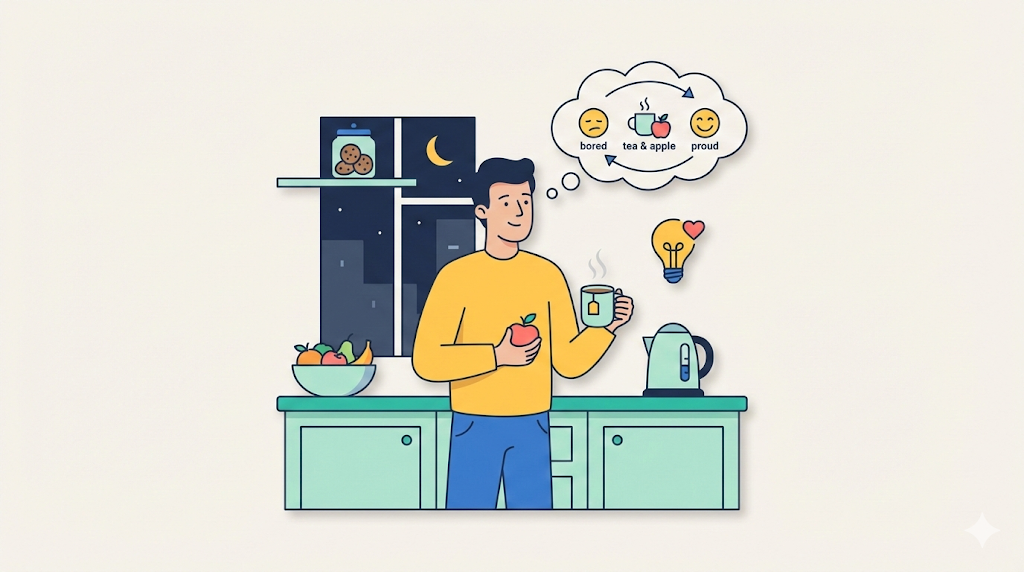
Tom does not try to erase the cue. He keeps the cue, but he swaps the middle. When he feels bored at 9 p.m., he makes tea first. He eats one apple. Then he plays one song and stretches for two minutes.

He also changes his space. He puts the cookies on a high shelf. He keeps fruit on the table. Now the old reward is harder to reach, and the new reward is easy.

Some nights, Tom still wants cookies. That is normal. But he can see the loop now. He can pause, choose a new routine, and feel proud of a small win.


Key Points

  • A habit often follows: cue → routine → reward.
  • Keep the cue, and swap the routine for a better one.

Words to Know

cue /kjuː/ (n) — a trigger that starts something
routine /ruːˈtiːn/ (n) — a habit action you repeat
reward /rɪˈwɔːrd/ (n) — the “good feeling” after an action
bored /bɔːrd/ (adj) — not interested; having nothing to do
swap /swɑːp/ (v) — change one thing for another
comfort /ˈkʌmfərt/ (n) — a warm, safe feeling
shelf /ʃelf/ (n) — a flat place to put things


📝 Practice Questions

A1 – True/False

  1. Tom eats cookies because he is very hungry.
  2. A habit loop can be cue → routine → reward.
  3. Tom puts the cookies on a high shelf to make them harder to reach.

A1 – Multiple Choice

  1. What is the cue in Tom’s cookie habit?
    A. A sweet taste
    B. Feeling bored at night
    C. Stretching for two minutes

  2. What does “swap the routine” mean?
    A. Change the trigger time
    B. Change the middle action
    C. Remove all rewards

  3. What reward does Tom get from cookies?
    A. Quick comfort
    B. More homework
    C. A longer walk

A1 – Short Answer

  1. What time is Tom bored?
  2. Who helps Tom?
  3. Where does Tom put cookies?

A1 – True/False

  1. False
  2. True
  3. True

A1 – Multiple Choice

  1. B
  2. B
  3. A

A1 – Short Answer

  1. 9 p.m.
  2. Lina
  3. On a high shelf
A2 Level

Use an If–Then plan and make the good choice easy.

A Practical Plan to Break the Habit Loop

Use an If–Then plan and make the good choice easy.

After dinner, Tom gets into bed with his phone. He tells himself, “Just five minutes.” But the screen keeps pulling him. One video becomes five. Soon it is 1 a.m., and he feels tired and guilty.

The next weekend, Tom and Lina sit with a notebook. Lina says, “Let’s map your loop.”

1) Name the loop

They write three lines:
Cue: bed + phone + tired brain
Routine: scrolling
Reward: easy comfort (no thinking)

This step matters because habits are not random. Many psychologists describe habits as patterns that connect triggers with quick rewards (American Psychological Association).

2) Keep the cue, swap the routine

Tom does not fight the cue at first. He builds a simple plan:
“If I get into bed, then I charge my phone in the hall.”

Then he chooses a replacement routine that still feels good:

  • one calm music playlist
  • five pages of a book
  • two minutes of slow breathing

3) Build a 7-day mini plan

Tom picks one cue time: 10:30 p.m. Every night, he does the same first step—phone to the hall. Lina tells him to track only one thing: “Did I do the first step?” A small check mark is enough.

4) Make the new choice easy

Tom adds friction to the old habit. He logs out of apps. He removes them from the home screen. He turns off most notifications. He also sets the screen to gray at night.

He makes the new routine easy, too. A book sits on the pillow. A charger waits in the hall. A small note on the wall says, “Bed = rest.”

Tom is not perfect. On a stressful day, he may slip. But now he treats slips as data. He asks, “What was my cue today?” Then he adjusts the plan.

Little by little, the loop changes. Tom sleeps earlier, wakes up calmer, and trusts himself again.


Key Points

  • First, write your loop: cue, routine, reward.
  • Use an If–Then plan to swap the routine.
  • Add friction to the old habit and make the new habit easy.

Words to Know

trigger /ˈtrɪɡər/ (n) — something that starts an action
pattern /ˈpætərn/ (n) — a repeated way things happen
replace /rɪˈpleɪs/ (v) — put a new thing in place of the old
friction /ˈfrɪkʃən/ (n) — extra steps that make something harder
notification /ˌnoʊtɪfɪˈkeɪʃən/ (n) — a phone alert
track /træk/ (v) — watch and record over time
slip /slɪp/ (n) — a small setback
breathe /briːð/ (v) — move air in and out


📝 Practice Questions

A2 – True/False

  1. Tom’s phone habit often starts when he gets into bed.
  2. Tom adds friction by turning on more notifications.
  3. Tom tracks one small step with a check mark.

A2 – Multiple Choice

  1. What is Tom’s If–Then plan?
    A. If I eat cookies, then I run.
    B. If I get into bed, then I charge my phone in the hall.
    C. If I feel tired, then I buy a new phone.

  2. Which is a replacement routine Tom tries?
    A. Two minutes of slow breathing
    B. Reading news for one hour
    C. Drinking soda in bed

  3. Why does Tom set the screen to gray at night?
    A. To make the phone more exciting
    B. To reduce the pull of apps
    C. To make videos louder

A2 – Short Answer

  1. What is the reward from scrolling for Tom?
  2. Name one way Tom adds friction.
  3. One habit you want to change (example).

A2 – True/False

  1. True
  2. False
  3. True

A2 – Multiple Choice

  1. B
  2. A
  3. B

A2 – Short Answer

  1. Easy comfort / no thinking
  2. Logs out / removes apps / turns off notifications (any one)
  3. Answers will vary (e.g., “late-night scrolling”)
B1 Level

Treat slips as data, and prepare for weak moments.

When Stress Brings the Habit Back

Treat slips as data, and prepare for weak moments.

On Monday night, Tom wins. He puts his phone in the hall and reads a few pages. On Tuesday and Wednesday, he wins again. By Thursday, he feels proud.

Then Friday arrives. Work is messy. A client complains. Tom comes home with a tight chest and a loud mind. He tells himself, “I deserve a break.” Ten minutes later, the phone is in his hand, and he is scrolling in bed.

The next morning, Tom wants to call it failure. Lina says, “It’s not failure. It’s information.”

The loop has a hidden engine: craving

A cue does not only start a habit. It also creates an expectation. Your brain predicts a reward and produces a craving. When you are stressed or tired, that craving feels stronger, and the brain looks for the fastest path.

Harvard Health Publishing often explains behavior change in a simple way: stress can push you toward shortcuts, especially when the shortcut gave relief before.

Track the cue, not your character

Tom lists his cues for one week. He finds five common types: time (late night), place (bed), emotion (stress), people (after a tense call), and a previous action (opening one app).
He does not write, “I am weak.” He writes, “Stress + bed + phone.”

This shift helps him spot danger moments early. Friday night is risky, so he prepares a safer routine before the cue appears.

Why replacement works better than “stop”

Tom tried to stop scrolling many times. But stopping leaves a hole. The cue still comes, and the brain still wants relief. Replacement fills that hole with a new routine that leads to a similar reward.

For Tom, the reward is comfort and escape. So he chooses replacements that give comfort quickly:

  • warm tea
  • a short walk playlist
  • a 3-minute breathing timer

Environment is quiet willpower

Tom notices something interesting. On a weekend trip, he sleeps well in a hotel. Why? The cue is weaker. No charger by the bed. No familiar routine. At home, the phone is one step away, and the loop restarts.

So Tom redesigns his space. He charges the phone outside. He removes the most tempting apps from the home screen. He turns off most notifications after 9 p.m. He puts a book and a pen on the bedside table.

Now, when stress hits, Tom still feels the pull. But he also has a prepared next step. Some nights he slips, but the slips become smaller and rarer. He is not fighting himself anymore. He is building a system that helps him on weak days.


Key Points

  • Stress increases craving and makes shortcuts feel “necessary.”
  • Track your cues so you can plan for risky moments.
  • Environment design reduces slips and protects your new routine.

Words to Know

craving /ˈkreɪvɪŋ/ (n) — a strong wanting feeling
expectation /ˌɛkspɛkˈteɪʃən/ (n) — what you think will happen
shortcut /ˈʃɔːrtkʌt/ (n) — the fastest, easiest path
relief /rɪˈliːf/ (n) — feeling better after stress
redesign /ˌriːdɪˈzaɪn/ (v) — design again in a better way
consistent /kənˈsɪstənt/ (adj) — doing the same thing often
environment /ɪnˈvaɪrənmənt/ (n) — the space around you
prepare /prɪˈpɛr/ (v) — get ready before it happens
rare /rɛr/ (adj) — not happening often
tension /ˈtɛnʃən/ (n) — stress in your body or mind


📝 Practice Questions

B1 – True/False

  1. Stress can make craving stronger in a habit loop.
  2. Tom treats slips as proof he cannot change.
  3. Tom sleeps better in a hotel because cues are weaker there.

B1 – Multiple Choice

  1. In the B1 story, what happens on Friday?
    A. Tom feels calm and reads early
    B. Tom is stressed and returns to scrolling
    C. Tom throws away his phone

  2. What does Tom track for one week?
    A. His favorite movies
    B. His cues (triggers)
    C. His shoe size

  3. Why is “replacement” helpful?
    A. It removes the cue forever
    B. It fills the “hole” after stopping
    C. It makes rewards disappear

B1 – Short Answer

  1. What emotion makes Tom slip on Friday?
  2. Give one example of a cue type.
  3. What does “quiet willpower” mean here?

B1 – True/False

  1. True
  2. False
  3. True

B1 – Multiple Choice

  1. B
  2. B
  3. B

B1 – Short Answer

  1. Stress
  2. Time / place / emotion / people / previous action (any one)
  3. Changing the environment so good choices are easier
B2 Level

Friction, defaults, and identity can reshape your daily life.

Habit Change as a Design Problem

Friction, defaults, and identity can reshape your daily life.

Tom used to think his habits were a moral test. If he scrolled late at night, he felt “lazy.” If he ate sugar when stressed, he felt “weak.” But after tracking his days for a week, he saw a different picture: his choices were not random. They were predictable.

One evening, Tom opens a simple table on his laptop. In seven days, he finds three repeating loops:

  1. boredom + couch → social media → easy stimulation
  2. stress + kitchen → cookies → quick relief
  3. fatigue + bed → scrolling → escape from thinking

He realizes something important: the cue is often outside him, and the reward is often designed to be fast. In a world of one-click delivery and endless feeds, fast reward is everywhere. Many work and media discussions (for example, in WEF-style reports about attention and well-being) warn that constant digital cues can drain focus and sleep. Tom does not need to read a report to feel it—his body already knows.

Reward prediction and the “next easiest action”

Modern products are built around immediate reward. A notification is a cue. One tap is a routine. A like, a new video, or a sweet taste is the reward. Your brain learns to predict that reward and pushes you to act before you even decide.

Researchers in behavior design, including the Stanford Behavior Design Lab (BJ Fogg), often focus on a practical truth: when motivation is low, the easiest action wins. So Tom stops asking, “Am I strong?” He asks, “What is my next easiest good action?”

He also works with timing. Late at night, his brain is tired, so he chooses a routine that is almost automatic: phone out, tea in, lights down, book open. He is not trying to be wise at midnight. He is trying to make midnight simple.

Friction, defaults, and choice architecture

Tom designs his environment like a small choice-architecture project.

  • He adds friction to bad routines: removes apps from the home screen, logs out, turns off key notifications, and keeps cookies in an opaque box on a high shelf.
  • He improves defaults for good routines: phone charger in the hall, walking shoes by the door, tea bags on the counter, and a book on the pillow.
  • He creates a replacement kit: gum, herbal tea, a 5-minute walk playlist, and a short breathing timer.

These changes look small, but they change what happens in the first 10 seconds after a cue. Even at work, Tom makes a tiny redesign: he keeps his phone facedown, and he sets two short check times for messages. Fewer cues means fewer cravings.

Identity-based habits: who you become

Tom notices a deeper layer. If he frames the habit as “I am trying to stop,” he feels stuck. If he frames it as “I am a person who protects sleep,” he acts differently. The routine becomes a vote for an identity.

So Tom writes one sentence on a card:
“When the cue hits, I choose the sleep-protecting routine.”
He puts the card where he used to charge his phone. He also tells Lina his plan, because social support makes the new default feel more real.

Tom still slips sometimes. The goal is not perfection. The goal is fewer cues, more friction, and better defaults. Over time, the craving does not disappear, but it loses power—because the old path is no longer the automatic path. And that is what real self-control often looks like: not constant fighting, but smart design.


Key Points

  • Your brain predicts rewards, so cues can push you before you “decide.”
  • Friction and good defaults reshape what happens in the first seconds.
  • Identity framing turns a routine into a long-term direction.

Words to Know

predict /prɪˈdɪkt/ (v) — guess what will happen next
immediate /ɪˈmiːdiət/ (adj) — happening right away
default /dɪˈfɔːlt/ (n) — the normal choice if you do nothing
architecture /ˈɑːrkɪtɛktʃər/ (n) — how parts are arranged and designed
identity /aɪˈdɛntəti/ (n) — who you believe you are
motivation /ˌmoʊtɪˈveɪʃən/ (n) — the drive to do something
drain /dreɪn/ (v) — slowly take away energy
automatic /ˌɔːtəˈmætɪk/ (adj) — happening without thinking
opaque /oʊˈpeɪk/ (adj) — not clear; you cannot see through it
stimulus /ˈstɪmjələs/ (n) — something that triggers a response
self-control /ˌsɛlf kənˈtroʊl/ (n) — managing your actions
well-being /ˌwɛl ˈbiːɪŋ/ (n) — health and life feeling

📝 Practice Questions

B2 – True/False

  1. Many modern products are designed around fast rewards.
  2. “Defaults” are choices that happen when you do nothing.
  3. Identity framing has no effect on habit change.

B2 – Multiple Choice

  1. What question does Tom start asking himself?
    A. “Am I strong?”
    B. “What is my next easiest good action?”
    C. “Who will blame me?”

  2. Which is an example of adding friction?
    A. Putting cookies in an opaque box on a high shelf
    B. Keeping cookies open on the table
    C. Turning on all notifications

  3. What is a “replacement kit” in the B2 article?
    A. A bag of new phone apps
    B. A set of quick healthy options for cravings
    C. A plan to work all night

B2 – Short Answer

  1. Why do cues feel stronger late at night?
  2. Name one “good default” Tom creates.
  3. One small friction you could add in your life.

B2 – True/False

  1. True
  2. True
  3. False

B2 – Multiple Choice

  1. B
  2. A
  3. B

B2 – Short Answer

  1. The brain is tired; low motivation
  2. Phone charger in the hall / book on pillow / shoes by door (any one)
  3. Answers will vary (e.g., “log out of apps”)