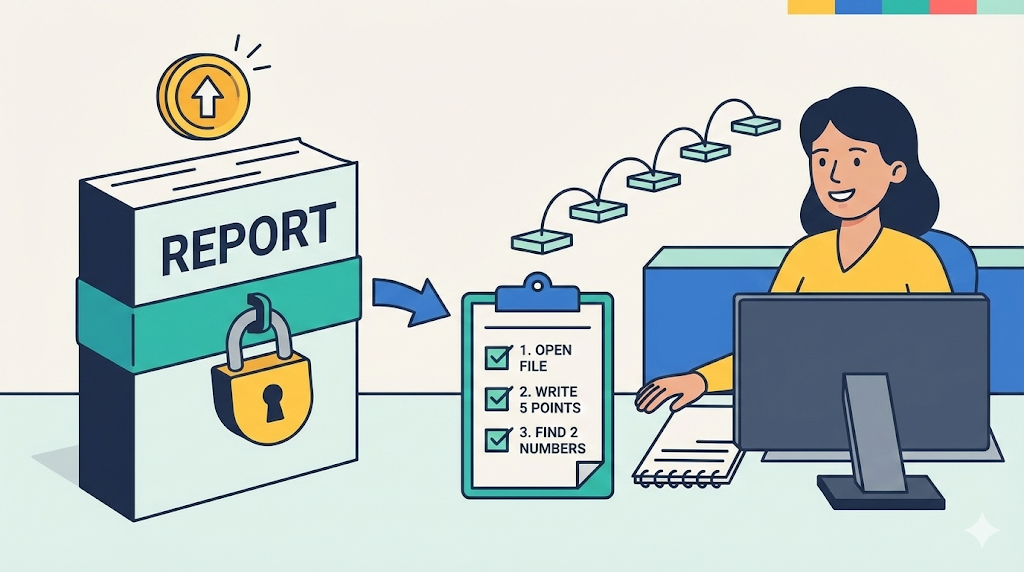
From “Big Project” to Professional Workflow
The skill is not doing more—it is making progress visible.
Sarah is leading a cross-team project for the first time.
In the kickoff meeting, someone says, “It’s simple—just improve onboarding.”
But Sarah hears hidden work: product changes, training, timelines, approvals, and feedback.
That night, she opens her notes and feels a familiar problem: one big label, many unclear parts.
Why “big” often means “unknown”
A big task is scary because it contains uncertainty:
- unclear goals (“What does ‘better’ mean?”)
- hidden dependencies (“We need data from another team.”)
- social risks (“Who decides the final version?”)
When uncertainty is high, people either freeze or stay busy with easier side tasks.
The solution is not motivation first.
The solution is structure first.
Step 1: Define the outcome in one sentence
Sarah writes an outcome statement:
“New users can finish onboarding in 10 minutes with fewer support requests.”
This sentence becomes a filter.
If a task does not support the outcome, it is not a priority.
Step 2: Map deliverables, owners, and dependencies
Next, Sarah lists deliverables (what must exist):
- a new onboarding checklist
- updated help pages
- a short training guide for support staff
- a simple success metric dashboard
For each deliverable, she adds:
- an owner (one responsible person)
- a due date
- dependencies (what must happen first)
- risks (what could block progress)
This is close to how project management frameworks work, including guidance often shared by groups like the Project Management Institute (PMI). It also matches the practical spirit of David Allen’s “next action” approach: reduce stress by making work concrete.
Step 3: Turn deliverables into next actions and checkpoints
Sarah then asks, “What is the next action I can do in 15 minutes?”
Not “work on onboarding.”
Instead:
- “Draft the first checklist step”
- “Book a 20-minute call with Support”
- “Request last month’s ticket data”
She adds weekly checkpoints: a short review every Friday.
In the review, she updates the plan based on what the small steps reveal.
This is where professionals gain control: not by predicting perfectly, but by adjusting early.
Why this matters in modern work
Teams are more global and more remote than before.
Work crosses time zones and tools. Complexity grows quietly.
In this environment, the competitive advantage is clarity:
clear outcomes, visible progress, and shared next actions.
Reports and dashboards help, but the real engine is the step-by-step design.
At the end of the month, Sarah is tired—but not panicked.
The project still has problems, but they appear early, not at the last minute.
Big tasks feel like fog because you cannot see the ground.
Small steps do not remove the mountain.
They give you a path.
Key Points
- Big projects feel hard because they contain uncertainty, dependencies, and social decisions.
- Define outcomes and deliverables, then convert them into next actions with owners and dates.
- Regular checkpoints turn planning into a living system you can adjust.
Words to Know
workflow /ˈwɝːkˌfloʊ/ (n) — an organized way to do work
uncertainty /ʌnˈsɝːtənˌti/ (n) — not being sure what will happen
dependency /dɪˈpɛndənsi/ (n) — something you must have before you can continue
risk /rɪsk/ (n) — a possible problem that could happen
metric /ˈmɛtrɪk/ (n) — a number used to measure success
owner /ˈoʊnər/ (n) — the person responsible for a task
approval /əˈpruːvəl/ (n) — official permission to proceed
scope /skoʊp/ (n) — the size and limits of a project
checkpoint /ˈtʃɛkˌpɔɪnt/ (n) — a planned time to review progress
time block /taɪm blɑːk/ (n) — a set time reserved for one kind of work
estimate /ˈɛstɪˌmeɪt/ (n) — a careful guess of time or cost
alignment /əˈlaɪnmənt/ (n) — shared agreement on direction
stakeholder /ˈsteɪkˌhoʊldər/ (n) — someone affected by the project
momentum /moʊˈmɛntəm/ (n) — steady movement that is hard to stop