Wisdom English Learn about the world. Grow your English.
Work & Money

How to Break Big Tasks Into Small Steps

A1 A2 B1 B2

Big work often feels like fog. When you turn it into tiny next actions, the brain feels safer, you start sooner, and progress becomes visible—one small step at a time.

A1 Level

Start with the next clear action.

One Big Task, Three Small Steps

Start with the next clear action.

Emma sits at her desk. She looks at her screen.
Her boss wrote one line: “Finish the report.”
Emma feels tight in her chest. The word “report” feels too big.
She thinks, “I cannot do this.” So she does nothing.

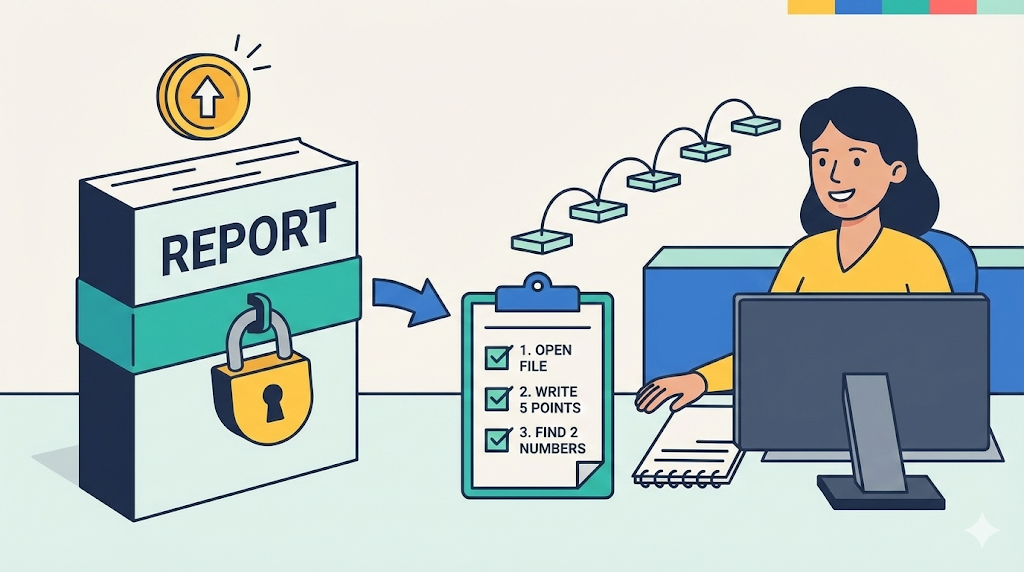
Then Emma takes a pen. She writes the big task at the top: REPORT.
Under it, she writes three small steps:

  1. Open the file.
  2. Write five bullet points.
  3. Find two numbers.

Now the task looks different. It is not one big wall.
It is three small doors.

Emma starts with step 1. She opens the file.
It takes one minute.
She feels a little better.
Then she does step 2 for ten minutes. She stops after five bullets.
That is okay. She started.

Big tasks feel scary because they are unclear.
When you make small steps, you can see the path.
You do not need to climb the whole mountain today.
You only need the next step.

At the end of the day, Emma smiles.
The report is not finished yet, but it is moving.
Small steps make big work possible.


Key Points

  • A big task feels easier when you turn it into small steps.
  • Start with one small action, and progress begins.

Words to Know

task /tæsk/ (n) — a piece of work to do
step /stɛp/ (n) — one small action in a process
start /stɑːrt/ (v) — to begin
list /lɪst/ (n) — items written one after another
clear /klɪr/ (adj) — easy to understand
plan /plæn/ (n) — a set of steps to follow
progress /ˈproʊɡrɛs/ (n) — forward movement toward a goal


📝 Practice Questions

A1 – True/False

  1. Emma feels scared because the word “report” feels too big.
  2. Small steps make the path clearer.
  3. Emma must finish the whole report in one hour.

A1 – Multiple Choice

  1. What is Emma’s first small step?
    A. Write the final report
    B. Open the file
    C. Present to the team

  2. Why do big tasks feel scary?
    A. They are always impossible
    B. They are unclear
    C. They are fun

  3. What helps Emma start?
    A. A clear next step
    B. Waiting until night
    C. Forgetting the task

A1 – Short Answer

  1. What is the big task called?
  2. How many small steps does Emma write?
  3. What does Emma feel at the end?

A1 – True/False

  1. True
  2. True
  3. False

A1 – Multiple Choice

  1. B
  2. B
  3. A

A1 – Short Answer

  1. The report
  2. Three
  3. She smiles / hope
A2 Level

Make the first move small enough to begin today.

The “Next Action” Trick

Make the first move small enough to begin today.

Lina stares at her to-do list in the office.
One item says, “Prepare the presentation.”
She feels tired before she even starts.
So she checks email, then checks messages, then says, “I will do it later.”

Her manager, Mark, walks by. “What’s wrong?” he asks.
Lina points at the list. “It’s too big,” she says.

Why big tasks feel heavy

A big label often hides many small tasks.
“Presentation” can mean: choose a topic, collect data, make slides, practice, and send it.
When your brain cannot see the path, it chooses avoidance.
It is not laziness. It is fear of unclear work.

Make one tiny next action

Mark says, “Don’t plan everything. Choose the next action.”
Not “work on presentation.”
Say: “Write the first three slide titles.”
Or: “Open a new file and type the main message.”

Then he adds one rule: “Make it a 10-minute start.”
Set a timer for 10 minutes. Work. Then stop.
This feels safe, so starting becomes easier.

Keep momentum with small wins

After a 10-minute start, you get a quick win.
A quick win gives energy. It also shows progress.
Lina makes a checklist with tiny verbs: write, find, draft, practice.
Each check mark tells her, “I am moving.”

One week later, Lina finishes early.
She did not become a new person overnight.
She simply made the work smaller—so she could begin.


Key Points

  • Big labels hide many smaller tasks, so the brain avoids them.
  • A tiny “next action” makes starting easier.
  • Small wins create momentum and reduce stress.

Words to Know

overwhelm /ˌoʊvərˈwɛlm/ (v) — to feel too much to handle
avoid /əˈvɔɪd/ (v) — to stay away from something
action /ˈækʃən/ (n) — something you do
timer /ˈtaɪmər/ (n) — a tool that counts time
draft /dræft/ (n) — a first rough version
checklist /ˈtʃɛkˌlɪst/ (n) — a list you mark when done
momentum /moʊˈmɛntəm/ (n) — energy that keeps movement going
deadline /ˈdɛdˌlaɪn/ (n) — the last day or time to finish
deliver /dɪˈlɪvər/ (v) — to produce and give a result


📝 Practice Questions

A2 – True/False

  1. Lina avoids work because the task feels unclear.
  2. Mark says you should plan every detail first.
  3. A 10-minute start can make beginning easier.

A2 – Multiple Choice

  1. What does Mark mean by “next action”?
    A. A tiny task you can do soon
    B. A long plan for the whole week
    C. A reward after finishing

  2. Which is a good “next action”?
    A. Work on presentation
    B. Make everything perfect
    C. Write the first three slide titles

  3. What do small wins help create?
    A. Momentum
    B. Confusion
    C. Silence

A2 – Short Answer

  1. What tool does Mark suggest for 10 minutes?
  2. Name one verb Lina puts on her checklist.
  3. Why does the brain avoid unclear work?

A2 – True/False

  1. True
  2. False
  3. True

A2 – Multiple Choice

  1. A
  2. C
  3. A

A2 – Short Answer

  1. A timer
  2. (Example) write / draft / practice
  3. It cannot see a clear path / it feels risky
B1 Level

Small steps turn uncertainty into a workable map.

When Work Feels Like Fog

Small steps turn uncertainty into a workable map.

David opens his laptop on Monday morning.
A message from his team says: “Please lead the project update.”
It sounds simple, but his mind fills with questions.
What should he show? How much detail? What if the plan changed?

So David starts “research.”
He reads documents, changes his outline, and then changes it again.
By Thursday, he is busy—but not ready.

The brain dislikes unclear work

Big tasks often feel risky because the path is not clear.
Psychologists sometimes describe this as a kind of mental load:
your mind holds too many open questions at once.
When mental load rises, procrastination becomes more likely.

Make deliverables, then next actions

David tries a different approach. He writes the outcome first:
“After my update, the team will know what is done, what is next, and what we need.”

Then he lists deliverables:

  • a one-page outline
  • five key slides
  • two numbers (budget and timeline)
  • a short practice run

Now he converts each deliverable into next actions with verbs:

  • “Write three headings for the outline”
  • “Draft slide 1 in 15 minutes”
  • “Email Sara for the budget number”

This kind of “next action” thinking is common in workplace advice, including Harvard Business Review articles on planning and execution.

Use checkpoints to prevent last-minute panic

David also adds checkpoints.
Not one giant deadline, but small dates: outline by Tuesday, slides by Wednesday, practice by Thursday.
Checkpoints reduce surprise. They show problems early, when fixes are easier.

On Friday, David presents calmly.
His work did not feel magical. It felt visible.
When you shrink a big task into clear actions, you do not need more talent.
You need a better path.


Key Points

  • Unclear tasks increase mental load and make procrastination more likely.
  • Deliverables and next actions turn “fog” into a clear plan.
  • Checkpoints help you finish with less stress and better quality.

Words to Know

outcome /ˈaʊtˌkʌm/ (n) — the result you want
mental load /ˈmɛnṭl loʊd/ (n) — how much the mind must hold at once
procrastination /proʊˌkræsṭɪˈneɪʃən/ (n) — delay of important work
deliverable /dɪˈlɪvərəbəl/ (n) — a required piece of finished work
checkpoint /ˈtʃɛkˌpɔɪnt/ (n) — a small review point on the way
priority /praɪˈɔːrɪti/ (n) — what matters most first
estimate /ˈɛstɪˌmeɪt/ (v) — to guess time or cost based on facts
batch /bætʃ/ (v) — to group similar tasks together
revise /rɪˈvaɪz/ (v) — to improve by changing
stakeholder /ˈsteɪkˌhoʊldər/ (n) — a person affected by the work
momentum /moʊˈmɛntəm/ (n) — steady forward movement


📝 Practice Questions

B1 – True/False

  1. David stays busy with research but still feels unready.
  2. Deliverables are required pieces of finished work.
  3. One giant deadline always reduces stress.

B1 – Multiple Choice

  1. What is the first thing David writes to guide the work?
    A. The outcome
    B. The color of the slides
    C. A long reading list

  2. Which is a deliverable in the article?
    A. “Be better at work”
    B. A one-page outline
    C. “Try harder tomorrow”

  3. Why do checkpoints help?
    A. They create surprise at the end
    B. They show problems early
    C. They remove all tasks

B1 – Short Answer

  1. What problem increases when tasks are unclear?
  2. Give one example of a “next action” David uses.
  3. What happens to David’s presentation on Friday?

B1 – True/False

  1. True
  2. True
  3. False

B1 – Multiple Choice

  1. A
  2. B
  3. B

B1 – Short Answer

  1. Mental load
  2. (Example) Write three headings / Draft slide 1 / Email Sara
  3. He presents calmly
B2 Level

The skill is not doing more—it is making progress visible.

From “Big Project” to Professional Workflow

The skill is not doing more—it is making progress visible.

Sarah is leading a cross-team project for the first time.
In the kickoff meeting, someone says, “It’s simple—just improve onboarding.”
But Sarah hears hidden work: product changes, training, timelines, approvals, and feedback.
That night, she opens her notes and feels a familiar problem: one big label, many unclear parts.

Why “big” often means “unknown”

A big task is scary because it contains uncertainty:

  • unclear goals (“What does ‘better’ mean?”)
  • hidden dependencies (“We need data from another team.”)
  • social risks (“Who decides the final version?”)

When uncertainty is high, people either freeze or stay busy with easier side tasks.
The solution is not motivation first.
The solution is structure first.

Step 1: Define the outcome in one sentence

Sarah writes an outcome statement:
“New users can finish onboarding in 10 minutes with fewer support requests.”

This sentence becomes a filter.
If a task does not support the outcome, it is not a priority.

Step 2: Map deliverables, owners, and dependencies

Next, Sarah lists deliverables (what must exist):

  • a new onboarding checklist
  • updated help pages
  • a short training guide for support staff
  • a simple success metric dashboard

For each deliverable, she adds:

  • an owner (one responsible person)
  • a due date
  • dependencies (what must happen first)
  • risks (what could block progress)

This is close to how project management frameworks work, including guidance often shared by groups like the Project Management Institute (PMI). It also matches the practical spirit of David Allen’s “next action” approach: reduce stress by making work concrete.

Step 3: Turn deliverables into next actions and checkpoints

Sarah then asks, “What is the next action I can do in 15 minutes?”
Not “work on onboarding.”
Instead:

  • “Draft the first checklist step”
  • “Book a 20-minute call with Support”
  • “Request last month’s ticket data”

She adds weekly checkpoints: a short review every Friday.
In the review, she updates the plan based on what the small steps reveal.
This is where professionals gain control: not by predicting perfectly, but by adjusting early.

Why this matters in modern work

Teams are more global and more remote than before.
Work crosses time zones and tools. Complexity grows quietly.
In this environment, the competitive advantage is clarity:
clear outcomes, visible progress, and shared next actions.
Reports and dashboards help, but the real engine is the step-by-step design.

At the end of the month, Sarah is tired—but not panicked.
The project still has problems, but they appear early, not at the last minute.
Big tasks feel like fog because you cannot see the ground.
Small steps do not remove the mountain.
They give you a path.


Key Points

  • Big projects feel hard because they contain uncertainty, dependencies, and social decisions.
  • Define outcomes and deliverables, then convert them into next actions with owners and dates.
  • Regular checkpoints turn planning into a living system you can adjust.

Words to Know

workflow /ˈwɝːkˌfloʊ/ (n) — an organized way to do work
uncertainty /ʌnˈsɝːtənˌti/ (n) — not being sure what will happen
dependency /dɪˈpɛndənsi/ (n) — something you must have before you can continue
risk /rɪsk/ (n) — a possible problem that could happen
metric /ˈmɛtrɪk/ (n) — a number used to measure success
owner /ˈoʊnər/ (n) — the person responsible for a task
approval /əˈpruːvəl/ (n) — official permission to proceed
scope /skoʊp/ (n) — the size and limits of a project
checkpoint /ˈtʃɛkˌpɔɪnt/ (n) — a planned time to review progress
time block /taɪm blɑːk/ (n) — a set time reserved for one kind of work
estimate /ˈɛstɪˌmeɪt/ (n) — a careful guess of time or cost
alignment /əˈlaɪnmənt/ (n) — shared agreement on direction
stakeholder /ˈsteɪkˌhoʊldər/ (n) — someone affected by the project
momentum /moʊˈmɛntəm/ (n) — steady movement that is hard to stop

📝 Practice Questions

B2 – True/False

  1. Sarah’s big project includes hidden dependencies and decisions.
  2. An outcome statement can help set priorities.
  3. Weekly reviews make adjustment harder and slower.

B2 – Multiple Choice

  1. Which is Sarah’s outcome statement idea?
    A. “Make onboarding look cool”
    B. “New users finish onboarding in 10 minutes with fewer support requests”
    C. “Write more emails to everyone”

  2. What does Sarah add to each deliverable?
    A. Owner, due date, dependencies, and risks
    B. Only a title and a color
    C. A promise to work late every night

  3. Why is clarity especially important in modern work?
    A. Teams are often global and remote
    B. All projects are small now
    C. Deadlines no longer exist

B2 – Short Answer

  1. Name two things that make big tasks feel “unknown.”
  2. What is one 15-minute next action Sarah could do?
  3. In your work, what is one small step you can do today?

B2 – True/False

  1. True
  2. True
  3. False

B2 – Multiple Choice

  1. B
  2. A
  3. A

B2 – Short Answer

  1. (Example) unclear goals, dependencies, social decisions, risks
  2. (Example) draft first checklist step / book a call / request ticket data
  3. (Personal answer)