Sleep and the Second Half of Learning
Your brain studies after you stop studying.
On Sunday night, Sarah closes her laptop and feels frustrated. She read grammar rules and understood them. But the next day, in a real conversation, the rules do not show up. “I studied,” she thinks. “So why can’t I use it?” Her brain feels full, but her speech feels empty.
Learning Has Two Jobs
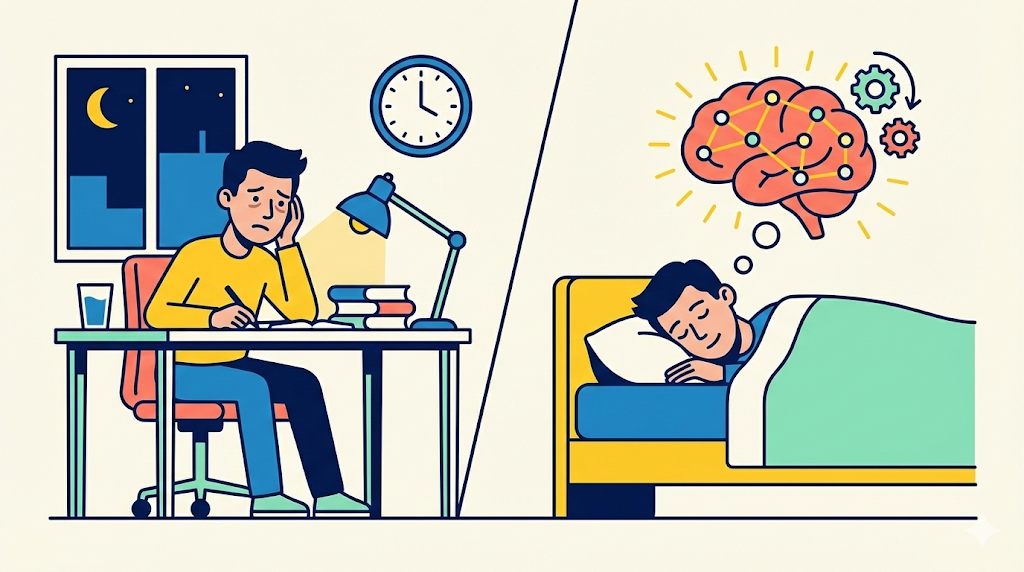
One reason is that learning has two phases. First, you encode new information while awake. This is when you pay attention, connect ideas, and practice. Second, you consolidate that learning later, especially during sleep. Consolidation is the brain’s way of stabilizing new memory networks and making them easier to reach. Without that second phase, new learning can stay fragile. It can feel clear at night and then feel “gone” in the morning.
Sleep also supports skill automation. Facts are one kind of learning: a definition, a date, a rule. Skills are another: speaking smoothly, typing without looking, playing a simple song. Skill learning needs the brain to turn slow, effortful steps into faster patterns. Many summaries from places like Harvard Medical School describe sleep as important for memory and performance, not only for mood or energy.
What Sleep Stages Add
Not all sleep is the same. Across the night, your brain moves through cycles that include deeper sleep and REM sleep. These stages are linked to different kinds of processing. Deep sleep is often discussed in connection with strengthening certain memories and restoring the body. REM sleep is often discussed in connection with emotions, creativity, and linking new information with older memories. The details can be complex, but the everyday message is clear: the brain uses the night to sort, strengthen, and connect what you practiced.
That is why all-nighters can backfire. You might gain extra study hours, but you lose the time when the brain finishes the work. You also arrive the next day with weaker attention, more mistakes, and less emotional control. In other words, you may study more and learn less.
Protecting Sleep in Modern Life
Modern life makes this hard. Screens keep our minds bright and busy. Work schedules push late nights. Stress keeps the body alert. Many learners blame themselves for “low talent,” but the real issue is often low recovery.
Timing matters, too. Your body follows a daily rhythm, so “random catch-up” sleep can feel less refreshing than steady sleep. A regular bedtime helps your brain predict rest, so it can enter deep sleep and REM more smoothly. This is also why two people can study the same amount, but learn differently: one protects sleep, and the other breaks it.
Sarah tries a different system. She studies in shorter blocks, with full focus. She stops one hour before bed. She reviews lightly, then sleeps at a steady time. If she must review, she does it earlier, not at 1 a.m. She keeps her phone away from the pillow. On days when she is tired, she chooses a short nap instead of a late-night crash.
After two weeks, she notices a change. The rules feel less like rules and more like tools. She speaks with fewer pauses. She remembers with less effort. Sleep becomes a study partner—quiet, invisible, but powerful—because it lets learning complete its second half at night.
Key Points
- Learning needs both encoding (awake) and consolidation (sleep).
- Sleep stages support different mental jobs, including memory and skill-building.
- Regular sleep timing can protect attention, emotion, and learning efficiency.
Words to Know
consolidation /kənˌsɑːlɪˈdeɪʃən/ (n) — making new learning stable in memory
encoding /ɪnˈkoʊdɪŋ/ (n) — putting new information into memory
automation /ˌɔːtəˈmeɪʃən/ (n) — a skill becoming fast and easy to do
network /ˈnetˌwɜːrk/ (n) — connected parts working together (like memory links)
REM /rem/ (n) — a sleep stage linked with dreaming and emotions
deep sleep /diːp sliːp/ (n) — a strong sleep stage linked with recovery
circadian rhythm /sərˈkeɪdiən ˈrɪðəm/ (n) — the body’s daily clock
recovery /rɪˈkʌvəri/ (n) — returning to a healthy, rested state
integration /ˌɪntɪˈɡreɪʃən/ (n) — joining new ideas with older knowledge
fragile /ˈfrædʒəl/ (adj) — easily broken or lost
rehearsal /rɪˈhɜːrsəl/ (n) — practice that repeats a skill or pattern
stimulus /ˈstɪmjələs/ (n) — something that wakes or pushes the brain
self-control /ˌself kənˈtroʊl/ (n) — managing impulses and emotions
efficiency /ɪˈfɪʃənsi/ (n) — doing well with less waste of time/energy