Wisdom English Learn about the world. Grow your English.
Health & Body

How Sleep Helps Your Brain Learn Better

A1 A2 B1 B2

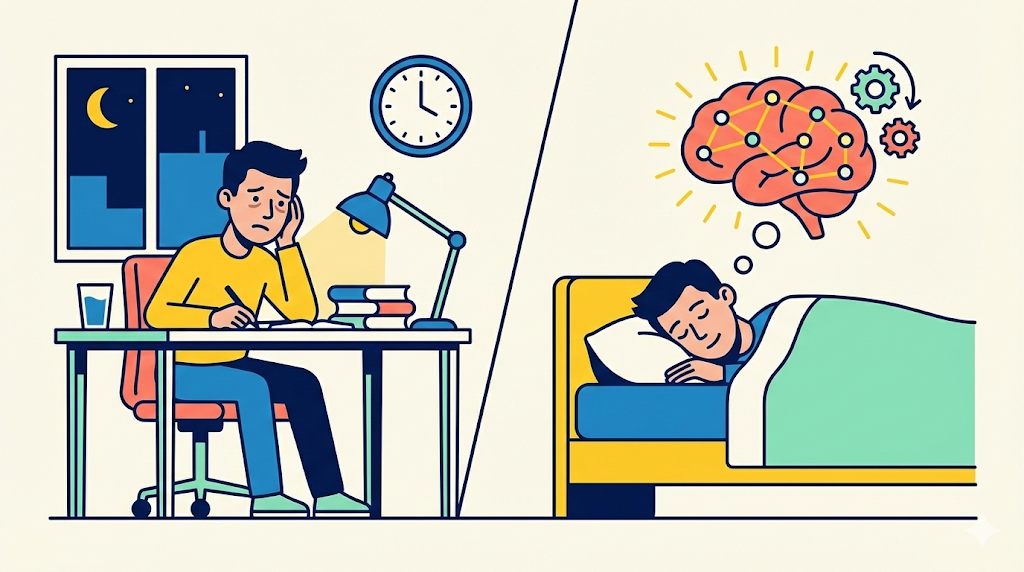
Sleep is the second half of learning. During the night, the brain saves memories, practices skills, and resets attention. With steady sleep, studying becomes easier, faster, and less stressful.

A1 Level

Study is step one. Sleep is step two.

Sleep Helps Learning Stay

Study is step one. Sleep is step two.

Ben sits at his desk at night. A small lamp is on. His room is quiet. He drinks water and turns pages. He studies new English words. He repeats them again and again. He feels proud. Then he looks at the clock. It is very late. His eyes feel heavy.

In the morning, Ben opens his notebook. He tries to remember the words. But his mind feels slow. The words feel far away. He reads the same line two times. He makes small mistakes. He thinks, “Why did I study so much?”

Sleep is not only rest. Sleep helps your brain learn. When you sleep, your brain keeps the important things. It makes the new memory stronger. It also removes some “noise,” like cleaning a messy table. Then you can focus better the next day.

Ben tries a new plan for three nights. He studies for a shorter time. Then he reviews for five minutes. After that, he goes to bed earlier. He does not scroll on his phone in bed. The next morning, he feels calmer. In class, one new word comes back fast. Then another word comes back. Ben smiles. He learns a simple lesson: study puts words in, but sleep helps them stay.


Key Points

  • Sleep helps your brain keep new learning.
  • Good sleep helps you focus tomorrow.

Words to Know

sleep /sliːp/ (n/v) — rest at night
brain /breɪn/ (n) — the organ that thinks and remembers
remember /rɪˈmembər/ (v) — keep something in your mind
focus /ˈfoʊkəs/ (n/v) — strong attention on one thing
tired /ˈtaɪərd/ (adj) — needing rest
review /rɪˈvjuː/ (n/v) — look again to remember
noise /nɔɪz/ (n) — extra sound or extra “mess” in the mind


📝 Practice Questions

A1 – True/False

  1. Ben studies very late at night.
  2. Sleep makes new memory weaker.
  3. Ben stops using his phone in bed.

A1 – Multiple Choice

  1. What happens to Ben in the morning?
    A. He forgets many words
    B. He runs a long race
    C. He cooks a big meal

  2. Sleep helps the brain by…
    A. saving important learning
    B. changing the weather
    C. making money grow

  3. Ben reviews before bed for…
    A. five minutes
    B. five hours
    C. five days

A1 – Short Answer

  1. Where does Ben study at night?
  2. How does Ben feel in the morning?
  3. What helps learning stay?

A1 – True/False

  1. True
  2. False
  3. True

A1 – Multiple Choice

  1. A
  2. A
  3. A

A1 – Short Answer

  1. At his desk
  2. Slow and tired
  3. Sleep
A2 Level

Less late-night struggle, more next-day memory.

Sleep Is the Save Button

Less late-night struggle, more next-day memory.

Emma walks out of class with a quiz paper. She studied late, but her score is lower than she hoped. “I know these words,” she says, “but they disappear.” On the bus home, she feels tired and a little angry. She thinks, “Maybe I am just bad at languages.”

Sleep is the “Save” Button

Her teacher, Mr. Harris, listens and nods. “Your brain learns in two steps,” he says. “Step one is study. Step two is sleep.” He explains it like a phone. You can type a message, but if you do not press save, it can vanish. Sleep is like the save button for learning.

During sleep, the brain strengthens the connections for useful memories. It also quiets extra signals, like turning down noise in a crowded room. Another way to picture it is a desk. At night the desk is messy with papers. Sleep helps sort the papers into simple folders. After that, attention works better. You can notice details, follow a conversation, and remember faster.

A Small Plan That Works

Emma used to do “one more hour” again and again. Sometimes she even tried an all-nighter. She had more study time, but she forgot more the next day. Now she tries a kinder plan for five nights. She studies for a clear time, not “until I drop.” She does a short review before bed. Then she sleeps at a similar time each night. In the morning, she drinks water and does a quick warm-up: one easy page, not a long test.

On one busy day, she also takes a short nap in the afternoon. It does not replace night sleep, but it helps her feel alert.

Some sleep groups, like the National Sleep Foundation, often remind people that good sleep supports memory and daytime focus. Emma feels this in her own life. She studies a little less, but she learns more. It is not magic. It is how the brain finishes the job at night.


Key Points

  • Sleep helps “save” new learning in your brain.
  • A steady routine can help memory and focus.
  • All-nighters often feel productive but hurt recall.

Words to Know

memory /ˈmeməri/ (n) — what your brain keeps and remembers
save /seɪv/ (v) — keep something so it does not disappear
connection /kəˈnekʃən/ (n) — a link between things
attention /əˈtenʃən/ (n) — the ability to focus
routine /ruːˈtiːn/ (n) — a regular pattern you follow
all-nighter /ˌɔːl ˈnaɪtər/ (n) — staying awake all night
alert /əˈlɜːrt/ (adj) — awake and ready
nap /næp/ (n) — a short sleep in the day
improve /ɪmˈpruːv/ (v) — get better


📝 Practice Questions

A2 – True/False

  1. Emma’s teacher says sleep is like a “save” button.
  2. Emma’s all-nighters helped her remember more.
  3. A short nap can help Emma feel more alert.

A2 – Multiple Choice

  1. In the article, sleep is compared to…
    A. a save button
    B. a loud speaker
    C. a heavy backpack

  2. What does sleep help “clean” in the metaphor?
    A. a messy desk
    B. a dirty street
    C. a broken window

  3. What new habit does Emma try?
    A. steady sleep times
    B. skipping all reviews
    C. studying only at noon

A2 – Short Answer

  1. Who talks with Emma after the quiz?
  2. What did Emma try before that hurt recall?
  3. When does Emma take a short nap?

A2 – True/False

  1. True
  2. False
  3. True

A2 – Multiple Choice

  1. A
  2. A
  3. A

A2 – Short Answer

  1. Mr. Harris
  2. An all-nighter
  3. In the afternoon
B1 Level

Attention learns. Sleep keeps. Morning uses.

Sleep: The Hidden Part of Studying

Attention learns. Sleep keeps. Morning uses.

David is preparing for a speaking test at work. He wants to sound smooth and confident. On Tuesday night, he looks at his notes and thinks about staying up very late. “If I study longer, I will learn more,” he tells himself. The room is quiet, but his brain feels busy. He has coffee. He checks messages. Time disappears.

First: Attention is the Door

After midnight, David notices a problem. His eyes move across the page, but his mind is not really taking in the meaning. He reads the same sentence again. He hears a new phrase, but it does not “stick.” When you are tired, attention drops first, and learning starts with attention. If the door is half closed, less information goes in. You may feel “busy,” but your brain is collecting weak, blurry memories.

Then: Sleep Stores What You Learned

The next part happens in sleep. Many researchers describe learning as two steps: you encode new information while awake, and you consolidate it during sleep. Consolidation means the brain makes the useful memory stronger and more stable. It also trims some weak signals, so important ideas stand out.

This is linked to skill learning, too. A language skill is not only “knowing a rule.” It is using the rule quickly while you speak. During sleep, the brain can replay patterns and make them easier to use. Different sleep stages seem to support different jobs across the night, which is one reason a full night often helps more than a short “crash.”

Public health groups like the CDC connect sleep with daily performance, including focus and decision-making. David feels this when he compares two nights: a short night with long study, and a full night with shorter study.

A Simple Night Plan

On Wednesday, he tries a different plan. He studies for 45 minutes with full focus. Then he stops. Ten minutes before bed, he does a light review: key words, one short dialogue, and three speaking lines. He sets an alarm for bedtime, not only for waking up. He puts his phone away. He sleeps.

On Thursday morning, he tests himself. He speaks the lines again. He still makes mistakes, but he hesitates less. He remembers the phrases faster. At lunch, he even takes a 15–20 minute nap. It does not replace night sleep, but it helps him feel alert for the afternoon meeting.

David learns a practical truth: an all-nighter can give you more hours, but it can also make your brain “leak.” A good night of sleep, plus a short review, often gives you better learning for the same effort.


Key Points

  • When you are tired, attention drops and learning becomes weaker.
  • Sleep helps store new information and build smoother skills.
  • A short review + steady sleep often beats an all-nighter.

Words to Know

encode /ɪnˈkoʊd/ (v) — put new information into memory
consolidate /kənˈsɑːlɪˌdeɪt/ (v) — make a new memory stronger and stable
stable /ˈsteɪbəl/ (adj) — strong and not easily changed
pattern /ˈpætərn/ (n) — a repeating way something happens
hesitate /ˈhezɪˌteɪt/ (v) — pause because you are unsure
decision /dɪˈsɪʒən/ (n) — a choice you make
performance /pərˈfɔːrməns/ (n) — how well you do a task
cycle /ˈsaɪkəl/ (n) — a repeated set of stages
stage /steɪdʒ/ (n) — one step in a process
schedule /ˈskedʒuːl/ (n) — a planned timing for activities
leak /liːk/ (v) — lose something slowly (like memory)


📝 Practice Questions

B1 – True/False

  1. The article says attention drops first when you are tired.
  2. Consolidation happens only while you are awake.
  3. David sets an alarm for bedtime, not only for waking up.

B1 – Multiple Choice

  1. What is “attention” compared to in the article?
    A. a door
    B. a river
    C. a mirror

  2. What does sleep help with besides facts?
    A. skill learning
    B. haircut speed
    C. phone brightness

  3. What is David’s bedtime review like?
    A. light and short
    B. long and stressful
    C. completely skipped

B1 – Short Answer

  1. What test is David preparing for?
  2. What two steps describe learning in the article?
  3. How long is David’s lunch nap?

B1 – True/False

  1. True
  2. False
  3. True

B1 – Multiple Choice

  1. A
  2. A
  3. A

B1 – Short Answer

  1. A speaking test
  2. Encode and consolidate
  3. 15–20 minutes
B2 Level

Your brain studies after you stop studying.

Sleep and the Second Half of Learning

Your brain studies after you stop studying.

On Sunday night, Sarah closes her laptop and feels frustrated. She read grammar rules and understood them. But the next day, in a real conversation, the rules do not show up. “I studied,” she thinks. “So why can’t I use it?” Her brain feels full, but her speech feels empty.

Learning Has Two Jobs

One reason is that learning has two phases. First, you encode new information while awake. This is when you pay attention, connect ideas, and practice. Second, you consolidate that learning later, especially during sleep. Consolidation is the brain’s way of stabilizing new memory networks and making them easier to reach. Without that second phase, new learning can stay fragile. It can feel clear at night and then feel “gone” in the morning.

Sleep also supports skill automation. Facts are one kind of learning: a definition, a date, a rule. Skills are another: speaking smoothly, typing without looking, playing a simple song. Skill learning needs the brain to turn slow, effortful steps into faster patterns. Many summaries from places like Harvard Medical School describe sleep as important for memory and performance, not only for mood or energy.

What Sleep Stages Add

Not all sleep is the same. Across the night, your brain moves through cycles that include deeper sleep and REM sleep. These stages are linked to different kinds of processing. Deep sleep is often discussed in connection with strengthening certain memories and restoring the body. REM sleep is often discussed in connection with emotions, creativity, and linking new information with older memories. The details can be complex, but the everyday message is clear: the brain uses the night to sort, strengthen, and connect what you practiced.

That is why all-nighters can backfire. You might gain extra study hours, but you lose the time when the brain finishes the work. You also arrive the next day with weaker attention, more mistakes, and less emotional control. In other words, you may study more and learn less.

Protecting Sleep in Modern Life

Modern life makes this hard. Screens keep our minds bright and busy. Work schedules push late nights. Stress keeps the body alert. Many learners blame themselves for “low talent,” but the real issue is often low recovery.

Timing matters, too. Your body follows a daily rhythm, so “random catch-up” sleep can feel less refreshing than steady sleep. A regular bedtime helps your brain predict rest, so it can enter deep sleep and REM more smoothly. This is also why two people can study the same amount, but learn differently: one protects sleep, and the other breaks it.

Sarah tries a different system. She studies in shorter blocks, with full focus. She stops one hour before bed. She reviews lightly, then sleeps at a steady time. If she must review, she does it earlier, not at 1 a.m. She keeps her phone away from the pillow. On days when she is tired, she chooses a short nap instead of a late-night crash.

After two weeks, she notices a change. The rules feel less like rules and more like tools. She speaks with fewer pauses. She remembers with less effort. Sleep becomes a study partner—quiet, invisible, but powerful—because it lets learning complete its second half at night.


Key Points

  • Learning needs both encoding (awake) and consolidation (sleep).
  • Sleep stages support different mental jobs, including memory and skill-building.
  • Regular sleep timing can protect attention, emotion, and learning efficiency.

Words to Know

consolidation /kənˌsɑːlɪˈdeɪʃən/ (n) — making new learning stable in memory
encoding /ɪnˈkoʊdɪŋ/ (n) — putting new information into memory
automation /ˌɔːtəˈmeɪʃən/ (n) — a skill becoming fast and easy to do
network /ˈnetˌwɜːrk/ (n) — connected parts working together (like memory links)
REM /rem/ (n) — a sleep stage linked with dreaming and emotions
deep sleep /diːp sliːp/ (n) — a strong sleep stage linked with recovery
circadian rhythm /sərˈkeɪdiən ˈrɪðəm/ (n) — the body’s daily clock
recovery /rɪˈkʌvəri/ (n) — returning to a healthy, rested state
integration /ˌɪntɪˈɡreɪʃən/ (n) — joining new ideas with older knowledge
fragile /ˈfrædʒəl/ (adj) — easily broken or lost
rehearsal /rɪˈhɜːrsəl/ (n) — practice that repeats a skill or pattern
stimulus /ˈstɪmjələs/ (n) — something that wakes or pushes the brain
self-control /ˌself kənˈtroʊl/ (n) — managing impulses and emotions
efficiency /ɪˈfɪʃənsi/ (n) — doing well with less waste of time/energy

📝 Practice Questions

B2 – True/False

  1. The article says learning has encoding and consolidation phases.
  2. All-nighters can improve attention the next day.
  3. Regular sleep timing can support learning efficiency.

B2 – Multiple Choice

  1. What is “skill automation” in the article?
    A. using a skill faster and easier
    B. buying a study robot
    C. forgetting rules on purpose

  2. Which sleep stage is linked with emotions and integration (in the article)?
    A. REM sleep
    B. deep sleep only
    C. no sleep stages

  3. What is one modern problem that can harm sleep?
    A. screens and late nights
    B. quiet rooms
    C. warm socks

B2 – Short Answer

  1. What problem does Sarah feel after studying grammar?
  2. Why can “catch-up” sleep feel less refreshing than steady sleep?
  3. What change does Sarah make one hour before bed?

B2 – True/False

  1. True
  2. False
  3. True

B2 – Multiple Choice

  1. A
  2. A
  3. A

B2 – Short Answer

  1. She can’t use rules in conversation
  2. The body’s rhythm prefers steady timing
  3. She stops studying and winds down