Wisdom English Learn about the world. Grow your English.
Health & Body

How Sleep Cycles Work Through the Night

A1 A2 B1 B2

Sleep is not one long “flat” state. It moves in repeating cycles—light sleep, deep sleep, and REM—so your body can recover and your brain can sort memory and emotion.

A1 Level

Your sleep moves in a simple pattern.

Sleep Has Steps at Night

Your sleep moves in a simple pattern.

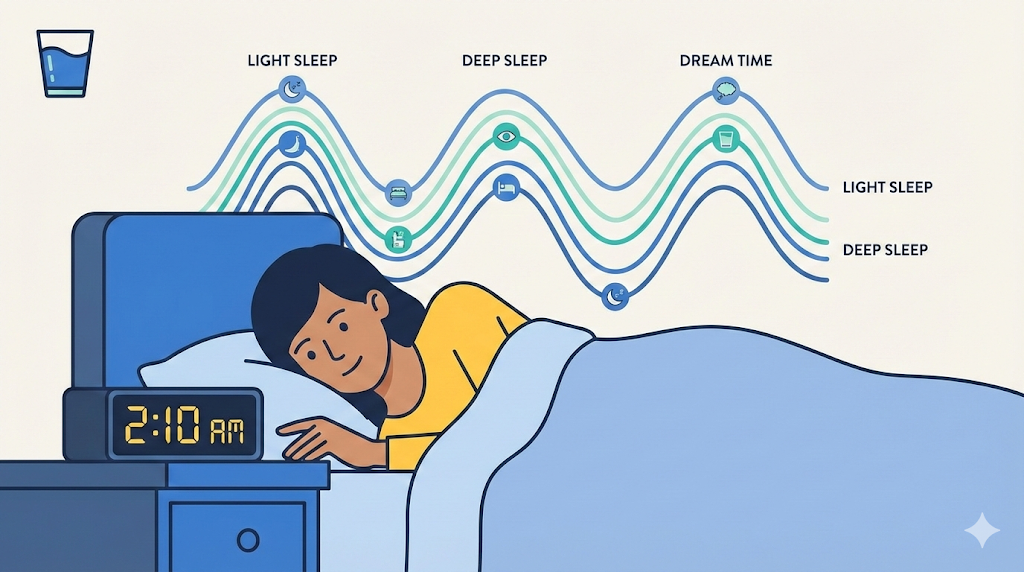
Mina is in bed. She wakes up at 2:10 a.m.
She looks at the clock. Her heart feels fast.
“I woke up,” she thinks. “My sleep is broken.”

But then she remembers something simple.
Sleep is not one long, flat time.
Sleep has steps. These steps repeat.

First, Mina falls into light sleep.
In light sleep, it is easier to wake up.
Then her body goes into deep sleep.
In deep sleep, the body rests more.
It is harder to wake up.

Later, Mina has more dream time.
Her brain is active in dreams.
Her face looks calm again.

Mina understands: waking for a short time can be normal.
Many people wake between sleep steps.
It does not always mean “bad sleep.”

She takes one slow breath.
She does not pick up her phone.
She lets her eyes close again.

In the morning, Mina may not remember the wake-up.
What matters is this: a good night is often many healthy cycles, not perfect unbroken sleep.


Key Points

  • Sleep has steps that repeat during the night.
  • Waking for a short time can be normal.

Words to Know

sleep /sliːp/ (n) — resting time at night
cycle /ˈsaɪkəl/ (n) — a pattern that repeats
stage /steɪdʒ/ (n) — one part of a process
light /laɪt/ (adj) — not heavy; easy
deep /diːp/ (adj) — strong and full; hard to wake from
dream /driːm/ (n) — stories in your mind during sleep
brain /breɪn/ (n) — the organ that thinks and feels
wake up /weɪk ʌp/ (v) — to stop sleeping


📝 Practice Questions

A1 – True/False

  1. Sleep is one long, flat state all night.
  2. Deep sleep is harder to wake from than light sleep.
  3. Waking for a short time at night can be normal.

A1 – Multiple Choice

  1. What does Mina do when she wakes at 2:10 a.m.?
    A. She grabs her phone right away
    B. She takes a slow breath and relaxes
    C. She makes loud noise to stay awake

  2. Which sleep stage is easier to wake from?
    A. Light sleep
    B. Deep sleep
    C. The final morning stage only

  3. What is a “good night” usually made of?
    A. One perfect, unbroken line of sleep
    B. Several healthy cycles
    C. No dreams at all

A1 – Short Answer

  1. What time does Mina wake up?
  2. Which sleep is hardest to wake from?
  3. What should Mina not grab?

A1 – True/False

  1. False
  2. True
  3. True

A1 – Multiple Choice

  1. B
  2. A
  3. B

A1 – Short Answer

  1. 2:10 a.m.
  2. Deep sleep
  3. Her phone
A2 Level

Sleep is like a repeating program, not one long line.

Your Night Runs in Cycles

Sleep is like a repeating program, not one long line.

In the morning, Mina meets her friend Sam for coffee.
Mina looks tired. “I woke up twice,” she says. “I failed.”

Sam smiles. “You didn’t fail,” Sam says. “Sleep works in cycles.”

A night has chapters

Sam explains it like a washing machine.
A washing machine has steps: wash, rinse, spin.
Sleep also has steps, and they repeat.

Many people move through:

  • Light sleep (easy to wake)
  • Deep sleep (body recovery)
  • REM sleep (often strong dreams)

Your brain does not stay in one stage all night.
It moves forward, then starts a new cycle again.

Why you feel groggy

Mina says, “But I felt so heavy when I woke up.”
Sam answers, “It depends on when you wake.”

If you wake from light sleep, you may feel okay.
If you wake from deep sleep, you may feel slow and foggy.
This heavy feeling can last a little while.

Sam also shares one helpful idea:
Deep sleep is often more common earlier in the night.
Dream time (REM) is often more common later in the night.
So, your sleep changes as the night goes on.

Mina feels calmer. “So waking a little can be normal?”
Sam nods. “Yes. Short wake-ups can happen between cycles. Many people do not remember them.”

Before the next night, Mina makes a small plan.
She will choose a steady bedtime for three nights.
She will keep her phone away.
She wants to help her cycles run smoothly.

Sleep is not a test you pass or fail.
It is your body and brain doing their nightly work—step by step.


Key Points

  • Sleep repeats in cycles with different stages.
  • Waking from deep sleep can feel more groggy.
  • A steady bedtime can help cycles feel smoother.

Words to Know

routine /ruːˈtiːn/ (n) — a regular way of doing things
repeat /rɪˈpiːt/ (v) — to happen again
recover /rɪˈkʌvər/ (v) — to get energy back
REM /rem/ (n) — dream stage with active brain
NREM /ˌenˈrem/ (n) — non-dream sleep stages
memory /ˈmeməri/ (n) — what you remember
mood /muːd/ (n) — how you feel
groggy /ˈɡrɒɡi/ (adj) — sleepy and not clear
signal /ˈsɪɡnəl/ (n) — a message in the body
timing /ˈtaɪmɪŋ/ (n) — when something happens


📝 Practice Questions

A2 – True/False

  1. Sleep cycles repeat like steps in a washing machine.
  2. REM sleep is often linked with dreams.
  3. Waking from deep sleep can feel lighter than waking from light sleep.

A2 – Multiple Choice

  1. Sam compares sleep cycles to a:
    A. Washing machine
    B. Bicycle race
    C. Weather map

  2. Which is more common later in the night for many people?
    A. Deep sleep
    B. REM sleep
    C. No sleep stages at all

  3. What plan does Mina choose for three nights?
    A. A steady bedtime
    B. More late-night videos
    C. Skipping sleep to feel tired

A2 – Short Answer

  1. Name one sleep stage Sam mentions.
  2. When can short wake-ups happen?
  3. What can help cycles run smoothly?

A2 – True/False

  1. True
  2. True
  3. False

A2 – Multiple Choice

  1. A
  2. B
  3. A

A2 – Short Answer

  1. Light sleep / deep sleep / REM (any one)
  2. Between cycles
  3. A steady bedtime (or calm routine)
B1 Level

The stage you wake from—and your timing—can change your morning.

Why Two 7-Hour Nights Can Feel Very Different

The stage you wake from—and your timing—can change your morning.

Mina had two nights with the same sleep time: seven hours.
But the mornings felt very different.

On Tuesday, she woke up clear and steady.
On Friday, she woke up heavy and slow, even after coffee.
She wondered, “Why is this happening?”

The early night: body repair

Sleep usually moves in cycles.
Inside each cycle, the brain and body shift through different stages.

In the earlier part of the night, many people get more deep sleep.
Deep sleep supports physical recovery.
Your muscles rest. Your heartbeat slows. Your body does quiet repair work.

Because deep sleep is strong, waking from it can feel unpleasant.
You may feel “stuck” in sleep for a while, even after you stand up.

The late night: brain work

Later in the night, many people get more REM sleep.
REM is a stage where vivid dreams are common.
The brain is active, and many researchers connect this stage to memory and emotion processing.

So, the night is not “the same sleep” from start to finish.
It changes, and the mix of stages shifts.

Small wake-ups are normal

Mina also noticed something important: she sometimes woke for a minute.
She thought it meant “bad sleep,” but that is not always true.

Short wake-ups can happen between cycles.
Many people fall back asleep quickly and forget it.

What made Mina’s Friday worse was her evening habit.
She stayed up late scrolling on her phone.
Her mind felt busy, and her bedtime moved later than usual.

The result: she woke at a worse moment in her cycles, and she felt more groggy.

Mina learned a kinder way to judge sleep.
Not “Did I wake up?” but “How do I function today?”
When she kept a calmer wind-down and a steadier bedtime, her cycles felt smoother.

A good night is not perfect silence.
It is your body and brain doing their jobs—again and again—until morning.


Key Points

  • Sleep cycles change across the night: more deep sleep early, more REM later.
  • Waking from deep sleep can cause strong morning grogginess.
  • Regular timing and a calm wind-down can improve how sleep feels.

Words to Know

cycle /ˈsaɪkəl/ (n) — a repeating pattern
deep sleep /diːp sliːp/ (n) — strong sleep for body recovery
REM sleep /rem sliːp/ (n) — dream stage with active brain
process /ˈprəʊses/ (v) — to work on and organize
emotion /ɪˈməʊʃən/ (n) — a strong feeling
balance /ˈbæləns/ (n) — a good mix of parts
wind-down /ˈwaɪnd daʊn/ (n) — calm time before sleep
scroll /skrəʊl/ (v) — to move down on a phone screen
steady /ˈstedi/ (adj) — stable and regular
foggy /ˈfɒɡi/ (adj) — not clear in the mind
recover /rɪˈkʌvər/ (v) — to regain energy
shift /ʃɪft/ (v) — to move or change


📝 Practice Questions

B1 – True/False

  1. Two nights with the same hours can feel different in the morning.
  2. Early night often has more deep sleep for body recovery.
  3. Short wake-ups always mean your sleep is unhealthy.

B1 – Multiple Choice

  1. Why did Mina feel more groggy on Friday?
    A. She woke during a harder stage and scrolled late
    B. She drank only water and slept early
    C. She had no sleep cycles at all

  2. Deep sleep mainly supports:
    A. Physical recovery
    B. Choosing breakfast foods
    C. Learning new languages instantly

  3. A kinder way to judge sleep is:
    A. “Did I wake up at all?”
    B. “How do I function today?”
    C. “Did I dream every hour?”

B1 – Short Answer

  1. Why is waking from deep sleep difficult?
  2. What habit made Mina’s Friday night worse?
  3. What changes helped Mina feel steadier?

B1 – True/False

  1. True
  2. True
  3. False

B1 – Multiple Choice

  1. A
  2. A
  3. B

B1 – Short Answer

  1. It’s a strong stage; waking feels heavy.
  2. Late-night phone scrolling
  3. Steady bedtime and calmer wind-down
B2 Level

Your cycles are shaped by biology, timing, and modern life.

Sleep Is a Night-Long Program, Not an Off Switch

Your cycles are shaped by biology, timing, and modern life.

On Sunday, Mina tried to “catch up.”
She slept late, stayed in bed, and hoped Monday would feel easy.

But Monday morning felt heavy again.
She had more hours—so why did she feel worse?

The answer is that sleep is not only about duration.
It is also about structure and timing.

Two forces guide your night

Your sleep is shaped by two main forces.

One is sleep pressure.
The longer you stay awake, the more your body wants sleep.

The other is your circadian rhythm, often called your body clock.
It helps your brain expect sleep at night and alertness in the day.
Light in the morning and darkness at night are strong signals for this clock.

When these two forces align, sleep cycles tend to run more smoothly.
When they clash—late nights, bright screens, irregular mornings—your sleep can feel less refreshing.

Cycle architecture and “sleep inertia”

During the night, your brain moves through repeating stages: lighter NREM sleep, deeper NREM sleep, and REM sleep.
This pattern repeats in cycles, and the mix changes across the night.

That is why you can wake for a short moment and still have a normal night.
Many small awakenings happen at the edges of cycles.

But waking from the “wrong” stage can feel terrible.
If you wake from deep sleep, you may feel strong sleep inertia—that heavy, slow, unclear feeling.
It can make you think you slept “badly,” even if you slept long.

Mina noticed this on weekends.
She slept in, but her wake-up time landed in a deeper stage more often.
She got more time in bed, but she started her day in fog.

Modern life can push your timing

Mina’s work week also mattered.
Late-night messages, bright lights, and “just one more episode” moved her bedtime later.
Alcohol on Friday made her fall asleep fast, but her sleep felt more broken later.
Stress made her mind active at 2 a.m.

None of these things are moral failures.
They are powerful inputs to a sensitive system.

Mina stopped chasing “perfect sleep.”
Instead, she tried a simpler goal: protect timing.

She kept a steadier bedtime, even on weekends.
She softened the last 30 minutes of the day—lower light, quieter mind, fewer screens.
In the morning, she opened the curtain for daylight.

Her night still had small wake-ups sometimes.
But she stopped panicking.
She began to trust the idea that sleep is a program with repeating chapters.

When you respect the rhythm—more than just the hours—your body and brain can do their work, cycle by cycle, until morning.


Key Points

  • Sleep quality depends on timing and structure, not only total hours.
  • Sleep pressure and circadian rhythm work together to shape cycles.
  • Screens, stress, alcohol, and irregular schedules can disrupt cycle flow.

Words to Know

sleep pressure /sliːp ˈpreʃər/ (n) — growing need for sleep after being awake
circadian rhythm /sərˈkeɪdiən ˈrɪðəm/ (n) — the body’s daily clock
body clock /ˈbɒdi klɒk/ (n) — internal timing system
architecture /ˈɑːrkɪtektʃər/ (n) — the structure of something
NREM /ˌenˈrem/ (n) — non-dream sleep stages
REM /rem/ (n) — dream stage with active brain
inertia /ɪˈnɜːrʃə/ (n) — slow start; hard to change quickly
sleep inertia /sliːp ɪˈnɜːrʃə/ (n) — heavy grogginess after waking
signal /ˈsɪɡnəl/ (n) — a message that guides the body
disrupt /dɪsˈrʌpt/ (v) — to break the normal flow
align /əˈlaɪn/ (v) — to match well
alertness /əˈlɜːrtnəs/ (n) — being awake and ready
episode /ˈepɪsəʊd/ (n) — one part of a series
reflect /rɪˈflekt/ (v) — to think calmly about something

📝 Practice Questions

B2 – True/False

  1. Sleep quality depends only on total hours slept.
  2. Sleep pressure grows the longer you stay awake.
  3. Bright light at night can affect your body clock signals.

B2 – Multiple Choice

  1. Which two forces guide sleep timing in the article?
    A. Sleep pressure and circadian rhythm
    B. Hunger and muscle size
    C. Luck and personality

  2. “Sleep inertia” is best described as:
    A. A fast energy boost after waking
    B. Heavy grogginess after waking
    C. A way to remember dreams perfectly

  3. Which modern factor can push bedtime later?
    A. Morning sunlight
    B. Bright screens at night
    C. A quiet wind-down routine

B2 – Short Answer

  1. Why can sleeping in still feel tiring on Monday for Mina?
  2. Give one simple way Mina protects her sleep timing.
  3. What is Mina’s new goal besides “more hours”?

B2 – True/False

  1. False
  2. True
  3. True

B2 – Multiple Choice

  1. A
  2. B
  3. B

B2 – Short Answer

  1. Her timing and stages shift; she may wake in deeper sleep.
  2. Steady bedtime / less screens / morning light (any one)
  3. Better timing and smoother cycles