Sleep Is a Night-Long Program, Not an Off Switch
Your cycles are shaped by biology, timing, and modern life.
On Sunday, Mina tried to “catch up.”
She slept late, stayed in bed, and hoped Monday would feel easy.
But Monday morning felt heavy again.
She had more hours—so why did she feel worse?
The answer is that sleep is not only about duration.
It is also about structure and timing.
Two forces guide your night
Your sleep is shaped by two main forces.
One is sleep pressure.
The longer you stay awake, the more your body wants sleep.
The other is your circadian rhythm, often called your body clock.
It helps your brain expect sleep at night and alertness in the day.
Light in the morning and darkness at night are strong signals for this clock.
When these two forces align, sleep cycles tend to run more smoothly.
When they clash—late nights, bright screens, irregular mornings—your sleep can feel less refreshing.
Cycle architecture and “sleep inertia”
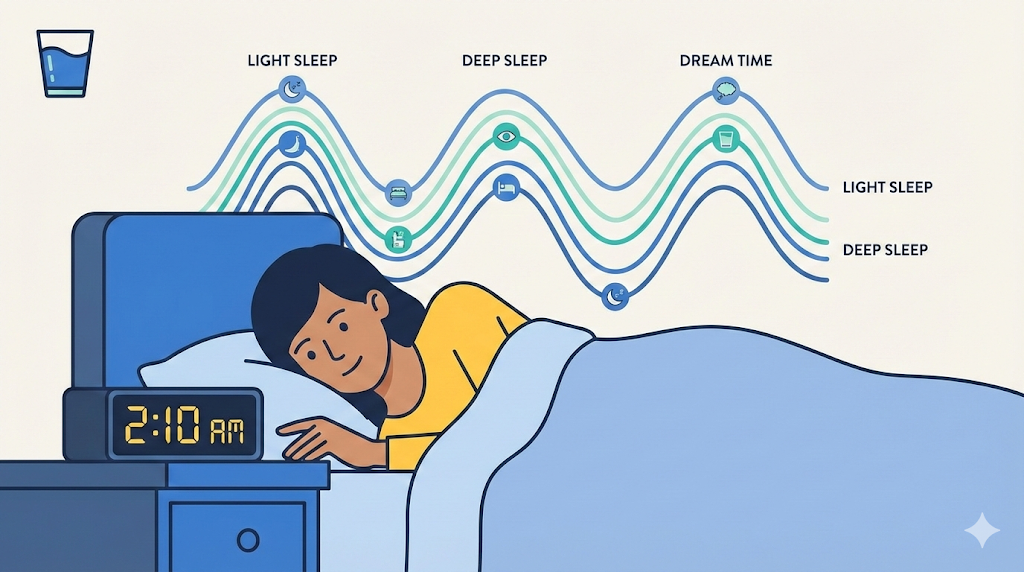
During the night, your brain moves through repeating stages: lighter NREM sleep, deeper NREM sleep, and REM sleep.
This pattern repeats in cycles, and the mix changes across the night.
That is why you can wake for a short moment and still have a normal night.
Many small awakenings happen at the edges of cycles.
But waking from the “wrong” stage can feel terrible.
If you wake from deep sleep, you may feel strong sleep inertia—that heavy, slow, unclear feeling.
It can make you think you slept “badly,” even if you slept long.
Mina noticed this on weekends.
She slept in, but her wake-up time landed in a deeper stage more often.
She got more time in bed, but she started her day in fog.
Modern life can push your timing
Mina’s work week also mattered.
Late-night messages, bright lights, and “just one more episode” moved her bedtime later.
Alcohol on Friday made her fall asleep fast, but her sleep felt more broken later.
Stress made her mind active at 2 a.m.
None of these things are moral failures.
They are powerful inputs to a sensitive system.
Mina stopped chasing “perfect sleep.”
Instead, she tried a simpler goal: protect timing.
She kept a steadier bedtime, even on weekends.
She softened the last 30 minutes of the day—lower light, quieter mind, fewer screens.
In the morning, she opened the curtain for daylight.
Her night still had small wake-ups sometimes.
But she stopped panicking.
She began to trust the idea that sleep is a program with repeating chapters.
When you respect the rhythm—more than just the hours—your body and brain can do their work, cycle by cycle, until morning.
Key Points
- Sleep quality depends on timing and structure, not only total hours.
- Sleep pressure and circadian rhythm work together to shape cycles.
- Screens, stress, alcohol, and irregular schedules can disrupt cycle flow.
Words to Know
sleep pressure /sliːp ˈpreʃər/ (n) — growing need for sleep after being awake
circadian rhythm /sərˈkeɪdiən ˈrɪðəm/ (n) — the body’s daily clock
body clock /ˈbɒdi klɒk/ (n) — internal timing system
architecture /ˈɑːrkɪtektʃər/ (n) — the structure of something
NREM /ˌenˈrem/ (n) — non-dream sleep stages
REM /rem/ (n) — dream stage with active brain
inertia /ɪˈnɜːrʃə/ (n) — slow start; hard to change quickly
sleep inertia /sliːp ɪˈnɜːrʃə/ (n) — heavy grogginess after waking
signal /ˈsɪɡnəl/ (n) — a message that guides the body
disrupt /dɪsˈrʌpt/ (v) — to break the normal flow
align /əˈlaɪn/ (v) — to match well
alertness /əˈlɜːrtnəs/ (n) — being awake and ready
episode /ˈepɪsəʊd/ (n) — one part of a series
reflect /rɪˈflekt/ (v) — to think calmly about something