Rivers: The Hidden System Behind the First Cities
Water control built trade, power, and tough choices
The river smells of wet earth after a long night of rain. In the grain storehouse, Anna, a young scribe, dips her reed pen into ink. She counts sacks of barley and writes numbers on a clay tablet. Outside, boats slide into the dock, heavy with wood and stone. People cheer—until someone shouts that the river is rising again. In a river city, prosperity and danger can arrive in the same current.
Rivers as engines of surplus
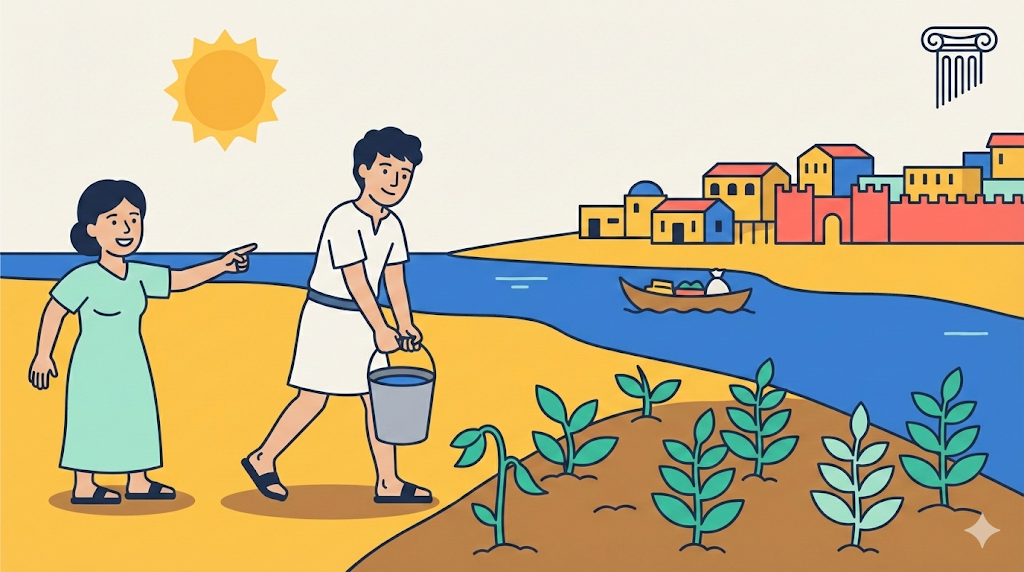
The first cities did not appear by magic. They appeared when daily life became more predictable. Rivers helped make that happen. They offered fresh water close to home, and they made irrigation possible. When a community dug canals, built gates, and timed water releases, farmers could grow crops beyond the reach of rainfall alone.
Floods added a second force. When flooding was moderate, it could renew the land with fertile silt. This raised yields and reduced the need to move constantly in search of better soil. The result was surplus—extra food that could be stored, taxed, traded, and used to feed people who were not farmers.
Surplus is the quiet fuel of urban life. It supports specialists: builders, potters, metalworkers, boat crews, guards, and administrators. It also supports public works—walls, temples, docks, warehouses—because workers can be fed while they build.
Rivers as networks, not just places
Rivers also connected people. A river is a long, natural path. Moving heavy goods by boat costs far less energy than dragging them across land. Over time, this creates trade routes that feel like early “supply chains.” Grain moves out; copper, timber, textiles, and ideas move in.
Many early civilizations formed in major river valleys—the Nile, the Tigris–Euphrates system, the Indus, and the Yellow River. The geography is different, but the logic repeats: water concentrates people, and movement concentrates exchange. A riverside market becomes a meeting point where strangers learn to negotiate, measure, and trust (or distrust) one another. That pressure often encourages standard weights, shared calendars, and record-keeping.
This is also where writing and accounting become more than culture. They become tools for managing a complex system: who delivered grain, who received rations, who repaired canals, and who owes labor after a flood.
Control, conflict, and the politics of water
Yet the same system that builds a city can also divide it. Water control is power. If one group controls the canal gates or the grain storehouse, they can decide who eats first and whose fields stay green. When floods are extreme, the city faces tough decisions: rebuild the riverbank, relocate homes, ration food, or demand extra labor.
Inequality can grow inside the river story. Farmers may do the hardest work, while officials collect taxes. Traders may profit, while poorer families live closer to risky flood zones. In that sense, a river is a gift and a test: it offers resources, but it also forces society to answer moral questions about fairness and responsibility.
Institutions like the British Museum and the Smithsonian help us see how river cities developed laws, administration, and long-distance exchange. The deeper lesson is not only “rivers bring water.” It is that rivers push humans to build systems. When people learned to manage water together—through canals, storage, schedules, and rules—they also learned how to manage a city. And that blueprint, in many forms, still shapes urban life today.
Key Points
- Rivers produced surplus food by enabling irrigation and fertile flood silt.
- River travel created long trade networks and pushed record-keeping systems.
- Water control shaped power, conflict, and fairness inside early cities.
Words to Know
surplus /ˈsɜːrpləs/ (n) — extra supply beyond needs
silt /sɪlt/ (n) — fine soil left after a flood
infrastructure /ˈɪnfrəˌstrʌktʃər/ (n) — basic systems like canals and roads
warehouse /ˈwɛrhaʊs/ (n) — building for storing goods
bureaucracy /bjʊˈrɑːkrəsi/ (n) — system of officials and rules
ration /ˈræʃən/ (n/v) — a limited amount given out
levy /ˈlɛvi/ (n/v) — a tax or to collect a tax
logistics /ləˈdʒɪstɪks/ (n) — planning how goods move
standard /ˈstændərd/ (n/adj) — an agreed rule or measure
governance /ˈɡʌvərnəns/ (n) — how a place is managed and ruled
inequality /ˌɪnɪˈkwɑːləti/ (n) — unfair difference in power or wealth
dispute /dɪˈspjuːt/ (n/v) — an argument or conflict
resilience /rɪˈzɪliəns/ (n) — ability to recover after trouble
administration /ədˌmɪnɪˈstreɪʃən/ (n) — managing systems and records