Wisdom English Learn about the world. Grow your English.
Great Lives

How Louis Braille Opened Books for Blind Readers

A1 A2 B1 B2

A teenage student invented a six-dot code that fingers can read. Braille became a global tool for real literacy—labels, notes, school, and private reading—beyond audio alone.

A1 Level

One page, six dots, and a big smile

The Dots That Became Words

One page, six dots, and a big smile

Mina sits in a small school library.
She loves stories. She wants to read alone.

But the book in her hands has only normal print.
Mina cannot see the letters.
She feels quiet and stuck.

Then her teacher comes with a new page.
The page has small raised dots.
Mina puts one finger on the dots.
She moves slowly.
The teacher says, “This is a letter.”

Mina touches again.
The dots feel like a tiny pattern.
Soon, the pattern becomes a sound in her mind.
A word appears. Mina smiles.

This is Braille.
Braille is a system of dots.
Blind readers can feel the dots with their fingertips.
Six dots can make many letters and numbers.
People can also write Braille with simple tools.

With Braille, books become possible.
School becomes easier.
A person can write a private note.
A person can label a door or a box.
One smart, simple system can open a big door.


Key Points

  • Braille uses raised dots that blind readers feel with their fingertips.
  • Braille helps people read, write, learn, and live more independently.

Words to Know

blind /blaɪnd/ (adj) — not able to see
touch /tʌtʃ/ (v) — feel with your hand or finger
dot /dɑt/ (n) — a very small round mark
raised /reɪzd/ (adj) — higher than the surface
pattern /ˈpætərn/ (n) — a shape that repeats in a clear way
system /ˈsɪstəm/ (n) — a method that works step by step
fingertip /ˈfɪŋɡərˌtɪp/ (n) — the end of a finger
independence /ˌɪndɪˈpɛndəns/ (n) — being able to do things by yourself


📝 Practice Questions

A1 – True/False

  1. Braille uses raised dots that fingers can feel.
  2. Mina can read normal print easily.
  3. Braille can help people read alone.

A1 – Multiple Choice

  1. What does Mina touch to read?
    A. Raised dots
    B. Loud music
    C. A phone screen

  2. What body part feels Braille?
    A. Fingertips
    B. Elbows
    C. Knees

  3. What can Braille help people do?
    A. Read and write
    B. Fly a plane
    C. Change the weather

A1 – Short Answer

  1. What is Braille made of?
  2. Who is the student in the story?
  3. What do the dots become in Mina’s mind?

A1 – True/False

  1. True
  2. False
  3. True

A1 – Multiple Choice

  1. A
  2. A
  3. A

A1 – Short Answer

  1. Raised dots
  2. Mina
  3. Words
A2 Level

When reading moves from eyes to hands

Louis Braille’s Six-Dot Idea

When reading moves from eyes to hands

A student sits at a desk in a special school.
He listens to lessons, but something is missing.
He cannot quickly read a page by himself.
He also cannot easily write a message to a friend.

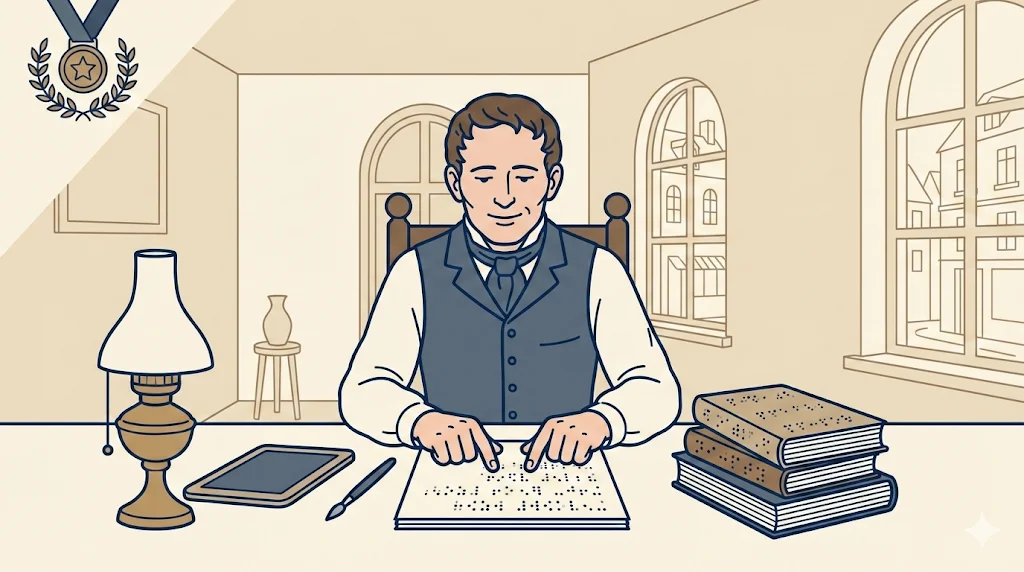
That student was Louis Braille. He lost his sight as a child.
At school, many students used listening and memory.
But they wanted true literacy: reading and writing.

A code you can feel

Louis noticed something important: fingers can “see” patterns.
So he built a simple system with raised dots.
In one small space, there are six dot positions.
This is called a Braille cell.
Different dot patterns make different letters.

Because the dots are clear and small, fingers can move fast.
A reader does not need a loud voice or a helper.
A person can read quietly, alone, and at their own speed.

From school to the world

Over time, the system spread beyond one classroom.
It moved into books, labels, elevators, and public signs.
Historians at Oxford and the Smithsonian have described how Braille became a key tool for education and independence.

Today, audio is also very useful.
But Braille still matters, because it builds spelling and writing skill.
It is not only “hearing information.”
It is reading and writing in your own hands.

Louis Braille’s gift was simple, but powerful:
dots became language, and language became access.


Key Points

  • Louis Braille made a six-dot system so blind students could read and write.
  • A Braille cell can form many symbols, so it works in many languages.
  • Braille supports strong literacy, not only listening.

Words to Know

invent /ɪnˈvɛnt/ (v) — create something new
cell /sɛl/ (n) — a small unit; here, one dot space
symbol /ˈsɪmbəl/ (n) — a sign that carries meaning
alphabet /ˈælfəˌbɛt/ (n) — letters used to write a language
punctuation /ˌpʌŋkʧuˈeɪʃən/ (n) — marks like . , ? !
label /ˈleɪbəl/ (n) — words on something to name it
literacy /ˈlɪtərəsi/ (n) — ability to read and write
access /ˈæksɛs/ (n) — the ability to reach and use something
dignity /ˈdɪɡnɪti/ (n) — being respected as a full person


📝 Practice Questions

A2 – True/False

  1. Louis Braille made a system to read and write by touch.
  2. A Braille cell has six dot positions.
  3. Braille is only useful for listening to books.

A2 – Multiple Choice

  1. Why did blind students need Braille?
    A. Print was made for eyes
    B. Books were too heavy
    C. Schools were too small

  2. What can a Braille cell create?
    A. Letters and numbers
    B. Food and water
    C. Roads and bridges

  3. What is one reason Braille still matters today?
    A. It supports spelling and writing
    B. It makes the sun brighter
    C. It stops all noise

A2 – Short Answer

  1. What is one place you may see Braille labels?
  2. How many dot positions are in one cell?
  3. Why is quiet reading important for some people?

A2 – True/False

  1. True
  2. True
  3. False

A2 – Multiple Choice

  1. A
  2. A
  3. A

A2 – Short Answer

  1. Elevator buttons (example)
  2. Six
  3. It lets them read alone quietly
B1 Level

Why dots on paper still matter today

Braille: Real Reading, Real Independence

Why dots on paper still matter today

A teenager opens a school website. The lesson is posted online, but the file is not easy to use with touch. The teen feels the old problem again: information is everywhere, but access is not equal.

This is why Louis Braille’s invention still matters.

The problem: print is made for eyes

Most writing is visual. Letters are flat. They are built for sight.
For blind students in the past, many books were not available. People could listen to someone read aloud, but that was not the same as literacy.

Literacy means you can do three things:
read, write, and control your learning speed.

The solution: a small “dot cell” that becomes language

Braille uses raised dots that fingertips can feel.
In one small cell, six dot positions can combine into many patterns. These patterns can represent letters, numbers, and punctuation.

Braille is also a writing system.
People can write with a slate and stylus, or with a Braille writer. This means a person can take notes, write homework, and leave a private message.

A simple example shows the difference:
With audio, you may need to listen for a long time to find one sentence.
With Braille, you can quickly scan a page to find one key line.

Everyday power: labels, study, and privacy

Braille shows up in daily life: elevator buttons, medicine boxes, room numbers, and signs. It supports independence at home and in public.

Organizations like the American Foundation for the Blind often explain that Braille supports strong spelling, structure, and confidence—especially for students. Audio is helpful, but it cannot fully replace reading and writing.

Louis Braille turned touch into text. And when people can read and write for themselves, they gain more than information. They gain choice.


Key Points

  • Braille gives blind people both reading and writing, which builds full literacy.
  • The six-dot cell can create many symbols, including numbers and punctuation.
  • Braille supports independence in school and daily life, even with modern audio tools.

Words to Know

barrier /ˈbæriər/ (n) — something that blocks progress
accessible /əkˈsɛsəbəl/ (adj) — easy to use or reach for everyone
notation /noʊˈteɪʃən/ (n) — special symbols for a subject (music, math)
device /dɪˈvaɪs/ (n) — a tool or machine
scan /skæn/ (v) — look or feel quickly to find information
private /ˈpraɪvət/ (adj) — not shared with others
independent /ˌɪndɪˈpɛndənt/ (adj) — able to do things alone
education /ˌɛʤəˈkeɪʃən/ (n) — learning in school or life
format /ˈfɔrˌmæt/ (n) — the way information is arranged
commute /kəˈmjut/ (n) — travel between home and work/school
inclusive /ɪnˈklusɪv/ (adj) — welcoming and usable for all people


📝 Practice Questions

B1 – True/False

  1. Audio access and literacy are exactly the same.
  2. Braille helps with private notes and labels in daily life.
  3. Braille lets readers scan for a key line faster than audio.

B1 – Multiple Choice

  1. What is a key difference between audio and Braille?
    A. Braille can be scanned quickly by touch
    B. Audio always shows spelling clearly
    C. Braille needs electricity every time

  2. What does “literacy” include in the B1 text?
    A. Reading, writing, and control of speed
    B. Only listening to stories
    C. Only speaking in public

  3. Which is an everyday use of Braille?
    A. Elevator buttons
    B. Cloud shapes
    C. Traffic lights changing color

B1 – Short Answer

  1. Give one example of Braille in daily life.
  2. Why can Braille feel faster than audio sometimes?
  3. What does Braille help students build besides information?

B1 – True/False

  1. False
  2. True
  3. True

B1 – Multiple Choice

  1. A
  2. A
  3. A

B1 – Short Answer

  1. Elevator buttons or medicine labels (example)
  2. You can scan for one line
  3. Spelling and writing confidence
B2 Level

From one student’s hands to a global standard of access

Louis Braille and the Idea That Barriers Can Be Redesigned

From one student’s hands to a global standard of access

A blind commuter steps into a busy subway station. The air is loud. Trains arrive and leave like waves. The commuter counts steps, listens for echoes, and reaches for the wall. Then the fingers find it: a small line of raised dots on a sign near the platform. In a place built for eyes, this tiny text is a quiet map.

That map exists because a teenager in 19th-century France believed touch could carry language.

A personal struggle that became a design solution

Louis Braille lost his sight as a child after an accident. In school, he met a problem that was bigger than one person: most knowledge was locked inside visual print. People could listen to reading, but listening is not the same as literacy.

Literacy includes privacy and control.
You can pause, re-read, skim, check spelling, and write back.

Braille’s solution was elegant: a six-dot cell. With only six positions, the system can create letters, numbers, punctuation, and more. Over time, it also developed music notation and math/science notation, so blind students could study complex subjects—not only stories.

Why Braille is different from “audio access”

Modern technology is powerful. Screen readers, audiobooks, and AI voices can open huge libraries. But audio often turns reading into a one-way stream. You receive words, but you may not build the same spelling skills or writing confidence.

Braille supports two-way literacy:

  • reading with touch
  • writing with patterns
  • checking structure and detail

This is why many educators and advocates continue to defend Braille as a foundation, not a luxury.

From dots on paper to a global promise

Braille spread from schools into public life: elevator buttons, hotel rooms, medicine labels, and transport systems. It became a kind of “design standard” for touch—proof that access can be built into the environment.

Groups and institutions such as UNESCO, the Royal National Institute of Blind People (RNIB), and the World Blind Union have long connected literacy to dignity and equal participation. And major reference works, including Encyclopaedia Britannica and the Oxford Dictionary of National Biography, describe Braille’s lasting social impact.

Louis Braille’s gift was not only a code. It was a way of thinking: barriers are often design problems. When we redesign information so more people can meet it directly—through eyes, ears, or hands—we do more than help. We share power: the power to learn, to work, and to choose your own path.


Key Points

  • Braille turned touch into full literacy: reading and writing, with privacy and control.
  • Technology helps, but Braille remains important for spelling, structure, and two-way learning.
  • Braille is also inclusive design: information built into public space, not added later.

Words to Know

commuter /kəˈmjutər/ (n) — a person who travels to work or school
standard /ˈstændərd/ (n) — a common rule people follow
stream /strim/ (n) — a continuous flow (like audio without stopping)
foundation /faʊnˈdeɪʃən/ (n) — the base that supports everything
participation /pɑrˌtɪsəˈpeɪʃən/ (n) — taking part fully
advocate /ˈædvəˌkeɪt/ (n) — a person who speaks up for others
environment /ɪnˈvaɪrənmənt/ (n) — the places and systems around us
redesign /ˌriˈdɪˈzaɪn/ (v) — design again in a better way
equal /ˈikwəl/ (adj) — the same in value and rights
notation /noʊˈteɪʃən/ (n) — special symbols for a subject
dignity /ˈdɪɡnɪti/ (n) — respect and human worth
inclusive /ɪnˈklusɪv/ (adj) — usable and welcoming for everyone
barrier /ˈbæriər/ (n) — something that blocks access
accessibility /əkˌsɛsəˈbɪləti/ (n) — how easy something is to use for all

📝 Practice Questions

B2 – True/False

  1. Braille began as a design solution to a learning barrier.
  2. Braille cannot be used for math or music.
  3. Inclusive design means access is built into the environment.

B2 – Multiple Choice

  1. What is the B2 text’s main idea about barriers?
    A. Many barriers are design problems we can redesign
    B. Barriers are permanent and never change
    C. Barriers only exist in schools

  2. Why might audio feel “one-way” for learning?
    A. It can be hard to skim and check spelling
    B. It always improves writing skills
    C. It makes reading faster for everyone

  3. What does Braille support that matters for dignity?
    A. Privacy and control in reading and writing
    B. Winning every competition
    C. Avoiding all mistakes in life

B2 – Short Answer

  1. Explain one way Braille supports “two-way literacy” in daily learning.
  2. In a city, where could Braille reduce barriers for a blind commuter?
  3. What is one “barrier” in your life that could be redesigned more fairly?

B2 – True/False

  1. True
  2. False
  3. True

B2 – Multiple Choice

  1. A
  2. A
  3. A

B2 – Short Answer

  1. It lets you read by touch and write notes with the same code.
  2. On platform signs, elevators, menus, or medicine labels in public spaces.
  3. Answers will vary (e.g., unclear instructions, hard forms, missing labels).