Rewriting Identity in a New Place
Culture, labels, and small courage can reshape habits over time.
In a bright meeting room in a new country, Asha sits very still. She is a skilled professional, but her accent feels heavy today. People speak fast. A few jokes pass that she does not catch. When her manager asks for ideas, she looks at her notes and stays silent.
Later, walking home, she thinks, “I am always going to be less here.” It is a painful label. But it also becomes a guide. The next morning, she chooses “safe” tasks again. She avoids speaking up again. A habit is growing—powered by an identity story.
Identity Is a Social Story, Not Only a Personal One
We often talk about identity as something inside us. But identity is also shaped by family messages, school labels, workplace culture, and media images. Asha grew up hearing, “You are smart,” but now she hears a new message: “You don’t belong.”
Social psychologists have studied how negative labels can reduce performance and confidence, especially when people feel judged by a stereotype. In simple terms, fear of “confirming” a label can push us into smaller, safer habits. Silence becomes a habit. Hiding becomes a routine.
Why Identity-Based Goals Can Work Better
Result goals sound clear: “Speak more in meetings.” “Get a better job.” But identity-based goals go deeper: “Become a person who contributes ideas.” “Be a brave learner in a new place.”
Research in Psychological Science often shows that self-concept and small choices influence behavior over time. And reviews in the Journal of Personality and Social Psychology suggest that people protect a stable self-image, even when that image is limiting.
So Asha tries something different. She chooses a value first: growth. Then she chooses a small identity sentence: “I am becoming the kind of colleague who speaks once.” Not ten times. Once.
Building New Evidence, One Small Vote at a Time
At the next meeting, she prepares one short sentence in advance. When a pause comes, she says it. Her voice shakes, but she finishes. A teammate nods. After the meeting, one person says, “That was helpful.”
This is how belief loops change: identity → action → evidence → stronger identity. The evidence can be tiny: one sentence, one email sent, one question asked. Over weeks, small proof becomes a new normal.
Workplaces also matter. The World Economic Forum often writes about skills and lifelong learning in changing economies. In diverse teams, leaders can help by inviting quieter voices, slowing the pace, and making space for many accents and styles. When the environment is safer, people can try new habits without feeling like a “fraud.”
Asha is still the same person, but her story is changing. She is not “less.” She is a learner building a new life.
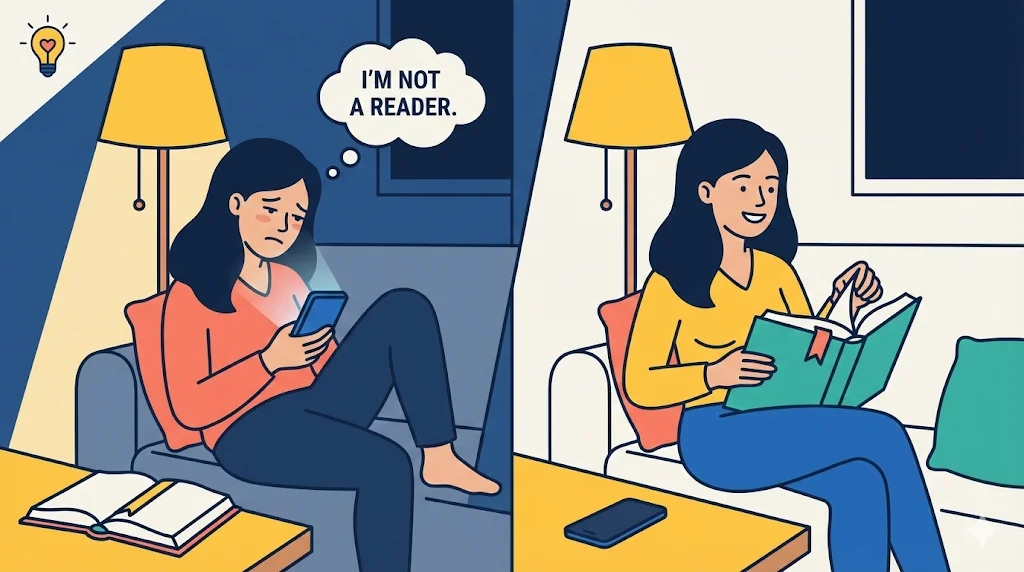
Maybe your identity story also carries old labels: “I’m lazy,” “I’m bad at languages,” “I’m not a leader.” You do not have to fight it with big promises. You can rewrite it with small, honest actions. Every time you practice the new habit, you are casting a new vote for who you are becoming—and slowly, your daily life begins to match that new story.
Key Points
- Identity is shaped by social labels, culture, and feedback, not only by you.
- Identity-based goals can feel more powerful than result-only goals.
- Small “votes” (actions) can rebuild confidence and change belief loops.
Words to Know
label /ˈleɪ.bəl/ (n) — a name placed on someone
stereotype /ˈstɛr.i.ə.taɪp/ (n) — a fixed idea about a group
belong /bɪˈlɔːŋ/ (v) — feel accepted in a place or group
confidence /ˈkɑːn.fɪ.dəns/ (n) — belief in your ability
contribute /kənˈtrɪb.juːt/ (v) — give ideas or help
diverse /daɪˈvɝːs/ (adj) — including many different kinds of people
inclusion /ɪnˈkluː.ʒən/ (n) — making people feel welcomed
lifelong /ˈlaɪf.lɔːŋ/ (adj) — lasting through life
evidence /ˈɛv.ɪ.dəns/ (n) — facts that support a belief
rewrite /ˌriːˈraɪt/ (v) — change a story into a new one
accent /ˈæk.sənt/ (n) — the way you pronounce words
fraud /frɔːd/ (n) — a person who feels “not real” or “not worthy”
self-concept /ˌsɛlf ˈkɑːn.sɛpt/ (n) — your idea of who you are