Wisdom English Learn about the world. Grow your English.
Mind & Habits

How Identity Shapes Your Habits

A1 A2 B1 B2

Your habits often follow the story you tell about yourself. Discover how tiny “votes” — small actions and wins — can reshape identity and make better habits feel natural.

A1 Level

One Page, New Me

Small habits follow the story you believe.
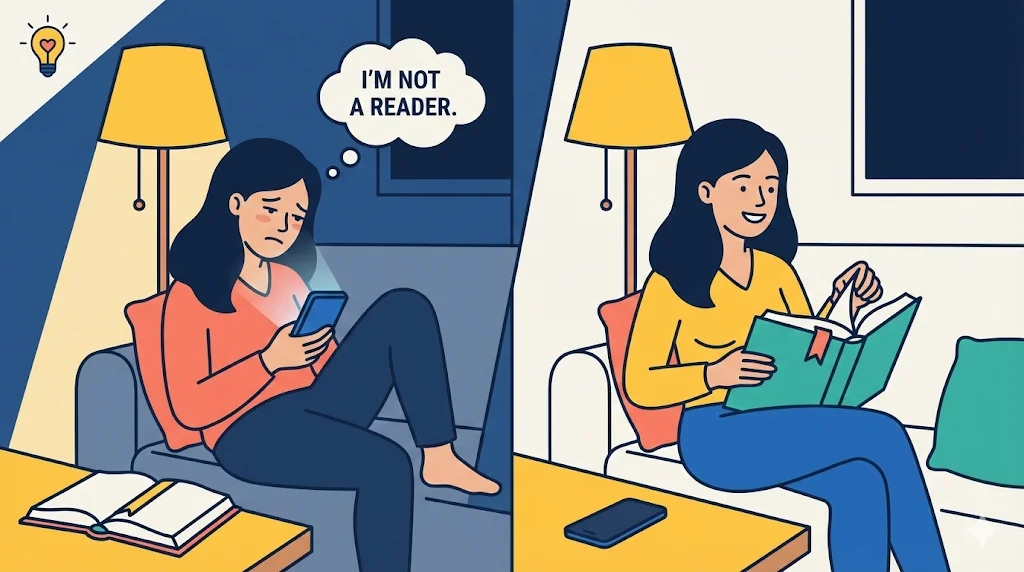
In the evening, Mina sits on a small sofa. A book is on the table. Her phone is there too. The book is an easy English story. A bookmark is near the first pages.

Mina says, “I’m not a reader.” She feels tired. She opens her phone. She scrolls and scrolls. Ten minutes pass. She looks at the book again, but she does not touch it. In her mind, a quiet story repeats: “This is not me.”

Then she stops. She takes a slow breath. She asks a new question: “What would a reader do right now?” She does not try to read for one hour. She chooses five minutes. She opens the book and reads one page.

It is not perfect. She does not know every word. But she finishes the page. She moves the bookmark a little forward. It is a small win. It feels like proof.

That night, Mina learns something simple. Habits follow identity. When she says, “I am not a reader,” she acts that way. When she says, “I can be a reader for five minutes,” she acts differently.

Maybe you have a habit like this too. You can start small. Each small action is like a vote for the person you want to be.

Key Points

  • Your habits often follow your “I am…” story.
  • Small actions can be proof of a new identity.

Words to Know

identity /aɪˈdɛn.tə.ti/ (n) — who you are
habit /ˈhæb.ɪt/ (n) — something you do often
action /ˈæk.ʃən/ (n) — something you do
story /ˈstɔː.ri/ (n) — a message in your mind
choice /tʃɔɪs/ (n) — a decision
small /smɔːl/ (adj) — not big
proof /pruːf/ (n) — something that shows it is true


📝 Practice Questions

A1 – True/False

  1. Mina has a book and a phone on the table.
  2. Mina reads for one hour on the first night.
  3. Moving the bookmark forward feels like proof to Mina.

A1 – Multiple Choice

  1. What does Mina usually choose first?
    A. Her phone
    B. Her laptop
    C. Her TV

  2. What question helps Mina start reading?
    A. “What will people think?”
    B. “What would a reader do right now?”
    C. “Why is this so hard?”

  3. What is Mina’s small win?
    A. She buys a new book
    B. She reads one page
    C. She joins a book club

A1 – Short Answer

  1. Where does Mina sit?
  2. How long does she choose to read?
  3. What does she move forward?

A1 – True/False

  1. True
  2. False
  3. True

A1 – Multiple Choice

  1. A
  2. B
  3. B

A1 – Short Answer

  1. On a sofa
  2. Five minutes
  3. The bookmark
A2 Level

The “I Am…” Sentence at Lunch

Small choices can slowly change self-image.
At lunch, Jae stands in a small work cafeteria. He holds a tray. On one side, there are fries and soda. On the other side, there is rice, vegetables, and water. He feels a little stuck.

Jae often says, “I’m the type of person who always eats junk food.” So his hand moves to the fries without thinking. Then he feels regret.

The “I Am…” Story

A close friend notices his face and asks, “What are you telling yourself?” Jae answers, “I’m not a healthy person.” The friend smiles gently and says, “That sentence is a story. Your choices follow your story.”

Psychologists say our self-image—our inner “I am…” picture—can guide our daily behavior. If you believe you are careless, you may act careless. If you believe you are learning, you may try again.

Small Wins as Proof

The friend gives one simple idea: “Try a new sentence. Not ‘I am healthy’ right away. Try ‘I’m learning to be a person who chooses one healthy thing each day.’”

Jae looks at his tray. He does not change everything. He keeps his food, but he switches the soda to water. It feels small, but it matters. The friend says, “That is proof. Tomorrow, do one more small thing. Over time, proof becomes belief.”

Researchers at Stanford and Harvard often explain habit change in this simple direction: small repeated actions can create a new pattern, and the pattern can change how we see ourselves.

Jae sits down and drinks water. He feels a quiet confidence. He thinks, “Maybe I can become a healthy person, one choice at a time.”

If you want a new habit, you can ask one helpful question today: “What would a person like me do right now?” Then choose one small action that fits your new story.

Key Points

  • Self-image is your inner “I am…” story, and it guides choices.
  • Small wins can become proof that builds a new identity.
  • A gentle new sentence can help you start.

Words to Know

self-image /ˌsɛlf ˈɪm.ɪdʒ/ (n) — how you see yourself
identity /aɪˈdɛn.tə.ti/ (n) — the kind of person you believe you are
habit /ˈhæb.ɪt/ (n) — something you do often
choice /tʃɔɪs/ (n) — a decision
value /ˈvæl.juː/ (n) — what matters to you
repeat /rɪˈpiːt/ (v) — do again and again
proof /pruːf/ (n) — evidence something is true
healthy /ˈhɛl.θi/ (adj) — good for your body
regret /rɪˈɡrɛt/ (n) — a sad feeling about a choice


📝 Practice Questions

A2 – True/False

  1. Jae feels stuck at lunch because of his usual choices.
  2. Jae changes his whole meal to a perfect healthy meal.
  3. The friend suggests a gentle new “I am…” sentence.

A2 – Multiple Choice

  1. What does Jae usually tell himself?
    A. “I always choose vegetables.”
    B. “I’m the type who eats junk food.”
    C. “I love cooking at home.”

  2. What is Jae’s small change at lunch?
    A. Fries to salad
    B. Soda to water
    C. Pizza to soup

  3. What do small wins become over time?
    A. Proof that builds belief
    B. Reasons to quit
    C. A sign you failed

A2 – Short Answer

  1. What place is the story set in?
  2. What question can you ask yourself?
  3. Name one small healthier choice Jae makes.

A2 – True/False

  1. True
  2. False
  3. True

A2 – Multiple Choice

  1. B
  2. B
  3. A

A2 – Short Answer

  1. A work cafeteria
  2. “What would a person like me do right now?”
  3. He chooses water
B1 Level

Breaking the Identity Loop

Small proof can turn “I’m stuck” into “I’m becoming.”
On payday, Luis opens his banking app on the train. The number looks smaller than he expected. His stomach tightens. He remembers last night: a late-night online purchase, “just one more thing,” and a quick click to pay.

A sentence comes to his mind: “I’m terrible with money.” It sounds like a fact, not a feeling. And that sentence shapes what he does next.

The Belief Loop

Many habits follow a loop:
identity → action → evidence → stronger identity.

For Luis, it looks like this:
“I’m bad with money” → impulse buying → stress and bills → “See? I’m bad with money.”

This loop is powerful because the brain likes consistency. When an action matches your self-image, it feels normal—even if it hurts you.

Identity Creates Motivation

Goals can help, but goals are not always enough. Internal motivation grows when a habit feels connected to your values and identity. If Luis wants to feel safe and responsible, he needs a money habit that supports that kind of person.

Psychologist Carol Dweck’s work on mindset reminds us that “who I am” can be flexible when we see ourselves as learning. Luis tries a new sentence: “I’m becoming a careful planner.” It feels more honest than “I’m great with money.” It leaves room for growth.

Building Proof in Small Steps

Luis chooses a tiny daily habit: every morning, he checks his account for three minutes and writes one number in a notebook. He circles it and smiles. Not a full budget. Just one number. This small action is a “vote” for his new identity.

He also changes his environment. He deletes one shopping app and turns off one notification. These are not dramatic moves, but they reduce temptation.

A friend in another country tells him, “In my family, we always planned ahead. We say, ‘I’m the kind of person who thinks about tomorrow.’” That friend saves a small amount each week, not because of strong willpower every day, but because the identity story makes the habit feel natural.

Luis does not change overnight. But after two weeks, he notices something: less fear when he opens the app. More calm in his body. The loop is shifting.

Maybe you have one negative “I am…” sentence too. If you replace it with “I’m becoming…” and add one tiny action as proof, your habits can slowly begin to match the person you choose to be.

Key Points

  • Belief loops can trap you: identity → action → evidence → stronger identity.
  • Internal motivation grows when habits match your values and chosen identity.
  • Tiny daily “votes” can slowly build a new self-image.

Words to Know

belief /bɪˈliːf/ (n) — something you think is true
loop /luːp/ (n) — a circle that repeats
evidence /ˈɛv.ɪ.dəns/ (n) — facts or proof
internal /ɪnˈtɝː.nəl/ (adj) — inside you
motivation /ˌmoʊ.tɪˈveɪ.ʃən/ (n) — desire to act
value /ˈvæl.juː/ (n) — what matters most to you
consistent /kənˈsɪs.tənt/ (adj) — steady, not changing much
impulse /ˈɪm.pʌls/ (n) — a sudden urge
plan /plæn/ (n) — a way to do something
environment /ɪnˈvaɪ.rən.mənt/ (n) — the place and things around you
temptation /tɛmˈteɪ.ʃən/ (n) — a strong desire to do something


📝 Practice Questions

B1 – True/False

  1. Luis checks his banking app on payday and feels stress.
  2. The belief loop ends when Luis makes one big promise.
  3. Luis builds proof by doing a tiny daily money habit.

B1 – Multiple Choice

  1. Which sentence starts Luis’s old loop?
    A. “I’m lucky with money.”
    B. “I’m terrible with money.”
    C. “I’m always calm.”

  2. What is Luis’s tiny daily habit?
    A. Investing for one hour
    B. Writing one number after checking his account
    C. Borrowing money from a friend

  3. What is one environment change Luis makes?
    A. He adds more shopping apps
    B. He deletes one shopping app
    C. He buys a new phone

B1 – Short Answer

  1. Write the loop in four parts (identity → …).
  2. What new sentence does Luis try?
  3. Why does the friend save easily in the story?

B1 – True/False

  1. True
  2. False
  3. True

B1 – Multiple Choice

  1. B
  2. B
  3. B

B1 – Short Answer

  1. identity → action → evidence → stronger identity
  2. “I’m becoming a careful planner.”
  3. Because planning is part of their identity story (“I plan ahead”), so saving feels normal.
B2 Level

Rewriting Identity in a New Place

Culture, labels, and small courage can reshape habits over time.
In a bright meeting room in a new country, Asha sits very still. She is a skilled professional, but her accent feels heavy today. People speak fast. A few jokes pass that she does not catch. When her manager asks for ideas, she looks at her notes and stays silent.

Later, walking home, she thinks, “I am always going to be less here.” It is a painful label. But it also becomes a guide. The next morning, she chooses “safe” tasks again. She avoids speaking up again. A habit is growing—powered by an identity story.

Identity Is a Social Story, Not Only a Personal One

We often talk about identity as something inside us. But identity is also shaped by family messages, school labels, workplace culture, and media images. Asha grew up hearing, “You are smart,” but now she hears a new message: “You don’t belong.”

Social psychologists have studied how negative labels can reduce performance and confidence, especially when people feel judged by a stereotype. In simple terms, fear of “confirming” a label can push us into smaller, safer habits. Silence becomes a habit. Hiding becomes a routine.

Why Identity-Based Goals Can Work Better

Result goals sound clear: “Speak more in meetings.” “Get a better job.” But identity-based goals go deeper: “Become a person who contributes ideas.” “Be a brave learner in a new place.”

Research in Psychological Science often shows that self-concept and small choices influence behavior over time. And reviews in the Journal of Personality and Social Psychology suggest that people protect a stable self-image, even when that image is limiting.

So Asha tries something different. She chooses a value first: growth. Then she chooses a small identity sentence: “I am becoming the kind of colleague who speaks once.” Not ten times. Once.

Building New Evidence, One Small Vote at a Time

At the next meeting, she prepares one short sentence in advance. When a pause comes, she says it. Her voice shakes, but she finishes. A teammate nods. After the meeting, one person says, “That was helpful.”

This is how belief loops change: identity → action → evidence → stronger identity. The evidence can be tiny: one sentence, one email sent, one question asked. Over weeks, small proof becomes a new normal.

Workplaces also matter. The World Economic Forum often writes about skills and lifelong learning in changing economies. In diverse teams, leaders can help by inviting quieter voices, slowing the pace, and making space for many accents and styles. When the environment is safer, people can try new habits without feeling like a “fraud.”

Asha is still the same person, but her story is changing. She is not “less.” She is a learner building a new life.

Maybe your identity story also carries old labels: “I’m lazy,” “I’m bad at languages,” “I’m not a leader.” You do not have to fight it with big promises. You can rewrite it with small, honest actions. Every time you practice the new habit, you are casting a new vote for who you are becoming—and slowly, your daily life begins to match that new story.

Key Points

  • Identity is shaped by social labels, culture, and feedback, not only by you.
  • Identity-based goals can feel more powerful than result-only goals.
  • Small “votes” (actions) can rebuild confidence and change belief loops.

Words to Know

label /ˈleɪ.bəl/ (n) — a name placed on someone
stereotype /ˈstɛr.i.ə.taɪp/ (n) — a fixed idea about a group
belong /bɪˈlɔːŋ/ (v) — feel accepted in a place or group
confidence /ˈkɑːn.fɪ.dəns/ (n) — belief in your ability
contribute /kənˈtrɪb.juːt/ (v) — give ideas or help
diverse /daɪˈvɝːs/ (adj) — including many different kinds of people
inclusion /ɪnˈkluː.ʒən/ (n) — making people feel welcomed
lifelong /ˈlaɪf.lɔːŋ/ (adj) — lasting through life
evidence /ˈɛv.ɪ.dəns/ (n) — facts that support a belief
rewrite /ˌriːˈraɪt/ (v) — change a story into a new one
accent /ˈæk.sənt/ (n) — the way you pronounce words
fraud /frɔːd/ (n) — a person who feels “not real” or “not worthy”
self-concept /ˌsɛlf ˈkɑːn.sɛpt/ (n) — your idea of who you are

📝 Practice Questions

B2 – True/False

  1. Asha avoids speaking in meetings because of a painful identity label.
  2. The article says identity is only created inside your mind.
  3. The article suggests small actions can change belief loops over time.

B2 – Multiple Choice

  1. What is Asha’s identity-based goal sentence?
    A. “I will never speak again.”
    B. “I am becoming the kind of colleague who speaks once.”
    C. “I must be perfect today.”

  2. What can negative stereotypes push people to do?
    A. Take bigger risks immediately
    B. Choose safer habits and stay quiet
    C. Forget their values completely

  3. What is one way workplaces can help?
    A. Speak faster and interrupt more
    B. Invite quieter voices and slow the pace
    C. Remove all teamwork

B2 – Short Answer

  1. How does Asha build evidence in the next meeting?
  2. Why can identity-based goals feel stronger than result goals?
  3. Name one old label people might carry, from the article.

B2 – True/False

  1. True
  2. False
  3. True

B2 – Multiple Choice

  1. B
  2. B
  3. B

B2 – Short Answer

  1. She prepares one short sentence and says it once in the meeting.
  2. They change “who I am,” so habits feel natural, not forced.
  3. “I’m lazy.” / “I’m bad at languages.” / “I’m not a leader.”