Wisdom English Learn about the world. Grow your English.
Science, Tech & Future

How Electricity Powers Homes and Cities

A1 A2 B1 B2

A light switch connects you to a huge system. Follow electricity from power plants to high-voltage lines, transformers, and home circuits—and learn why the grid must stay balanced every second.

A1 Level

From a far place to your home

The Light Comes Back

From a far place to your home

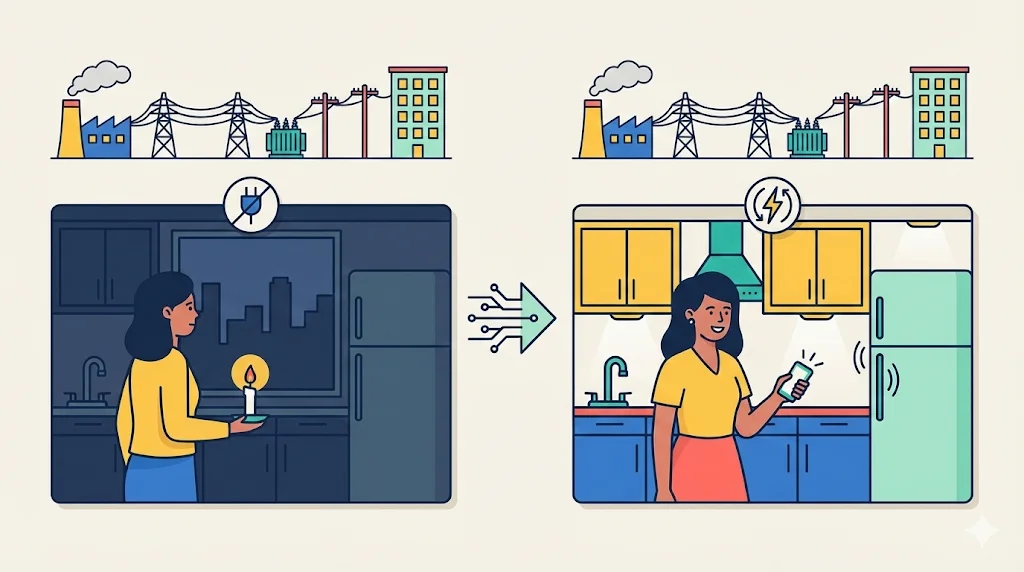
Mina is in her small kitchen at night. She flips the light switch. Nothing happens. The room is dark. She lights one candle. The refrigerator is quiet. She looks out the window. The whole street is dark.

A few minutes later, the lights come back. The fridge starts to hum again. Mina feels relief. Then she feels curious. “Where did the power go? And how did it return so fast?”

Electricity is energy that moves in wires. It can run lights, phones, and machines. But it must travel in a safe way.

First, electricity is made far away, in a power plant. Then it moves through long power lines to the city. These lines are like big roads for electricity.

Next, the electricity goes to a place that changes it to a safer level. Then it comes to Mina’s building.

Inside the building, electricity goes into a box with safety switches. After that, it goes into small circuits. A circuit is a closed loop. Electricity needs a full loop to flow.

When everything is working, Mina can cook, charge her phone, and stay warm. The system feels invisible. But it is always there, helping daily life.


Key Points

  • Electricity travels from power plants to homes through many steps.
  • Circuits and safety switches help electricity work safely.

Words to Know

electricity /ɪˌlɛkˈtrɪsɪti/ (n) — power that runs lights and machines
power /ˈpaʊər/ (n) — energy used to do work
wire /waɪər/ (n) — metal line that carries electricity
line /laɪn/ (n) — a long cable that carries power far
circuit /ˈsɝːkɪt/ (n) — a closed loop for electricity
switch /swɪtʃ/ (n) — a tool that turns power on or off
safe /seɪf/ (adj) — not dangerous
blackout /ˈblækˌaʊt/ (n) — a time with no electricity


📝 Practice Questions

A1 – True/False

  1. Electricity must travel through wires to reach homes.
  2. A circuit is an open path with a break.
  3. A blackout means there is no electricity for a time.

A1 – Multiple Choice

  1. Where does electricity often start?
    A. A power plant
    B. A kitchen outlet
    C. A phone screen

  2. What does a switch do?
    A. Turns power on or off
    B. Makes rain stop
    C. Changes day to night

  3. What is one sign of a blackout in Mina’s home?
    A. The refrigerator is silent
    B. The window is bigger
    C. The tea is sweeter

A1 – Short Answer

  1. What did Mina light in the dark?
  2. What must a circuit be (open or closed)?
  3. What is the word for “no electricity”?

A1 – True/False

  1. True
  2. False
  3. True

A1 – Multiple Choice

  1. A
  2. A
  3. A

A1 – Short Answer

  1. One candle
  2. Closed
  3. Blackout
A2 Level

Why electricity must travel in steps

A City’s Hidden Power Road

Why electricity must travel in steps

Mina is making tea when the lights suddenly go out. She hears a neighbor open a door in the hallway. People ask the same question: “Is it just our home, or the whole area?”

A neighbor says, “It’s the whole street. Don’t worry. Electricity comes in a long chain. If one part stops, the lights stop.”

Step 1: Making electricity

Electricity usually starts at a power plant. Many plants spin a turbine. A turbine is a big wheel that turns. When it turns, a generator makes electricity. Different places use different energy sources—water, wind, coal, gas, or nuclear power.

Step 2: Sending it far

Next, the electricity travels on large transmission lines. It often travels at high voltage. This helps it move far with less loss. Researchers at MIT often explain this idea in simple energy lessons: higher voltage can reduce wasted energy on long trips.

Step 3: Bringing it to streets and homes

Near the city, electricity reaches a substation. Here, transformers change the voltage to a safer level. Then distribution lines carry power to neighborhoods.

Finally, electricity enters a building. Inside, a breaker panel helps protect the home. If too much current flows, a breaker can stop it. This is important, because uncontrolled electricity can be dangerous.

When Mina’s power returns, she feels thankful. She also remembers a simple lesson: electricity is not “magic.” It is a carefully controlled journey—make it, move it, lower it, and use it safely.


Key Points

  • Electricity moves through a chain: plant → big lines → smaller lines → homes.
  • Transformers lower voltage, and breakers help keep homes safe.
  • The system must control electricity every moment.

Words to Know

generator /ˈdʒɛnəˌreɪtər/ (n) — a machine that makes electricity
turbine /ˈtɝːbaɪn/ (n) — a spinning wheel that produces power
transmission /trænzˈmɪʃən/ (n) — sending electricity long distances
distribution /ˌdɪstrɪˈbjuːʃən/ (n) — delivering electricity to local areas
transformer /trænsˈfɔːrmər/ (n) — a device that changes voltage
voltage /ˈvoʊltɪdʒ/ (n) — the “push” that moves electricity
current /ˈkɝːrənt/ (n) — the flow of electric charge
breaker /ˈbreɪkər/ (n) — a safety switch that stops too much current
substation /ˈsʌbˌsteɪʃən/ (n) — a place that controls and routes electricity


📝 Practice Questions

A2 – True/False

  1. Transmission lines carry electricity long distances.
  2. Transformers step voltage up or down.
  3. Breakers are used to make electricity more dangerous.

A2 – Multiple Choice

  1. Why is high voltage used on long lines?
    A. To reduce energy loss
    B. To change the weather
    C. To make lights colorful

  2. What happens at a substation?
    A. Voltage is changed and routed
    B. Food is stored for winter
    C. Roads are repaired at night

  3. What is one job of a breaker panel?
    A. Stop unsafe current
    B. Create wind power
    C. Print electricity bills

A2 – Short Answer

  1. Name two steps in the electricity chain.
  2. Why do homes need breakers?
  3. How did Mina feel when power returned?

A2 – True/False

  1. True
  2. True
  3. False

A2 – Multiple Choice

  1. A
  2. A
  3. A

A2 – Short Answer

  1. Power plant → lines (or substation → home)
  2. To stop unsafe current / prevent danger
  3. Relieved / thankful / happy
B1 Level

From power plant to plug, without you noticing

The Long Trip Behind One Light Switch

From power plant to plug, without you noticing

A storm hits the city at night. Rain taps the window like fast fingers. Then, the living room light flickers—once, twice—and disappears. Outside, half the street is dark, but the other half still glows. People start guessing: “Is my apartment broken? Did I forget to pay? Or is it bigger than that?”

In most cases, the answer is simple: electricity comes through a chain, and one link has a problem.

Making electricity: motion becomes power

Electricity is moving electric charge, pushed by voltage through a closed circuit. But first, we need a source. Many power plants turn motion into electricity. Steam, wind, or flowing water spins a turbine. The turbine turns a generator, and the generator produces electricity.

Different regions use different mixes. A windy coast may use more wind power. A river region may use hydropower. Cities often connect to many sources, not just one, so they can keep running if a plant stops.

Moving it safely: why voltage changes

To send electricity far, the grid uses transmission lines. These lines often carry high voltage. The main idea is efficiency: high voltage helps reduce energy loss over long distances.

Then a substation and transformer step the voltage down. A transformer is like a phone charger idea, but on a much bigger scale. Your phone needs a safe amount of voltage. Your neighborhood does too.

Using it at home: circuits and protection

When electricity enters a building, it goes to a breaker panel. From there, it splits into circuits: kitchen outlets, lights, air conditioner, and so on. Each circuit is a loop. If a wire is damaged or too many devices run at once, current can rise too high. A breaker can “trip” and stop the flow to prevent danger.

On the street during the storm, the dark homes feel quiet and fragile. But the bright homes show something hopeful: the grid is built to limit problems and restore power fast.

Understanding the chain—generation, transmission, distribution, and home circuits—also helps you act wisely. You can reduce load during peak times, and you can prepare for outages without panic. The system is huge, but the basic story is clear.


Key Points

  • Electricity is made by generators, then sent long distances on transmission lines.
  • Transformers step voltage down before power reaches neighborhoods and homes.
  • Breakers and circuits protect homes and control electricity safely.

Words to Know

charge /tʃɑːrdʒ/ (n) — electric property that can move and create current
closed /kloʊzd/ (adj) — complete, with no open break
loop /luːp/ (n) — a circle path that returns to the start
efficiency /ɪˈfɪʃənsi/ (n) — using energy with less waste
loss /lɔːs/ (n) — energy that is wasted as heat
step down /stɛp daʊn/ (v) — reduce to a lower level (like lower voltage)
substation /ˈsʌbˌsteɪʃən/ (n) — a grid control point for routing electricity
outlet /ˈaʊtˌlɛt/ (n) — a wall place to plug in devices
overload /ˈoʊvərˌloʊd/ (n) — too much demand on a system
trip /trɪp/ (v) — stop automatically for safety (a breaker trips)
peak /piːk/ (n) — the highest level in a time period


📝 Practice Questions

B1 – True/False

  1. Many power plants use turbines and generators to make electricity.
  2. Distribution lines usually bring power from streets into neighborhoods.
  3. A breaker trips to increase current in the home.

B1 – Multiple Choice

  1. What is the main job of a transformer near a neighborhood?
    A. Lower voltage to a safer level
    B. Produce electricity from sunlight
    C. Store electricity for a whole year

  2. In the article, what is a circuit described as?
    A. A closed loop for electricity
    B. A type of storm cloud
    C. A city map on paper

  3. Why do cities connect to many power sources?
    A. To reduce the risk of one failure
    B. To make phones heavier
    C. To stop people from saving energy

B1 – Short Answer

  1. Give one example of a “peak time” for electricity use.
  2. Why can high voltage help long-distance power travel?
  3. What can you do during peak times to help the grid?

B1 – True/False

  1. True
  2. True
  3. False

B1 – Multiple Choice

  1. A
  2. A
  3. A

B1 – Short Answer

  1. Evening heatwave / hot afternoon / early evening
  2. It reduces energy loss over long distances
  3. Use less power / reduce AC / delay heavy appliance use
B2 Level

Why electricity feels instant, but is never simple

The Power Grid: A City’s Daily Balancing Act

Why electricity feels instant, but is never simple

On a summer heatwave day, the city feels like a warm oven. Air conditioners run from morning to midnight. Elevators move slower because buildings are packed. Hospitals, subway systems, and data centers keep working, even when the streets look tired.

Most people only notice electricity when it fails. But on days like this, the grid is doing its hardest job: balancing supply and demand in real time.

From generation to your wall socket

Electricity is not a “thing” that calmly sits in a box. It is a flow—moving electric charge—guided by voltage through closed circuits. That is why a city needs a chain with clear roles:

  • Generation: power plants and renewable sources produce electricity. Many systems still use spinning generators (turbines + generators) because rotating machines naturally support stable grid operation.
  • Transmission: high-voltage lines carry electricity long distances. High voltage is used because it reduces losses during travel.
  • Distribution: substations and transformers lower voltage and route electricity into neighborhoods.
  • Building circuits: breaker panels split electricity into safe circuits for rooms and devices, and they stop dangerous overloads.

You do not see this chain when you charge a phone. But every step matters.

Balancing every second: stability and frequency

Here is the hard part: large amounts of electricity are difficult to store, and uncontrolled electricity is dangerous. So grid operators try to match supply and demand every moment. If demand jumps fast—like millions of air conditioners turning on—the system must respond.

In many AC grids, frequency is a key stability signal. Frequency is the “heartbeat speed” of the grid’s alternating current. If supply falls behind demand, frequency can drop. If supply is too high, it can rise. Protective systems may act to prevent damage, which is good for safety—but it can also create cascading outages if many parts shut down at once.

This is why cities build redundancy: multiple lines, backup routes, and extra generation options. It is also why “peak demand” matters so much. The grid is sized for the busiest times, not the calmest times.

The future grid: renewables, storage, and smart control

Modern grids are changing. Wind and solar power are clean and increasingly common, but they can vary with weather and time of day. That does not make them “bad.” It means the grid needs new tools:

  • Flexible generation that can ramp up and down.
  • Storage (like batteries) to move energy from one time to another—useful, but still limited compared to a whole city’s needs.
  • Demand response: smart programs that reduce load during peaks (for example, shifting some industrial use or encouraging homes to lower AC settings briefly).
  • Better monitoring and automation: sensors, software, and fast control help operators spot problems early.

Organizations like the IEA discuss these system-wide transitions, and engineering groups like IEEE focus on reliability and safety as grids modernize.

As we add “smarter” controls, we also add new risks: cybersecurity threats, uneven access between rich and poor areas, and over-dependence on complex software. On the other hand, smart design can reduce outages, cut waste, and support cleaner energy.

Electricity feels invisible because it usually works. But it is one of the largest shared systems humans run every day. When you flip a switch and light fills a room, you are seeing the final moment of a careful promise: make it, move it, lower it, and use it safely.


Key Points

  • A city’s electricity system is a chain: generation, transmission, distribution, and home circuits.
  • The grid must balance supply and demand in real time to stay stable.
  • Future grids need flexibility, storage, and smart control—plus strong safety rules.

Words to Know

grid /ɡrɪd/ (n) — the network that delivers electricity to many places
supply /səˈplaɪ/ (n) — the amount available to provide
demand /dɪˈmænd/ (n) — the amount people want to use
frequency /ˈfriːkwənsi/ (n) — the “heartbeat” rate of AC electricity
stability /stəˈbɪləti/ (n) — staying steady without dangerous changes
redundancy /rɪˈdʌndənsi/ (n) — backup parts that keep a system working
efficiency /ɪˈfɪʃənsi/ (n) — doing the same work with less waste
storage /ˈstɔːrɪdʒ/ (n) — keeping energy for later use
renewable /rɪˈnuːəbl/ (adj) — naturally replaced, like wind or solar
automation /ˌɔːtəˈmeɪʃən/ (n) — control done by machines and software
cybersecurity /ˌsaɪbərsɪˈkjʊrɪti/ (n) — protection from digital attacks
cascade /kæˈskeɪd/ (n) — a failure that spreads from one part to others
dispatch /dɪˈspætʃ/ (v) — send power resources where needed
load /loʊd/ (n) — the amount of electricity being used

📝 Practice Questions

B2 – True/False

  1. Grid operators try to match supply and demand in real time.
  2. Frequency can act like a stability signal in AC power systems.
  3. Renewable energy always produces the same amount every minute.

B2 – Multiple Choice

  1. What can happen if many protective systems shut down together?
    A. A cascading outage can spread
    B. All batteries become full instantly
    C. Voltage disappears from physics

  2. Which tool can help the future grid handle changing wind and solar?
    A. Storage and flexible control
    B. Turning off all substations
    C. Removing breaker panels from homes

  3. Which is a realistic risk of a “smarter” grid?
    A. Cybersecurity threats
    B. Gravity getting weaker
    C. Water turning into metal

B2 – Short Answer

  1. Explain why electricity is hard to store at city scale.
  2. Name two ways cities can reduce stress during peak demand.
  3. In your life, when do you notice electricity the most?

B2 – True/False

  1. True
  2. True
  3. False

B2 – Multiple Choice

  1. A
  2. A
  3. A

B2 – Short Answer

  1. Demand changes fast; storage is limited vs. huge city use
  2. Demand response, energy saving, shifting use, storage support
  3. During blackouts, storms, or when devices suddenly stop