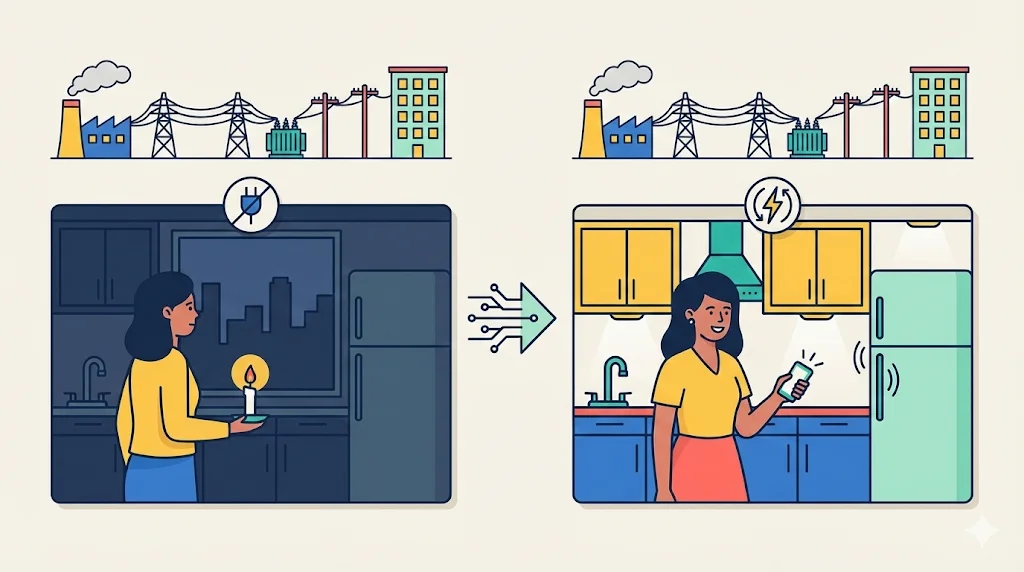
The Power Grid: A City’s Daily Balancing Act
Why electricity feels instant, but is never simple
On a summer heatwave day, the city feels like a warm oven. Air conditioners run from morning to midnight. Elevators move slower because buildings are packed. Hospitals, subway systems, and data centers keep working, even when the streets look tired.
Most people only notice electricity when it fails. But on days like this, the grid is doing its hardest job: balancing supply and demand in real time.
From generation to your wall socket
Electricity is not a “thing” that calmly sits in a box. It is a flow—moving electric charge—guided by voltage through closed circuits. That is why a city needs a chain with clear roles:
- Generation: power plants and renewable sources produce electricity. Many systems still use spinning generators (turbines + generators) because rotating machines naturally support stable grid operation.
- Transmission: high-voltage lines carry electricity long distances. High voltage is used because it reduces losses during travel.
- Distribution: substations and transformers lower voltage and route electricity into neighborhoods.
- Building circuits: breaker panels split electricity into safe circuits for rooms and devices, and they stop dangerous overloads.
You do not see this chain when you charge a phone. But every step matters.
Balancing every second: stability and frequency
Here is the hard part: large amounts of electricity are difficult to store, and uncontrolled electricity is dangerous. So grid operators try to match supply and demand every moment. If demand jumps fast—like millions of air conditioners turning on—the system must respond.
In many AC grids, frequency is a key stability signal. Frequency is the “heartbeat speed” of the grid’s alternating current. If supply falls behind demand, frequency can drop. If supply is too high, it can rise. Protective systems may act to prevent damage, which is good for safety—but it can also create cascading outages if many parts shut down at once.
This is why cities build redundancy: multiple lines, backup routes, and extra generation options. It is also why “peak demand” matters so much. The grid is sized for the busiest times, not the calmest times.
The future grid: renewables, storage, and smart control
Modern grids are changing. Wind and solar power are clean and increasingly common, but they can vary with weather and time of day. That does not make them “bad.” It means the grid needs new tools:
- Flexible generation that can ramp up and down.
- Storage (like batteries) to move energy from one time to another—useful, but still limited compared to a whole city’s needs.
- Demand response: smart programs that reduce load during peaks (for example, shifting some industrial use or encouraging homes to lower AC settings briefly).
- Better monitoring and automation: sensors, software, and fast control help operators spot problems early.
Organizations like the IEA discuss these system-wide transitions, and engineering groups like IEEE focus on reliability and safety as grids modernize.
As we add “smarter” controls, we also add new risks: cybersecurity threats, uneven access between rich and poor areas, and over-dependence on complex software. On the other hand, smart design can reduce outages, cut waste, and support cleaner energy.
Electricity feels invisible because it usually works. But it is one of the largest shared systems humans run every day. When you flip a switch and light fills a room, you are seeing the final moment of a careful promise: make it, move it, lower it, and use it safely.
Key Points
- A city’s electricity system is a chain: generation, transmission, distribution, and home circuits.
- The grid must balance supply and demand in real time to stay stable.
- Future grids need flexibility, storage, and smart control—plus strong safety rules.
Words to Know
grid /ɡrɪd/ (n) — the network that delivers electricity to many places
supply /səˈplaɪ/ (n) — the amount available to provide
demand /dɪˈmænd/ (n) — the amount people want to use
frequency /ˈfriːkwənsi/ (n) — the “heartbeat” rate of AC electricity
stability /stəˈbɪləti/ (n) — staying steady without dangerous changes
redundancy /rɪˈdʌndənsi/ (n) — backup parts that keep a system working
efficiency /ɪˈfɪʃənsi/ (n) — doing the same work with less waste
storage /ˈstɔːrɪdʒ/ (n) — keeping energy for later use
renewable /rɪˈnuːəbl/ (adj) — naturally replaced, like wind or solar
automation /ˌɔːtəˈmeɪʃən/ (n) — control done by machines and software
cybersecurity /ˌsaɪbərsɪˈkjʊrɪti/ (n) — protection from digital attacks
cascade /kæˈskeɪd/ (n) — a failure that spreads from one part to others
dispatch /dɪˈspætʃ/ (v) — send power resources where needed
load /loʊd/ (n) — the amount of electricity being used