Wisdom English Learn about the world. Grow your English.
History & Civilization

How Ancient Tools Changed Daily Life

A1 A2 B1 B2

From a sharp stone by a fire to a spear and shelter, early tools made daily work faster and safer—and helped groups learn, share skills, and build the first steps toward civilization.

A1 Level

How one simple tool made life easier

The Sharp Stone by the Fire

How one simple tool made life easier

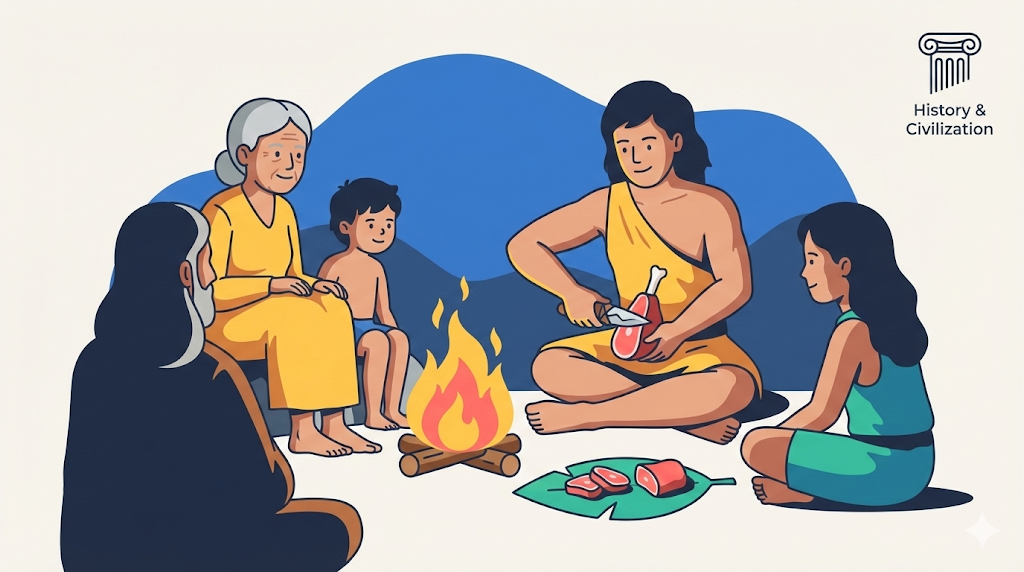
Late afternoon. A small group sits near a fire. The air is cool. Someone brings a piece of meat from the hunt. They try to cut it with their hands. It is slow. It is messy. Fingers slip. It can hurt.

Then a young adult picks up a stone. This stone is not like a broken rock. One side is sharp. The edge shines in the firelight. The person holds the meat with one hand and uses the stone with the other hand.

Now the meat cuts cleanly. Small pieces fall onto a flat leaf. The work is faster. The hands feel safer. The group can cook the food sooner. They can share it with everyone, even the old and the young.

A sharp stone is a simple tool. But it changes a hard job. It helps people prepare food with less pain and less waste. It also saves time. When a job is easier, people have more energy for other things, like fixing a shelter or caring for a child.

Long ago, tools were an “upgrade” for the body. A stronger hand is not always a bigger hand. Sometimes it is a smarter hand—with a sharp edge.


Key Points

  • A sharp stone cuts food faster than bare hands.
  • Simple tools can make daily life safer and easier.

Words to Know

tool /tuːl/ (n) — something you use to do a job
stone /stoʊn/ (n) — a hard piece of rock
sharp /ʃɑːrp/ (adj) — able to cut easily
edge /edʒ/ (n) — the thin cutting side of something
cut /kʌt/ (v) — to slice with a sharp thing
fire /faɪr/ (n) — burning heat and light
safe /seɪf/ (adj) — not in danger
meat /miːt/ (n) — animal food


📝 Practice Questions

A1 – True/False

  1. A sharp stone helped people cut meat faster.
  2. Ancient people only used their hands for food preparation.
  3. Tools could help make daily life safer.

A1 – Multiple Choice

  1. What problem happens when cutting meat with bare hands?
    A. It is slow and can hurt
    B. It becomes sweet and cold
    C. It makes the fire brighter

  2. What is special about the stone in the story?
    A. It has a sharp edge
    B. It is full of water
    C. It is made of metal

  3. What does the article say tools were for the human body?
    A. An upgrade
    B. A decoration
    C. A game

A1 – Short Answer

  1. Where does the group sit?
  2. What shines in the firelight?
  3. What does the stone help do?

A1 – True/False

  1. True
  2. False
  3. True

A1 – Multiple Choice

  1. A
  2. A
  3. A

A1 – Short Answer

  1. Near a fire
  2. The stone edge
  3. Cut meat cleanly
A2 Level

How early people hunted and built with simple tools

Stone and Wood: The First Everyday Technology

How early people hunted and built with simple tools

Two friends stand near a river. Water moves quietly. Smooth stones sit on the shore. Long branches lie under a tree. The friends have a problem: small animals are quick, and hands are not enough. They need a better way to hunt.

A sharp stone becomes a helper

One friend finds a stone with a clean, hard surface. They hit it carefully with another stone. A small piece breaks off. Now there is a sharper edge. With this edge, they can cut plants, open nuts, and slice meat. They can also scrape dirt and fat from animal skin.

This matters because food and clothing are daily needs. A good cutting tool makes food preparation faster and safer. It also helps the group waste less.

Wood gives strength and reach

Next, they shape a branch. Wood is easier to hold than a small stone. It can become a handle. When you add a handle, your hand has better control. Your fingers are farther from the sharp edge.

Then they tie the stone to the wooden stick. Now it is a simple spear. The spear gives reach. It lets a hunter stay a little farther away from an animal. It also helps the group hunt in open land, near water, or in forests.

Some museum experts say many early humans used stone and wood in clever ways, long before metal tools. The idea is simple: choose a material, shape it, and test it.

In the end, a better tool is not just an object. It is a new way to live. When people make better tools, they can do more—and they can do it together.


Key Points

  • Stone edges helped people cut and scrape for food and clothing.
  • Wood handles and spears improved control, reach, and safety.
  • Tool-making was early problem-solving: choose, shape, test.

Words to Know

branch /bræntʃ/ (n) — a part of a tree
handle /ˈhændl/ (n) — a part you hold
tie /taɪ/ (v) — to connect with rope or fiber
spear /spɪr/ (n) — a long hunting tool with a point
hunt /hʌnt/ (v) — to look for and catch animals
shelter /ˈʃɛltər/ (n) — a safe place to stay
scrape /skreɪp/ (v) — to rub and clean with a hard edge
control /kənˈtroʊl/ (n) — the power to guide something
waste /weɪst/ (n) — food or material not used


📝 Practice Questions

A2 – True/False

  1. Wood handles can give better control and keep fingers safer.
  2. A spear can help a hunter reach farther.
  3. Early people used only metal to make tools.

A2 – Multiple Choice

  1. Why is a handle helpful?
    A. It improves control and reduces injury
    B. It makes the stone softer
    C. It changes day into night

  2. What do the two friends make together?
    A. A spear with stone and wood
    B. A book with paper and ink
    C. A bowl with glass and paint

  3. What can scraping tools help prepare?
    A. Animal skin for clothing
    B. Clouds for rain
    C. Salt for snow

A2 – Short Answer

  1. Where do the friends stand?
  2. What two materials become a spear?
  3. How can a better tool help a group?

A2 – True/False

  1. True
  2. True
  3. False

A2 – Multiple Choice

  1. A
  2. A
  3. A

A2 – Short Answer

  1. Near a river
  2. Stone and wood
  3. It makes work safer/faster
B1 Level

Food, clothing, teamwork—and the power of shared skills

Winter Work: When Tools Changed the Whole System

Food, clothing, teamwork—and the power of shared skills

Winter comes early. Wind moves through the trees. A group returns to camp with tired steps. They need more food. They also need warmer clothing. Everyone has a role: one person watches the fire, two prepare food, and one skilled maker checks the tools.

Better cutting means less waste

With a rough rock, cutting takes time, and pieces tear. But a shaped stone edge slices more cleanly. The group can divide meat faster and store it better. Less waste matters in winter. A small improvement can mean one more meal for a child.

Cutting tools also help with plants: roots, tough stems, and bark. In many regions—cold mountains, dry grasslands, or river valleys—people had to use whatever nature offered. A good edge made local food easier to use.

Scraping hides becomes warm clothing

After hunting, the work is not finished. Hides must be cleaned. Scraping tools remove fat and dirt. Then the hide can dry and become clothing, blankets, or simple bags. This step is slow without tools, and it is harder to do well.

Cooperation and teaching

Tools also change how people work together. When one person becomes better at shaping stone, others notice. They ask questions. They copy the steps. The young watch closely. Shared knowledge becomes a kind of “community strength.”

The Smithsonian’s historians often describe daily life as a system: food, shelter, and skills all connect. When tools improve, the whole system improves. People can stay in one place longer. They can build stronger shelters. They can plan for tomorrow, not only survive today.

The tools look simple, but the lesson is big: small improvements, shared with others, can change a group’s future.


Key Points

  • Better tools reduced waste and made winter survival easier.
  • Scraping and cutting tools helped turn hides into warm clothing.
  • Tool skills spread through cooperation, teaching, and shared practice.

Words to Know

role /roʊl/ (n) — a job in a group
prepare /prɪˈpɛr/ (v) — to get something ready
slice /slaɪs/ (v) — to cut into thin pieces
store /stɔːr/ (v) — to keep for later
hide /haɪd/ (n) — animal skin
blanket /ˈblæŋkɪt/ (n) — a warm covering
skill /skɪl/ (n) — an ability you learn and improve
share /ʃɛr/ (v) — to give and use together
improve /ɪmˈpruːv/ (v) — to make better
community /kəˈmjuːnɪti/ (n) — people living and working together
plan /plæn/ (v) — to think ahead and prepare


📝 Practice Questions

B1 – True/False

  1. Better cutting tools can reduce waste in winter.
  2. Scraping hides is an important step for making warm clothing.
  3. Tool skills never spread to younger people.

B1 – Multiple Choice

  1. Why does “less waste” matter in winter?
    A. It can mean more meals for the group
    B. It makes the wind stop
    C. It makes stones lighter

  2. What is one result of improved tools for a group?
    A. They can plan and stay longer in one place
    B. They forget how to work together
    C. They stop needing shelter

  3. How do tool skills often spread in the article?
    A. People watch, ask, and copy
    B. People hide tools forever
    C. People only learn alone

B1 – Short Answer

  1. Name one job people do in the winter camp scene.
  2. What do scraping tools remove from hides?
  3. What is the “big lesson” at the end?

B1 – True/False

  1. True
  2. True
  3. False

B1 – Multiple Choice

  1. A
  2. A
  3. A

B1 – Short Answer

  1. Keep the fire / prepare food / make tools
  2. Fat and dirt
  3. Small improvements change the future
B2 Level

From sharp edges to shared knowledge, trade, and new kinds of work

The First Engineers: How Tool-Making Built a Path to Civilization

From sharp edges to shared knowledge, trade, and new kinds of work

A tool-maker sits apart from the noise of the camp. A child watches from a short distance. The maker turns a stone in the light, looking for the best angle. One mistake can cut a finger. One good strike can create a clean edge. In this quiet moment, survival meets skill—and something like engineering begins.

From need to method: test, learn, improve

Ancient tools were not only “things people used.” They were solutions that followed a cycle:

  • Choose the right material (hard stone, flexible wood, strong fibers).
  • Shape it with care (chip, grind, scrape, smooth).
  • Test it in real life (cutting, hunting, building).
  • Improve the design (a better edge, a tighter tie, a longer handle).

This cycle is a basic form of engineering: problem → design → test → upgrade. Over time, small improvements added up. A sharper stone edge saved time. A wooden handle reduced injury. A spear increased distance and safety. A stronger shelter helped a group stay through harsh seasons.

Specialization: when one person’s skill helps everyone

As skills grew, groups often began to depend on certain people. One person became known for shaping stone well. Another understood wood, knots, and strong joints. This is early specialization—different roles that make a group more effective.

Specialization also changes social life. A skilled tool-maker may gain respect. Their tools may be traded for food, hides, or other resources. Over long periods, trade networks can grow: not only objects move, but ideas move too. UNESCO often highlights how human heritage is not just monuments, but also skills passed through teaching and practice.

A long bridge to later technology

Stone and wood tools did not disappear overnight. They stayed useful for a long time, even as people later learned to use metals. But the deeper change was already there: a habit of improving daily actions.

Historians writing about early societies often point to technology as a quiet force that shapes daily life—what people eat, how they build, how far they travel, and how safely they live. A study tradition in journals like the Journal of World History looks at these broad patterns: small tools can support bigger systems. And when scholars in places like Oxford University study early material culture, they often focus on the same truth: the simplest objects can reveal complex thinking.

Ancient tools look humble. Yet they carry a powerful human message: we build a future by making small work a little safer, a little faster, and a little wiser—and by sharing what we learn.


Key Points

  • Tool-making followed an early engineering cycle: choose, shape, test, improve.
  • Specialized tool skills supported cooperation, respect, and early trade.
  • Small tool upgrades helped create stable life, leading toward larger technologies.

Words to Know

material /məˈtɪriəl/ (n) — what something is made from
design /dɪˈzaɪn/ (n) — a planned shape or idea for making something
test /tɛst/ (v) — to try something to see if it works
upgrade /ˈʌpɡreɪd/ (n) — a change that makes something better
engineering /ˌɛnʤəˈnɪrɪŋ/ (n) — making and improving useful things
specialization /ˌspɛʃələˌzeɪʃən/ (n) — focusing on one skill or role
trade /treɪd/ (n) — exchange of goods between people
network /ˈnɛtˌwɜːrk/ (n) — connected people or places that share
heritage /ˈhɛrɪtɪdʒ/ (n) — culture and skills passed down
invention /ɪnˈvɛnʃən/ (n) — a new tool or idea
injury /ˈɪnʤəri/ (n) — harm to the body
stable /ˈsteɪbəl/ (adj) — steady and not changing quickly
timeline /ˈtaɪmˌlaɪn/ (n) — a long line of time and changes
civilization /ˌsɪvələˈzeɪʃən/ (n) — organized society with shared systems

📝 Practice Questions

B2 – True/False

  1. Tool-making can follow a cycle of choosing, shaping, testing, and improving.
  2. Specialization means everyone does exactly the same work.
  3. Simple tools can support bigger social systems like trade and teaching.

B2 – Multiple Choice

  1. What is described as early engineering in the article?
    A. Problem → design → test → upgrade
    B. Sleep → dream → wake → forget
    C. Sing → dance → shout → run

  2. What can specialization change in a group?
    A. Roles, respect, and exchange between people
    B. The color of the river
    C. The length of the winter

  3. What is the main “bridge” idea to later technology?
    A. The habit of improving daily actions and sharing skills
    B. The idea that tools are only decorations
    C. The belief that tools stop changing over time

B2 – Short Answer

  1. Why can tool-making be called a kind of engineering?
  2. How might a skilled tool-maker affect trade or status?
  3. What human message do ancient tools show, according to the ending?

B2 – True/False

  1. True
  2. False
  3. True

B2 – Multiple Choice

  1. A
  2. A
  3. A

B2 – Short Answer

  1. It solves problems by design, testing, and improving tools.
  2. They can gain respect and trade tools for food or resources.
  3. Small, shared improvements build a safer, wiser future together.

Built using the Wisdom Topics structure and the History & Civilization module. The overall system includes other category modules as well (example: Money & Modern Work).