How Ancient Farmers Managed Water and Irrigation
When rain was not enough, people learned to guide water together.
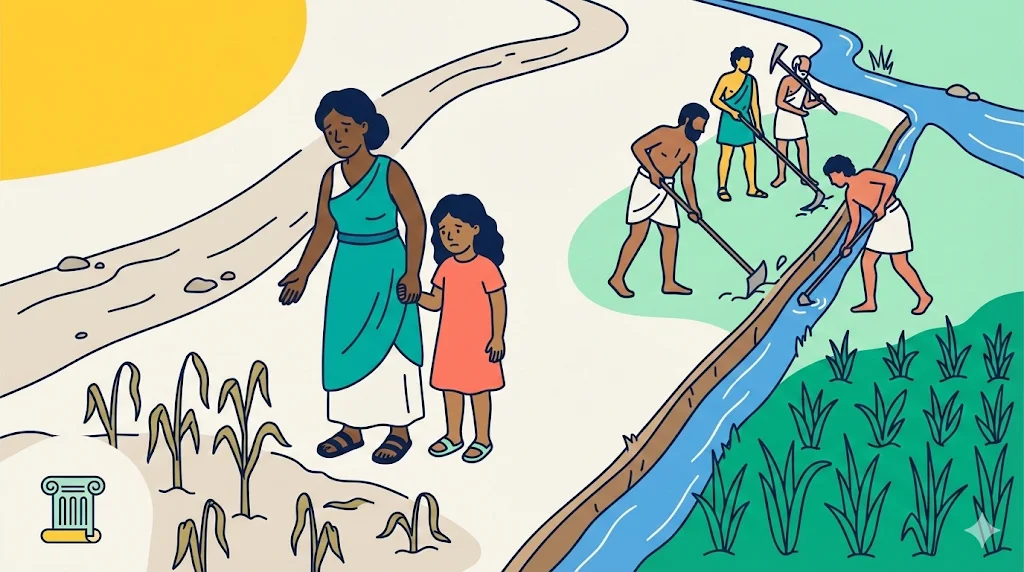
Maya stands near the river with her mother. Their young plants look weak. The sun is strong. The river is lower than last week. Maya feels worried. “If the water goes down more,” she thinks, “our plants will die.”
Then she looks at her neighbor’s field. It is still green. She sees a small channel on the ground. Water moves slowly in it. It does not go everywhere. It goes to one place, like a quiet line.
Long ago, many farmers did this. They captured water from a river or a stream. They made canals and ditches. They used small walls of mud or stones. They let gravity help. Water goes downhill, so the channel can carry it to dry fields. Some farmers also saved water in a pond or a small storage place. Then they could use it later.
But irrigation was not only about tools. It was also about people. Farmers had to share water. They needed simple rules: “Who gets water first?” “How long?” “What day?” If one person took too much, others could get angry. So they worked as a group. They also repaired broken parts and cleaned dirt from the channels.
Irrigation changed daily life. Harvests became more steady. People had new work: digging, cleaning, watching, and measuring water. Farms could help nearby towns grow. Maya learns a big lesson: water can be guided—but it must be guided fairly.
Key Points
- Farmers guided water with canals, ditches, and small ponds.
- Irrigation worked best with teamwork, rules, and regular repairs.
Words to Know
canal /kəˈnæl/ (n) — a water path people build
ditch /dɪtʃ/ (n) — a long narrow hole for water
gravity /ˈɡræv.ə.ti/ (n) — the force that pulls things down
pond /pɑːnd/ (n) — a small area of still water
share /ʃer/ (v) — to use something together
repair /rɪˈper/ (v) — to fix something
harvest /ˈhɑːr.vɪst/ (n) — crops collected from fields
rule /ruːl/ (n) — an agreed way to do things