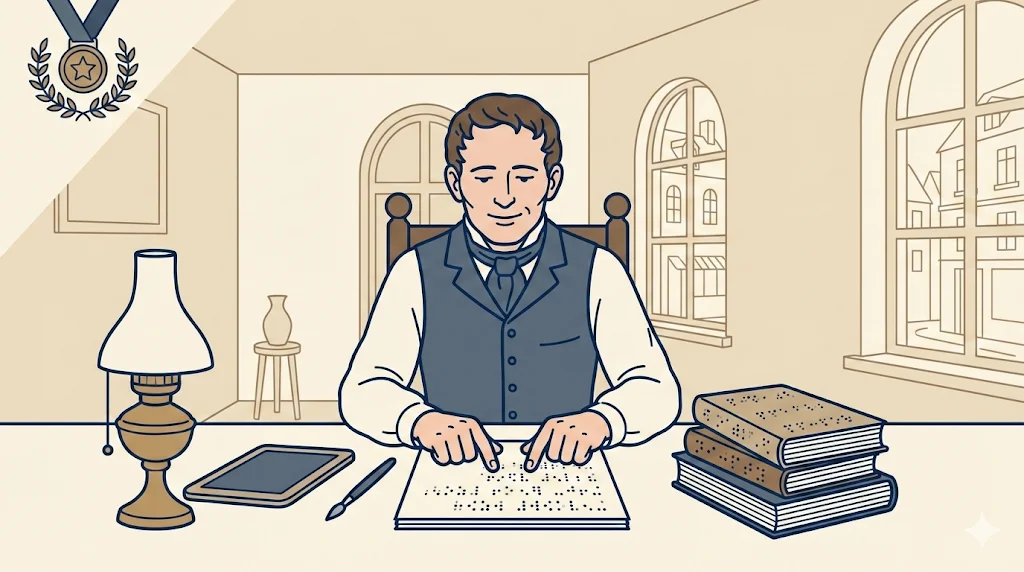
Louis Braille and the Idea That Barriers Can Be Redesigned
From one student’s hands to a global standard of access
A blind commuter steps into a busy subway station. The air is loud. Trains arrive and leave like waves. The commuter counts steps, listens for echoes, and reaches for the wall. Then the fingers find it: a small line of raised dots on a sign near the platform. In a place built for eyes, this tiny text is a quiet map.
That map exists because a teenager in 19th-century France believed touch could carry language.
A personal struggle that became a design solution
Louis Braille lost his sight as a child after an accident. In school, he met a problem that was bigger than one person: most knowledge was locked inside visual print. People could listen to reading, but listening is not the same as literacy.
Literacy includes privacy and control.
You can pause, re-read, skim, check spelling, and write back.
Braille’s solution was elegant: a six-dot cell. With only six positions, the system can create letters, numbers, punctuation, and more. Over time, it also developed music notation and math/science notation, so blind students could study complex subjects—not only stories.
Why Braille is different from “audio access”
Modern technology is powerful. Screen readers, audiobooks, and AI voices can open huge libraries. But audio often turns reading into a one-way stream. You receive words, but you may not build the same spelling skills or writing confidence.
Braille supports two-way literacy:
- reading with touch
- writing with patterns
- checking structure and detail
This is why many educators and advocates continue to defend Braille as a foundation, not a luxury.
From dots on paper to a global promise
Braille spread from schools into public life: elevator buttons, hotel rooms, medicine labels, and transport systems. It became a kind of “design standard” for touch—proof that access can be built into the environment.
Groups and institutions such as UNESCO, the Royal National Institute of Blind People (RNIB), and the World Blind Union have long connected literacy to dignity and equal participation. And major reference works, including Encyclopaedia Britannica and the Oxford Dictionary of National Biography, describe Braille’s lasting social impact.
Louis Braille’s gift was not only a code. It was a way of thinking: barriers are often design problems. When we redesign information so more people can meet it directly—through eyes, ears, or hands—we do more than help. We share power: the power to learn, to work, and to choose your own path.
Key Points
- Braille turned touch into full literacy: reading and writing, with privacy and control.
- Technology helps, but Braille remains important for spelling, structure, and two-way learning.
- Braille is also inclusive design: information built into public space, not added later.
Words to Know
commuter /kəˈmjutər/ (n) — a person who travels to work or school
standard /ˈstændərd/ (n) — a common rule people follow
stream /strim/ (n) — a continuous flow (like audio without stopping)
foundation /faʊnˈdeɪʃən/ (n) — the base that supports everything
participation /pɑrˌtɪsəˈpeɪʃən/ (n) — taking part fully
advocate /ˈædvəˌkeɪt/ (n) — a person who speaks up for others
environment /ɪnˈvaɪrənmənt/ (n) — the places and systems around us
redesign /ˌriˈdɪˈzaɪn/ (v) — design again in a better way
equal /ˈikwəl/ (adj) — the same in value and rights
notation /noʊˈteɪʃən/ (n) — special symbols for a subject
dignity /ˈdɪɡnɪti/ (n) — respect and human worth
inclusive /ɪnˈklusɪv/ (adj) — usable and welcoming for everyone
barrier /ˈbæriər/ (n) — something that blocks access
accessibility /əkˌsɛsəˈbɪləti/ (n) — how easy something is to use for all